Retailers Have Quietly Pointed AI at the One Moment the Shopper Thought They Had Leverage
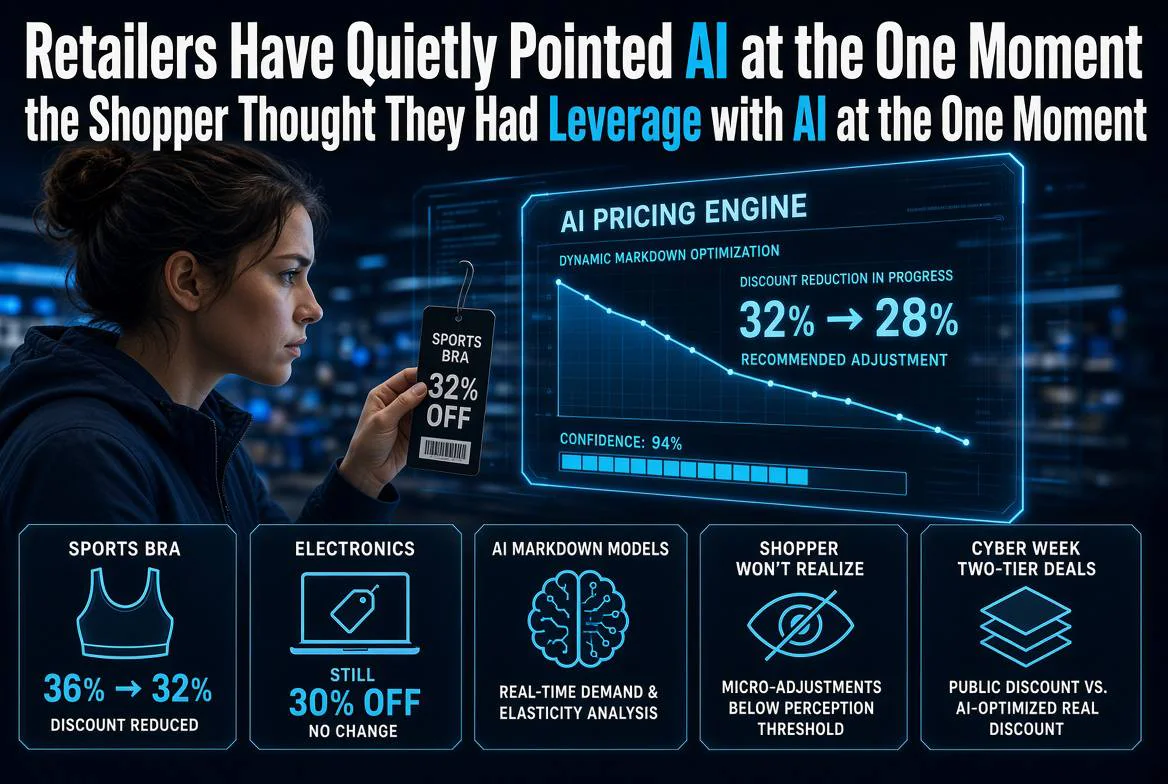
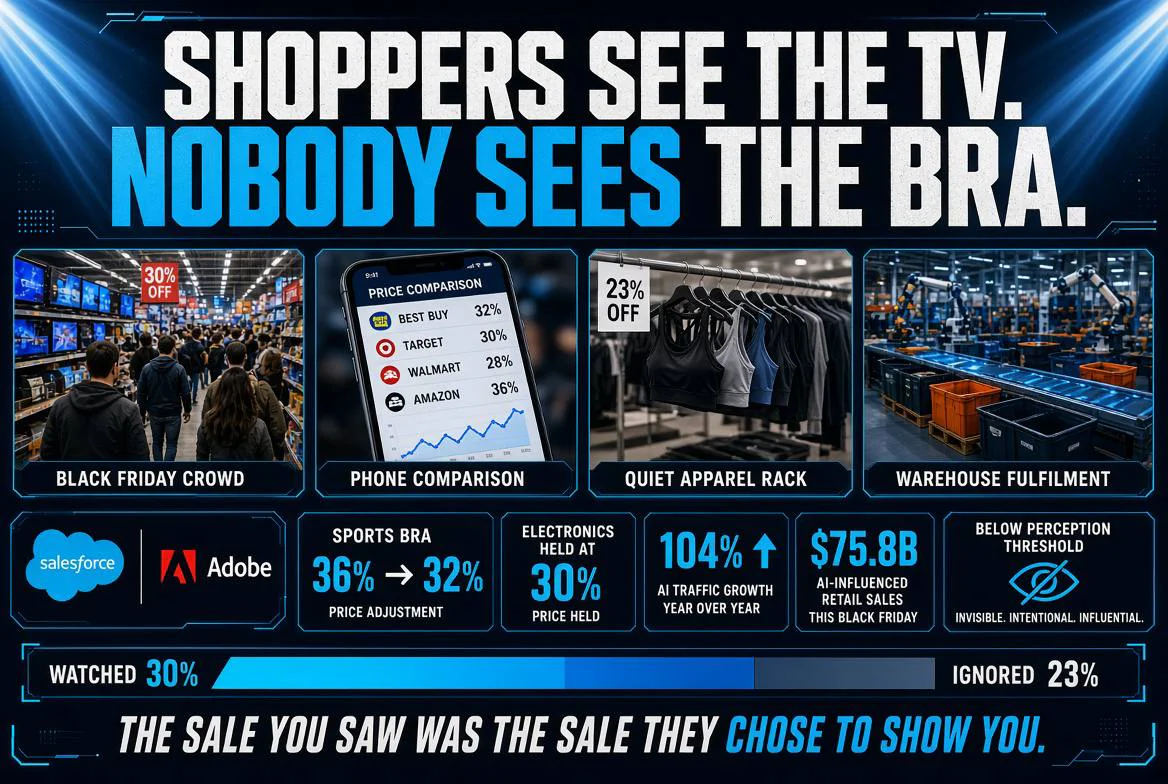
⚡ The Short Version: Adobe says Cyber Week discounts will hit 30% this year, deeper than last year’s 28%. Salesforce says US discount rates are up 8% year over year. Both are true, and both are measuring the wrong thing. The same week, Reuters reported that the average on-sale sports bra got discounted at 32% this year, against 36% the year before — four points of discount gone from a category nobody puts in a television ad. The deep cuts are real; they live on the big-ticket items that get screenshotted. Everything else is being quietly repriced by software that an executive at one of the vendors describes, on the record, as something consumers “won’t realize is happening.”
You have one evening a year when the price is supposed to be on your side.
The television is cheaper. The laptop, the toy, the games console, the pair of headphones that makes the thumbnail — all of it is at or below last year’s floor. Adobe is forecasting peak Cyber Week discounts of 30%, up from 28% a year ago, and the electronics category specifically at 30% against a forecast of 28%. If you go hunting for the thing in the ad, the deal is genuinely there. That part is not a trick.
Then you walk past the table with the sports bras.
Reuters reported in November that the average on-sale sports bra was discounted by 32% this year, against 36% the year before. Four points, gone. Nobody is going to sell that as a Black Friday headline, and nobody is going to apologise for it either, because it did not happen by accident and it did not happen to one product. It happened because a category manager sat with a piece of software that told them how much they could take back without losing the sale, and the software was right.
That is the story hiding under every “record discounts this holiday season” headline. The discount did not disappear. It moved. It moved off the things ordinary households actually buy at volume and onto the things that make the front of the catalogue.
What the Two Sets of Numbers Are Actually Measuring
Start with the people who make the optimistic case, because they are not lying. Adobe Analytics tracks online transactions across a huge slice of US retail, and its holiday forecast is the number most newsrooms quote. For 2026 it projects a record $275.1 billion in US online holiday spending, up 6.7% year over year. It also forecasts discounts building through November — 14% off in early November, 21% just before Thanksgiving, and 30% at the deepest point of Cyber Week.
Salesforce, working from live transaction data rather than a forecast, is even more bullish on the shopper’s behalf. It reported that US discount rates in November were up 8% year over year, that global discount rates were roughly 5% higher, and that average selling prices for physical goods were down 1% in the US and 2% globally. On those numbers, a shopper walking into this holiday season is being offered more off, on cheaper goods, than a year ago.
Now put the sports bra next to it.
Both sets of numbers are correct and they are not measuring the same population. Adobe’s category peaks are dominated by the big-ticket electronics and toys that generate the headline percentage, the press release, and the doorbuster queue. Reuters went and asked brands about their actual planned markdowns across apparel, beauty and general merchandise, and got a different answer: brands are trimming the depth of promotions on mid-priced goods because the software says they can.
The result is a discount market with two tiers that nobody advertises as two tiers.
| What’s being measured | This year | Last year | Direction |
|---|---|---|---|
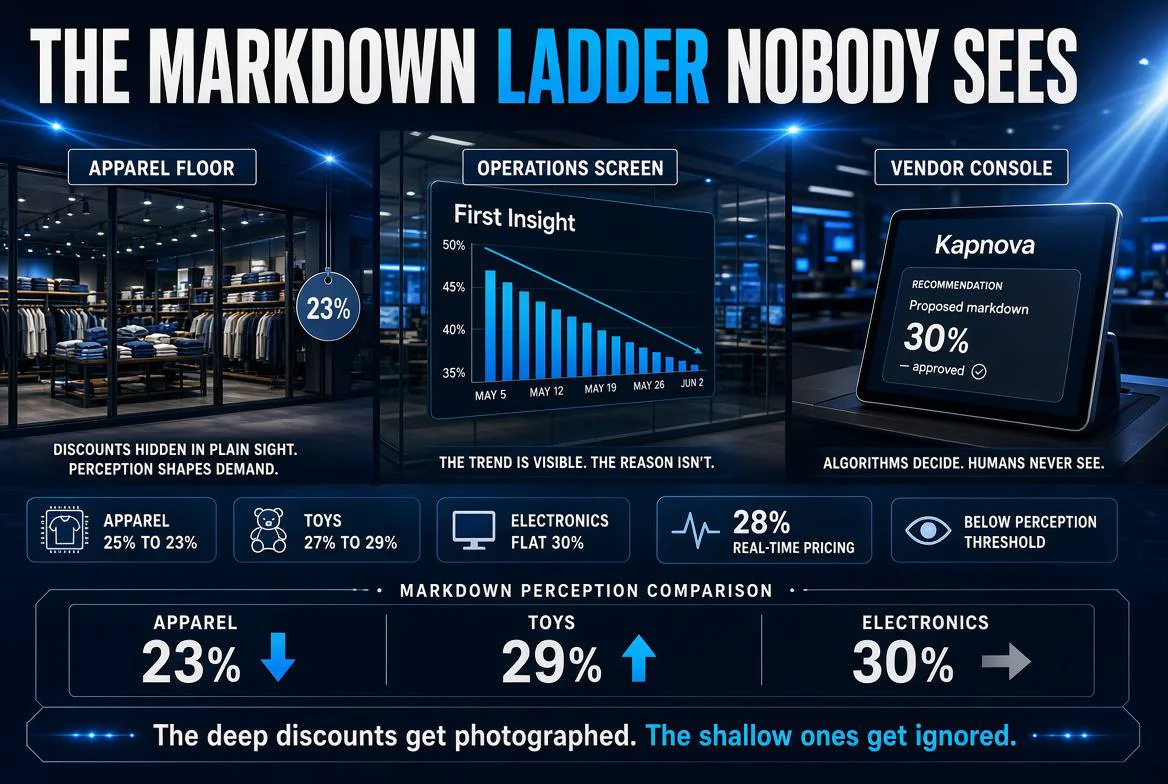
| Adobe forecast peak Cyber Week discount | 30% | 28% | Deeper |
| Adobe electronics peak discount | 30% | 28% forecast / 30.1% actual | Flat to deeper |
| Adobe toys peak discount | 29% | 27% forecast / 28% actual | Deeper |
| Adobe apparel peak discount | 23% | 25% | Shallower |
| Average on-sale sports bra (Reuters) | 32% | 36% | Shallower |
| Salesforce: US discount rates, November | +8% YoY | — | Deeper overall |
Read that table again, because the two facts that get quoted in every holiday retail story are sitting right next to the two facts that never do. Electronics: deeper. Toys: deeper. Apparel: shallower. The sports bra: shallower. The direction of the discount depends entirely on which aisle you are standing in.
This is not a conspiracy. It is optimisation, and optimisation is very good at finding the split. The average shopper reads one number — “discounts are deeper this year” — and applies it to whatever they happen to be buying. The software does not make that mistake. It treats each category, each product, each week of the season as its own pricing problem with its own answer.
The Software That Decides What You Don’t Get
To understand how a discount quietly shrinks, you need to know what these tools actually do, because “AI pricing” covers several different machines.
The enterprise version — the one behind the Reuters reporting — does not look at you. It looks at the product. Impact Analytics, one of the vendors named in the reporting, describes the mechanism on its own site: base price models learn how demand responds to price changes for each individual stock-keeping unit; promotion models predict how much lift you get at a specific price point and discount depth; markdown models recommend how deep and how soon to cut to clear stock by a target date.
In plain English: the software knows what a given item sold at last year, how fast it moved, what the competitor across the street is charging, what the weather is doing, and how much stock is sitting in the back. It then tells the merchandiser the smallest discount that will still shift the unit.
Prashant Agrawal, chief executive of Impact Analytics, described what the model tends to conclude, in Reuters: it “generally shows you need fewer promos for less time on less products.”
That is the entire argument in fourteen words, from the man who sells it. Fewer promotions. For less time. On fewer products.
And the industry is candid about what that feels like from the shopper’s side. Ryan Orabone, a consultant at Spaulding Ridge, told Reuters that the goal, “if done well,” is that consumers “won’t realize it’s happening.” James Sun, chief executive of the pricing firm Kapnova, put it more bluntly: “It is controversial. Consumers go, ‘We want those discounts,’ but retailers are getting smarter and smarter with AI.”
Kapnova’s own worked example, per Reuters: it advised a beauty brand to cut this year’s Black Friday discount on a skincare product to 30% from 40%. First Insight, another vendor, suggested scaling a promotion back from 50% to 40%. Neither brand is named. Both are billion-dollar businesses by Reuters’ description. The shopper who wanted the 40% gets 30% and has no way of knowing the other number ever existed.
Who Set the Expectation in the First Place
Here is where the story gets less flattering, and where it stops being a story about software and becomes a story about how a deal is constructed.
The shopper’s expectation of a 40% discount did not fall from the sky. It was built — by years of Black Friday advertising, by the “was” price on the tag, by the countdown timer, by the email that says 50% off ends Sunday. The brand sets that reference price. Then the same vendor ecosystem sells the brand the tool that decides whether the reference price gets met.
Reuters noted that the reporting contacted more than 12 brands and that the technology is “still emerging,” with the “full scale of its price impact unknown.” That is the honest caveat, and it deserves to sit in the middle of the piece rather than the bottom. Nobody has measured how much of this is happening across the whole market. What is measured is that it is happening, at named brands, with named vendors, on named products.
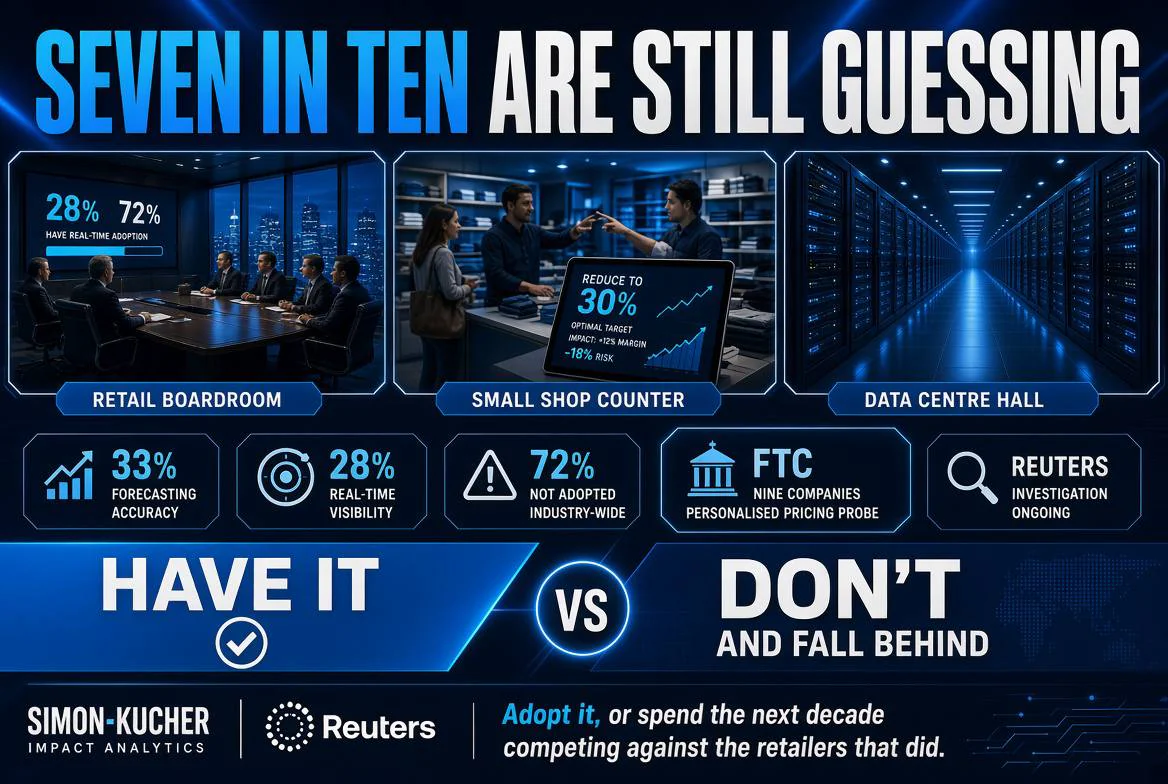
The scale question cuts both ways. A survey by the consultancy Simon-Kucher, cited by Reuters, found that a third of companies now use AI pricing for demand forecasting and 28% for real-time price optimisation. That means roughly seven in ten are not. It also means that within a few years, the seven in ten will either adopt it or compete against companies that did.
| Claim | Evidence | Strength | Who benefits from you believing it |
|---|---|---|---|
| “Discounts are deeper than ever” | Adobe 30% peak vs 28%; Salesforce US discount rates +8% YoY | True for the categories tracked, dominated by big-ticket goods | Retailers, and any publication that needs a holiday spending story |
| “Discounts are shrinking” | Sports bra 36% → 32%; apparel peak 25% → 23%; Kapnova 40% → 30%; First Insight 50% → 40% | True for mid-category apparel and beauty | Nobody — which is why you don’t hear it |
| “AI is doing this” | Named vendors, named executives, on the record | Strong on mechanism, weaker on market-wide scale | Vendors, who get free proof-of-concept in every write-up |
| “It’s still early, impact unknown” | Reuters’ own concession; 28% adoption for real-time pricing | True, and load-bearing | Retailers, who would prefer the story stay small |
That last row is the one to hold on to. The same reporting that breaks the story also tells you the story is not yet big enough to prove. Both things are true, and any writer who gives you only one of them is selling something.
The Version of This That Already Happened
If any of this feels familiar, it should. The 2025 version of this story was about surveillance pricing — the accusation that two shoppers at the same store, at the same moment, were being charged different prices for the same cart.
In December 2025, Groundwork Collaborative and Consumer Reports published an investigation into Instacart’s price experiments. Researchers built identical grocery carts at the same store and same time and found shoppers sorted into separate algorithmic price tiers. One tester was charged $4.99 for a box of Cheerios; another was charged $6.12. The same basket came in at $81.24 for roughly a quarter of testers and $86.78 for 5% of them. The report estimated that a household of four exposed to average basket fluctuations would spend roughly an extra $1,200 a year.
The federal response followed. The FTC opened a 6(b) study into surveillance pricing, then in August 2026 proposed an enforcement policy statement under Section 5 of the FTC Act covering businesses that misrepresent a personalised price as a static one. In October 2026 it launched fresh 6(b) inquiries into nine companies. New York’s Algorithmic Pricing Disclosure Act had already taken effect in November 2025, requiring the disclosure “THIS PRICE WAS SET BY AN ALGORITHM USING YOUR PERSONAL DATA” on affected prices. New Jersey passed a ban on personalised grocery pricing in July 2026. Maryland and Connecticut followed.
What changed in 2026 is the target. The 2025 fight was about who you are — charging one shopper more than another. The 2026 version is about how deep the sale is — compressing the promotion for everybody, without the awkward business of treating shoppers differently. That is easier to defend legally, harder to notice, and it does not require a single line of personal data.
That is why the sports bra matters more than the Cheerios. A pricing algorithm that charges you more because of who you are is now a regulated act in several states. A pricing algorithm that tells the brand to run a 32% discount instead of a 36% discount is, in most of the country, just merchandising.
The Shopper Is Now Fighting Back With a Different Algorithm
There is one genuinely new element this year, and it is the only part of the story that gives the shopper any leverage at all.
Salesforce reported that AI-driven traffic to retail sites more than doubled year over year, up 104%, and projected that $75.8 billion — 21% of global Cyber Week sales — would be influenced by AI assistants and shopping agents. Adobe put AI referral traffic growth at 95% on Black Friday and 88% on Cyber Monday. Thirty-nine percent of shoppers told Salesforce they had used a brand’s own shopping agent, and 80% of those said it went well.
Read that against everything above and you get the real shape of the 2026 holiday season: it is an algorithm gap. A shopper who asks an AI assistant to compare prices across four retailers before buying is running negotiation software. A shopper who taps the first ad and checks out is not. The pricing tools do not need to know which one you are. The discount was already set below the old level before you arrived.
Caila Schwartz, who leads agentic commerce shopper insights at Salesforce, put the shift plainly: “AI is no longer a niche tool just for tech-savvy shoppers. Everyday shoppers are asking AI what to buy, where to buy it, and whether it’s worth the money before they ever land on a retailer’s site.”
What no one has measured is whether the shoppers using AI actually recover the four points the sports bra lost, or whether they simply get a slightly better version of a discount that was reduced for everyone. That is a genuine gap in the reporting, and it is the question I would most like answered.
The Honest Case Against This Article
Before you take any of this and repeat it, here is the strongest argument that I am overreading the evidence.
Adobe and Salesforce are not naive. They track billions of dollars of real transactions, they have no incentive to flatter retailers, and their independent verdict is that discount depth is flat to deeper and average selling prices are down. If AI were systematically shrinking what shoppers get, you would expect those numbers to move the other way. They have not. On the biggest, most credible dataset available, the shopper is not worse off this year.
There is also a real argument that these tools remove a genuine abuse. Retailers have been caught inflating “regular” prices to manufacture fake discounts — Canada’s Competition Bureau opened an investigation into Gap and Old Navy in November 2026 over precisely that. Vendors argue that demand-matched markdowns replace artificial high-low pricing cycles with clearance that actually clears stock, cutting waste and unsold inventory. That is a real benefit, not a talking point.
And the adoption numbers are small. Twenty-eight percent for real-time optimisation means most retailers are still doing this the old way.
All of that is true. What it does not do is reconcile the sports bra. A market can simultaneously deepen the discount on a television and thin it on everything in the middle — that is exactly what a category-by-category optimisation engine would produce, and it is what the two datasets show when you read them together instead of separately. The macro number is a weighted average across a basket dominated by big-ticket electronics. The sports bra is what happens to the middle of the basket.
What This Means for the Next Three Weeks
If you are shopping this season, the practical consequence is narrow and it is not “don’t buy anything.”
The deep discounts are real and they are concentrated. If you were planning to buy a television, a laptop, a games console, headphones or a large toy, the maths this year is genuinely in your favour and the forecast supports going early in Cyber Week rather than late.
What has quietly changed is the middle of the basket — apparel, beauty, skincare, mid-priced gifts, the fill-in purchases that make up most of a family’s actual holiday spend. That is where the four points went. If you assume the store’s best published discount applies across the range because it applies to the television, you will overpay by a margin you will never see, on goods you will never think to check.
Three things follow, and none of them require you to trust an AI or mistrust one:
The reference price on the tag is a marketing artefact. “Was $80, now $48” is only meaningful if $80 was ever charged. The tool that set the $48 also knows what the $80 did last year.
Comparison is the only leverage left. A price checked against three retailers is a price that competes. A price checked against nothing is a price that was optimised against you. This is the one place where running an AI assistant on your own behalf is not a gimmick — it is the only counter-algorithm the shopper has.
And the category is the tell. If a retailer is shouting about a 60% discount on a television and offering 20% on the coat you actually need, you are not looking at a store-wide sale. You are looking at two pricing strategies running in parallel inside one shop, and only one of them is aimed at you.
The Part Nobody Will Publish
Here is the gap I cannot close, and I would rather name it than paper over it.
Nobody has published the aggregate number. Not Reuters, not Adobe, not Salesforce, not the NRF, not any of the pricing vendors. Nobody will tell you what the shrinking of mid-category discounting costs American households this Christmas in total dollars.
The reason is structural. The vendors selling the optimisation software are also the only parties holding the data that would prove its effect on consumers. Kapnova and First Insight supplied the anecdotes in the Reuters story about their own unnamed clients. There is no independent body measuring whether a 40%-to-30% cut on a beauty product costs shoppers $50 million or $5 billion this season, and no mechanism forcing anyone to find out.
That asymmetry is the actual story, and it is bigger than Black Friday. A pricing layer has been inserted between the shopper’s expectation and the shopper’s outcome, and the entire industry that operates that layer reports its own results. The retailer knows what it gave up. The vendor knows what it recommended. The shopper knows the price at the till and nothing else.
So the next time a headline tells you discounts are deeper than ever this year, read the number underneath it. It is probably true — for the television. The four points they took off the sports bra are in the same dataset, just not in the same sentence.
Frequently Asked Questions
Are Black Friday discounts actually smaller this year?
It depends on the category. Adobe forecasts peak Cyber Week discounts of 30% in 2026 against 28% in 2025, and electronics at 30% against 28% last year, while apparel goes the other way at 23% against 25%. Reuters reported that the average on-sale sports bra was discounted at 32% this year against 36% the year before. The headline discount is deeper; the mid-category discount is thinner.
Is AI really setting the price I see?
Increasingly, yes — but usually at the category or product level, not the individual level. Reuters reports that predictive algorithms typically stop short of pricing items differently for individual customers, a practice Walmart and Target have said they do not engage in and which several states have moved to curb. The AI is deciding how deep a promotion runs, not what you personally are charged.
Who is doing this?
Named vendors include Kapnova, First Insight, Impact Analytics, Anaplan, Simon-Kucher and Spaulding Ridge. Named brands in the reporting include Gap, Under Armour, Family Dollar, Tiffany, Dolce & Gabbana and Yves Saint Laurent, with Walmart, Target, Dick’s Sporting Goods and Ross Stores named in the wider context. Gap confirmed through a spokesperson that it uses Impact Analytics to make what it called “more informed” decisions.
How many retailers actually use AI pricing?
A Simon-Kucher survey cited by Reuters found a third of companies use AI pricing for demand forecasting and 28% for real-time price optimisation. No US-only retailer count has been published, and the true market-wide scale is unknown by the reporting’s own admission.
Is this legal?
Category-level markdown optimisation is legal almost everywhere in the US. Personalised pricing based on individual data is a different matter: New York’s Algorithmic Pricing Disclosure Act requires disclosure, New Jersey banned personalised grocery pricing effective August 2027, and Maryland and Connecticut have passed their own restrictions. The FTC has proposed an enforcement policy statement on personalised pricing and opened inquiries into nine companies in October 2026.
What can I do about it?
Check the price against more than one retailer before buying, treat “was” prices as marketing until proven otherwise, and pay attention to which categories a store is actually promoting. Deep discount on a television and a thin discount on a coat are not contradictions — they are the same strategy applied to two different products.

About Barak Schurr
Barak Schurr built and sold a major ticketing platform, ran global nightlife operations at Eventbrite, and now spends his time figuring out which AI tools actually move the needle for independent business owners — and which ones are just noise. No hype. No fluff. Just what works.
Email: [email protected]
More AI Resources for Your Business