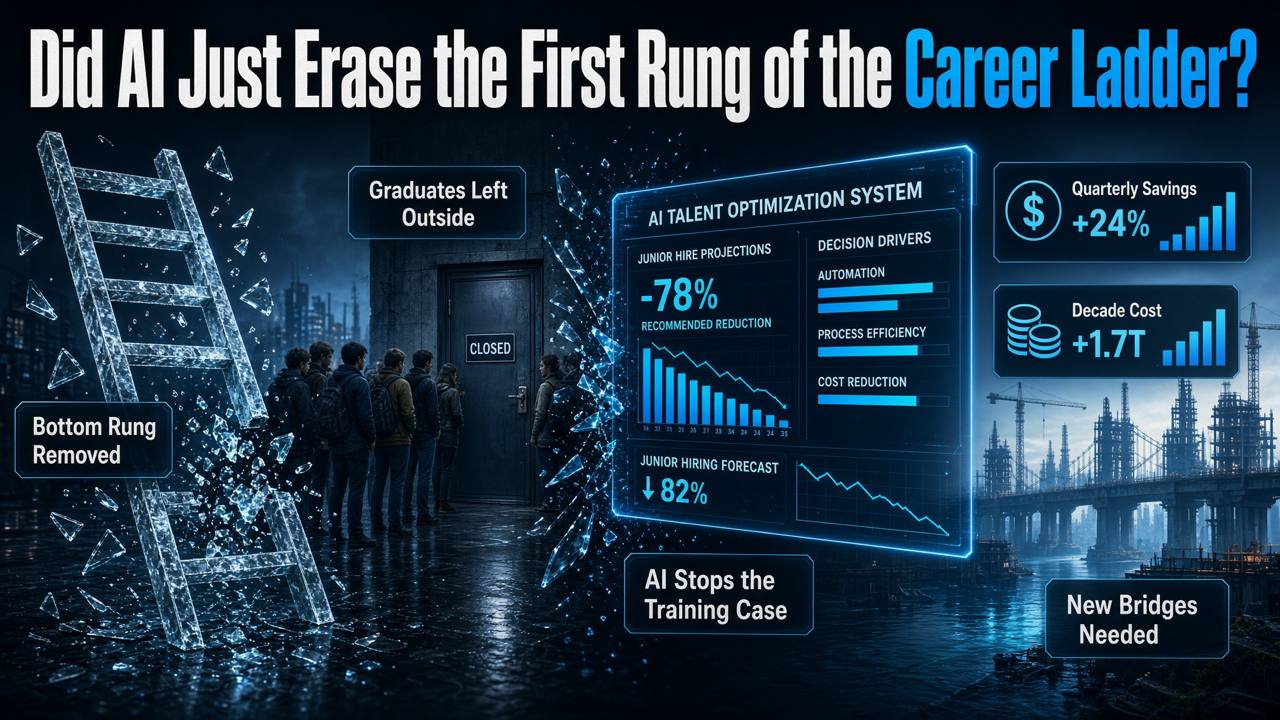
Did AI just erase the first rung of the career ladder?
⚡ The Short Version: Soham Nayak graduated from IIT Bombay, took a ₹23 lakh offer, and was unemployed six months later. He is one number in a report published this week by the Burning Glass Institute and RAISE US — “Fewer Rungs, New Bridges” — which puts the five-year gap at 1.5 million jobs, with entry-level postings at 1.4 million and the college-premium collapse in fields that were supposed to be AI-proof. The authors explicitly hedge: AI is “one likely factor among several.” PwC’s own data is blunter. Postings that survived the cull now demand senior skills — redesigned ones up 35% since 2019 — while ordinary junior postings fell 10%. At firms that adopted AI, junior employment drops roughly 9% after six quarters, driven not by layoffs but by fewer hires. Salesforce’s Benioff said he is not hiring more engineers because coding agents do the work; AWS’s Matt Garman called that “one of the dumbest ideas.” Both can be right. The rung is not gone. It has been quietly re-labelled “senior.”
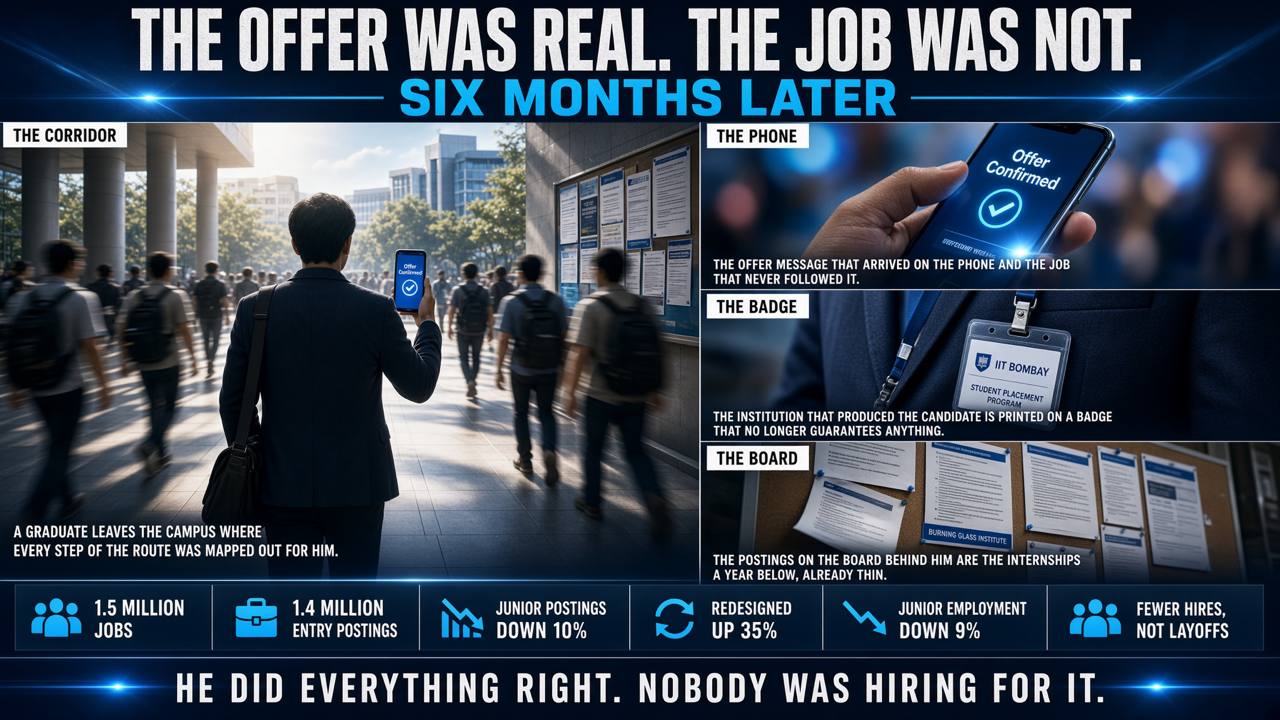
Soham Nayak did everything right.
IIT Bombay. A graduate offer at ₹23 lakh a year, the kind of number that makes a family in India take photographs of the letter. Six months later he was unemployed, and the reason was not that he had failed anything. It was that the job he had been hired for stopped being the job that needed doing.
His story ran in Mint on 21 November. It is one paragraph long in the reporting and it is the whole argument of this piece: the ladder was not kicked away at the top. It was removed at the bottom, quietly, and the people who had just climbed onto the first rung found the rung was no longer attached to anything.
This week, two institutions put a number on it. The Burning Glass Institute and RAISE US published “Fewer Rungs, New Bridges,” a report dated 19 November and released into coverage on 23 and 24 November, co-chaired by Gina Raimondo and Eric Holcomb, with Harry Carr among the authors. Their figure: a five-year gap of 1.5 million jobs, 1.4 million of them entry-level postings, and a collapse in the college premium in fields that were supposed to be immune to this.
1.5 million is a big number and it is being repeated everywhere with the wrong modifier attached. It is not a count of jobs lost. It is a modelled net gap against the pre-pandemic trend line, and the report’s own authors are careful about what caused it. They describe AI as “one likely factor among several.”
That hedge is not a weakness in the story. It is the story. Because the effect is real, measurable and visible in a single person’s bank balance, and the honest explanation for it is not one technology. It is a decision companies made about who they were willing to train, made at the exact moment a cheaper alternative appeared.
What the Report Actually Says
Start with the record, because most of what has been written about this report has been written about the headline number.
| What the report says | The figure | What it actually measures |
|---|---|---|
| Five-year net job gap | 1.5 million | A modelled shortfall against a pre-pandemic linear projection, not a count of layoffs |
| Entry-level postings missing | 1.4 million | The bottom of the ladder absorbing almost the entire gap |
| Cause attributed to AI | “One likely factor among several” | The authors refuse to make AI the sole cause. Anyone quoting this report as proof of an AI jobs apocalypse is misquoting it |
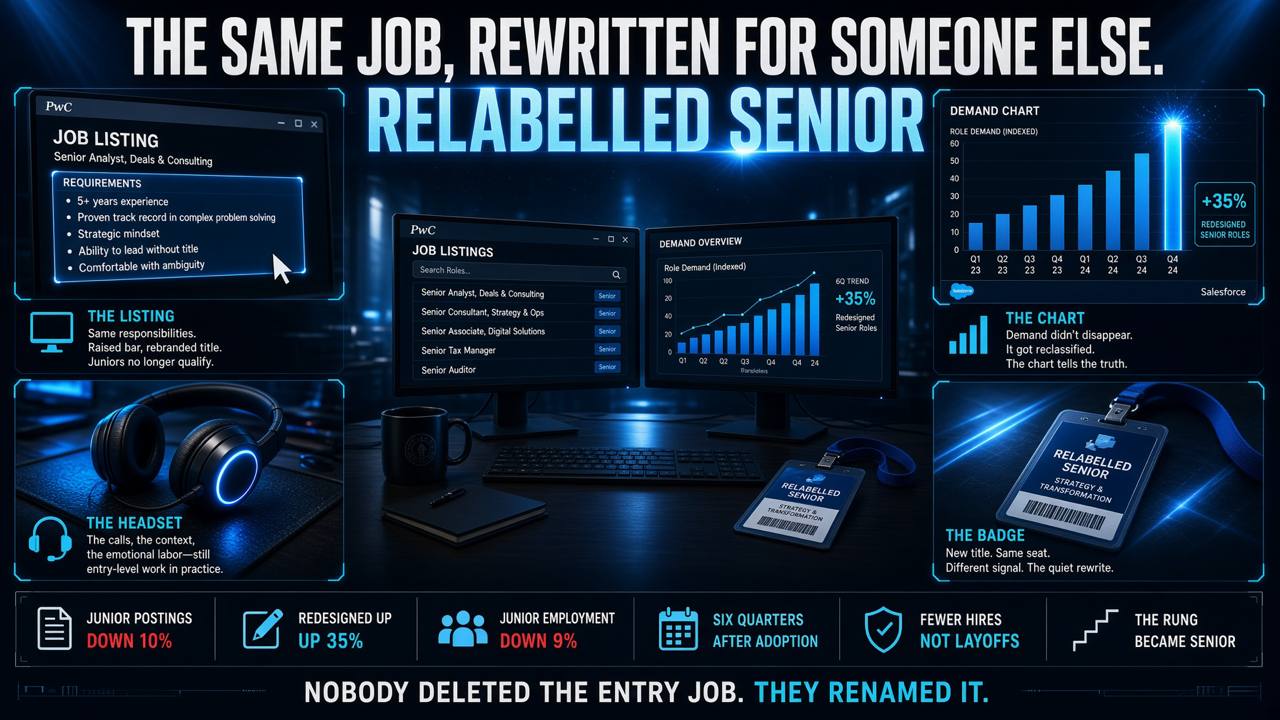
| Designed roles: reshaped postings up | +35% since 2019 | PwC data: surviving postings now ask for senior skills, which the young do not have yet |
| Ordinary junior postings | −10% | The same period, the same category of worker, going the other way |
| Junior employment at AI-adopting firms, six quarters out | about −9% | Driven by reduced hiring, not by layoffs |
Read the fourth and fifth rows together, because they are the mechanism and everything else is consequence.
A design job that has been redesigned to demand senior skills is still a job posting. It shows up in the same database. It gets the same listing fee. What it is not, is a job a graduate can do. So the count of “open roles” looks healthy while the count of “open roles a 22-year-old can actually get” falls through the floor. That is the +35% against −10%. Not fewer jobs opening. The same jobs opening with a door too high to walk through.
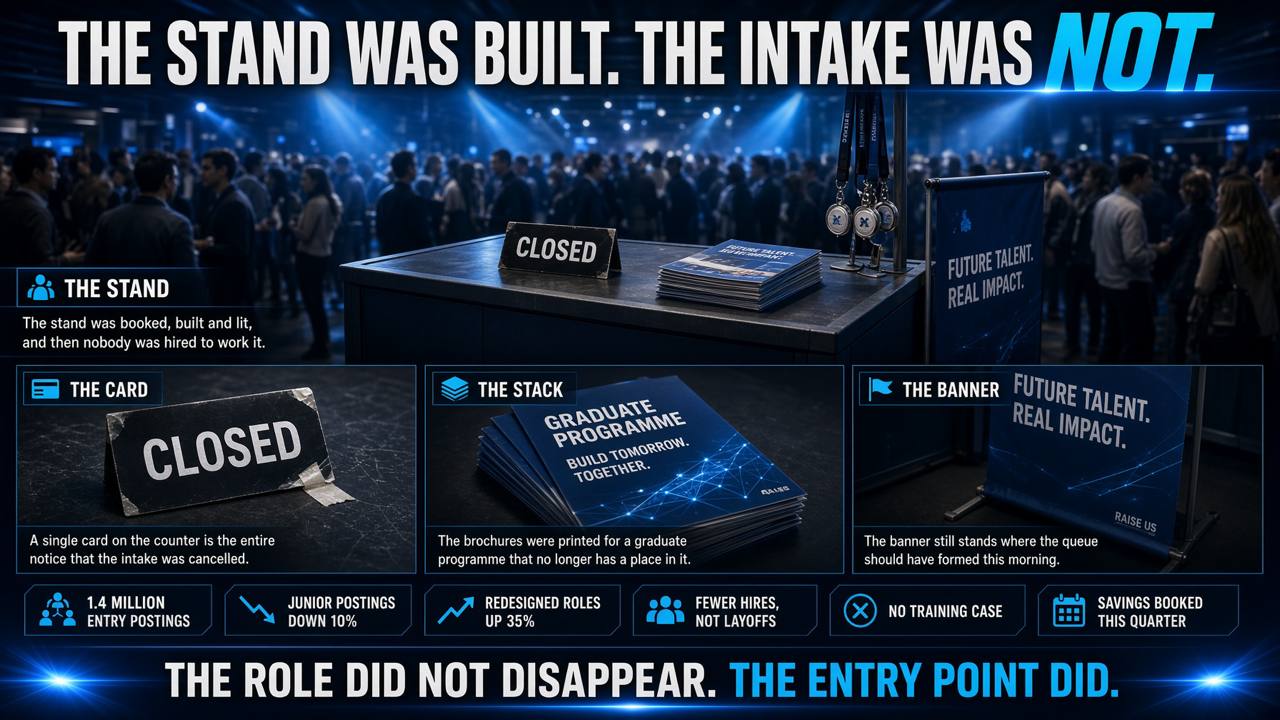
Now the −9%. At firms that adopted AI, junior headcount drops about nine per cent after six quarters. The instinct is to picture a mass firing. The research says the opposite: those firms did not let their juniors go. They stopped letting new ones in. A hiring freeze is a gentle phrase that produces the exact same outcome as a cull if you happen to be the graduate standing outside it.
And the cost of that freeze lands on a cohort that has no voice in the decision, no severance, and no story anyone will report. Nobody writes a headline about the twenty-three-year-old who was never hired.
The Two Men Who Disagree, and Why They’re Both Right
In October, Marc Benioff said Salesforce would not add more engineers in fiscal 2026 because he was using coding agents instead. That line has been quoted about ten thousand times and every time it is quoted without the other half.
The other half is Matt Garman at AWS calling that strategy “one of the dumbest ideas.” His reasoning is the part that gets cut: if you stop hiring junior engineers for three years, you have no senior engineers in ten. You have not saved money. You have sold your own succession to avoid a payroll line today.
Most commentary treats these as opposing positions and picks a side. They are not opposing. They describe the same trade-off from the two ends of a company.
Benioff is answering a question about this year’s margin. Garman is answering a question about the decade. A public company is judged quarterly, and a quarterly number is a real thing with real bankers attached to it. That is why the hiring freeze keeps winning even where the executives privately agree with Garman. The incentive is not hidden. It is sitting in the compensation structure.
This is the part people miss when they argue about whether AI steals jobs. The technology is one input. The accounting calendar is the other, and the accounting calendar is not neutral about time.
What Actually Happens to the Junior Work
The strongest version of the optimist case is that junior work did not disappear, it moved. First-draft code, literature reviews, tier-one support replies, the tedious first pass of anything — that work was always the training ground, and the tools now do it faster.
The problem is what a training ground was for.
A junior developer’s first year was never economically justifiable on its own output. Any manager who tell you otherwise is lying. The first year cost money and lost time, and it was tolerated because the third year was worth it. The training was an investment with a delayed return that the company could only harvest if it also employed the person at the end.
Automate away the first-year output and the investment case for the first year evaporates. The tool did not replace the third-year engineer. It removed the justification for ever creating one.
That is why the numbers do not show a hiring crisis. They show a training crisis that presents as a hiring crisis. The companies are not short of work. They are short of reasons to teach anyone how to do it.
| What the junior used to do | Who does it now | What the company loses |
|---|---|---|
| First-pass code on well-specified tasks | A coding agent, reviewed by a senior | Nobody learns the codebase by breaking it |
| Research and summarising | A model, checked by whoever is accountable | Judgement about what sources mean is never built |
| Tier-one customer support | Automation with escalation rules | Nobody learns where the product actually fails |
| Making the slides, the reports, the tidy-up | The same person, with a tool | Less than you think, which is why the other rows matter |
Which is why the report’s title is the most useful thing in it. Fewer rungs, new bridges. There are fewer places to stand. Somebody now has to build something to cross the gap, because the market has no reason to build it on its own.
The Evidence That Points Somewhere Else
Now the honest part, because the AI explanation is not the only one and pretending otherwise would make this article worthless.
The New York Fed has run the numbers on young graduates and attributes roughly 64% of the recent rise in unemployment to remote work, not to AI. Remote entry-level roles are the ones that disappeared, and they disappeared when offices reopened — a timeline that fits geography far better than it fits the release schedule of any model.
Stanford researchers looking at the same data call the AI link descriptive rather than causal. The correlation is there. The mechanism has not been isolated, and being careful about that distinction is not the same as being wrong about the problem.
And NACE, which tracks graduate hiring directly, projects 2026 graduate hiring up 5.6%. That is not a collapse. It is not even flat. It sits alongside a 1.4 million entry-level posting gap and it is not necessarily inconsistent with it, because these are measuring different populations — the graduate with an internship and a network against the general population of young jobseekers.
Put together, the counter-evidence says: something is badly wrong at the bottom of the ladder, and it is not one thing. Remote work removed the entry-level job that used to be done by anyone. AI removed the reason to train someone on the parts of the job that remain. A tight labour market let companies be pickier about who they hired. All three landed on the same cohort in the same five years.
What Soham Nayak’s Story Actually Tells You
Return to the person, because the aggregate is where the argument gets soft and the individual is where it holds.
A ₹23 lakh offer from an IIT graduate is not a lottery win. It is the output of a system that had, for twenty years, been the most reliable escalator in Indian middle-class life. Crack the entrance exam, take the placement, work three years, become expensive. The rung existed, it was load-bearing, and it was understood by everybody involved.
Six months unemployed is not a gap year. It is a signal that the job’s contents changed between the offer letter and the start date, and that nobody had bothered to redesign a path for someone who was mid-climb.
His case is not representative in the statistical sense. IIT graduates have networks, savings and options most people do not. That is what makes it worth reporting. If the bottom rung is creaking for the most privileged cohort in the system, look at what it is doing to the rest.
What to Do If You’re Standing at the Bottom
Practical, because a reader who is 24 and unemployed does not need a macro essay.
Get inside a loop where someone reviews your work. The single thing the freeze removes is feedback. A paid role gives it to you for free; if the paid role is gone, build it deliberately — a small team, an open-source project with reviewers, a client who tells you what was wrong. The output is not the point. The correction is.
Take the work the tools are bad at. Ambiguous problems, angry customers, conversations where the context is unspoken, anything where being wrong is expensive and being present is the value. The clearer and more specified a task is, the more exposed it is. Go to the messy end.
Learn the tool, but do not sell the tool. Everyone can prompt. Far fewer people can look at what a model produced and tell whether it is right, and that judgement is what a firm is actually buying now. Being the person who checks is a better position than being the person who generates, because the checking is where the accountability lives.
Do not wait for the market to fix this. The incentives that caused the freeze are quarterly and the damage is a decade out. Nobody is coming to build the bridge on your behalf.
What Is Not Known Here
Several things, and they matter more than the confident version of this story would.
The 1.5 million figure is a model, not a census. It depends on a projection of what employment would have done without the disruption, and that projection is a judgement call, not an observation. Change the baseline and the number moves.
The report itself does not say AI caused this. Its authors call AI one likely factor among several. Any article, including this one, that implies otherwise is adding confident language to a careful paragraph.
Nobody has published a causal estimate of the AI effect on entry-level hiring that survives scrutiny. The −9% at AI-adopting firms is the closest thing to it and it is a correlation across firms that chose to adopt AI, which is not a random assignment.
And Soham Nayak’s case is single-sourced to one report. It is a real person with a real outcome and the reporting behind it is credible, but one case is an illustration, not a data point.
The Question Behind the Question
The question in the headline is whether AI erased the first rung. On the evidence, that is the wrong question, because it invites a yes or no about a technology and there is no clean answer to it.
The better question is who decided not to build the next one.
Every generation of professionals was trained at a cost their employer absorbed and a benefit their employer later collected. That deal has a name in economics and it has been unwritten for a hundred years. The tools did not break it. The tools made breaking it look like a saving.
That is the thing about a corporate hiring freeze. It is invisible. There is no announcement, no press conference, no angry quote from a departing employee. There is only a job listing that never appears, and the person who would have filled it, filing applications six months after taking the photo of the offer letter.
The ladder did not fall.
It was retracted, from the bottom, quietly, one quarter at a time.
Frequently Asked Questions
Did AI actually kill 1.5 million entry-level jobs?
No. The 1.5 million figure from the Burning Glass Institute and RAISE US report “Fewer Rungs, New Bridges” is a modelled net gap against a pre-pandemic projection, not a count of jobs destroyed. The authors call AI “one likely factor among several.” The report’s own finding is a shortfall in entry-level postings, which is a different and narrower claim than a jobs apocalypse.
Why are entry-level jobs disappearing if companies are not laying people off?
Because firms stopped hiring new juniors rather than letting existing ones go. Research finds junior employment at AI-adopting firms falls about 9% after six quarters, driven by reduced hiring rather than redundancies. A hiring freeze produces the same outcome for a graduate as a layoff, with none of the reporting.
What does the 35% increase in redesigned postings mean?
PwC’s research shows postings that survived recent cutbacks now demand senior-level skills, with redesigned roles up 35% since 2019, while ordinary junior postings fell 10%. The jobs are still being advertised. They have been rewritten to require experience a new graduate cannot yet have, so the count of open roles stays healthy while the number a junior can actually win collapses.
Is Marc Benioff right that AI means fewer engineers are needed?
He said Salesforce would not add engineers in fiscal 2026 because coding agents were doing the work. AWS’s Matt Garman called that “one of the dumbest ideas,” arguing that stopping junior hiring leaves no senior engineers in a decade. Both describe the same trade-off from different ends — a quarterly margin decision against a ten-year succession problem — and the incentive structure keeps favouring the quarter.
Is remote work a bigger cause than AI?
It is a serious competing explanation. The New York Fed attributes roughly 64% of the recent rise in young-graduate unemployment to remote work, and Stanford researchers describe the AI link as descriptive rather than causal. The honest reading is that remote work, AI adoption and a tight labour market all landed on the same cohort within the same five years.
What should a young jobseeker do about it?
Get into a feedback loop where someone reviews your work, and go toward the work tools handle badly — ambiguity, unspoken context, expensive mistakes. Learn to judge model output rather than only generate it, because verification is where the accountability and therefore the job security sits.
Is the college premium really collapsing?
The report finds a decline in the college premium in fields that had been considered insulated from automation. That is the sharpest finding in it, because a degree premium falling means the return on the degree itself is being repriced, not just the availability of the first job after it.

About Barak Schurr
Barak Schurr built and sold a major ticketing platform, ran global nightlife operations at Eventbrite, and now spends his time figuring out which AI tools actually move the needle for independent business owners — and which ones are just noise. No hype. No fluff. Just what works.
Email: [email protected]
More AI Resources for Your Business