Tesla’s $29,990 Robotaxi Comes With a Contract That Bans You From Making Any Money
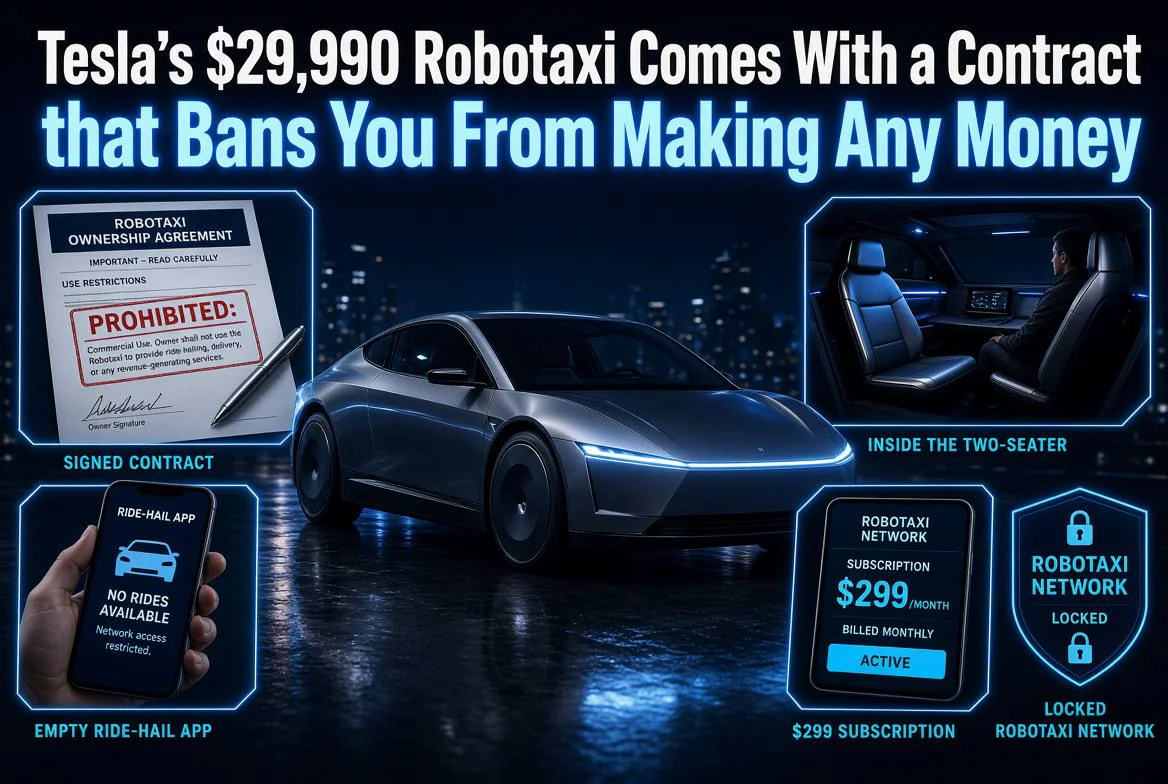
⚡ Expert Summary: Tesla is selling the Cybercab to private buyers at $29,990, but the order terms restrict it to personal, non-commercial use, limit each customer to one vehicle, and require the registered owner to be physically on board. That means a buyer in the United States who wants to run ride-hail, delivery or fleet work with it cannot legally do so. Add the $299 monthly Autonomy Subscription and five years of ownership runs roughly $47,600 before insurance, tax or charging — for a two-seater that works in eight metro areas.
The most expensive mistake in this business is buying a machine and discovering the permission was never included.
Tesla opened Cybercab orders to what it calls “select customers” at $29,990 before taxes, and the vehicle that arrives is genuinely the thing the company has been promising since 2024: a two-seat, steering-wheel-free pod built for driverless operation. What it is not, according to the terms reviewed by Electrek, is an income-producing asset. The order page restricts personal-use buyers to their own private use, one car per customer, and travel that only happens with the owner present in the vehicle.
Read that last clause twice. A robotaxi that requires its owner to be sitting inside it is not a robotaxi. It is a car with a very confident press release.
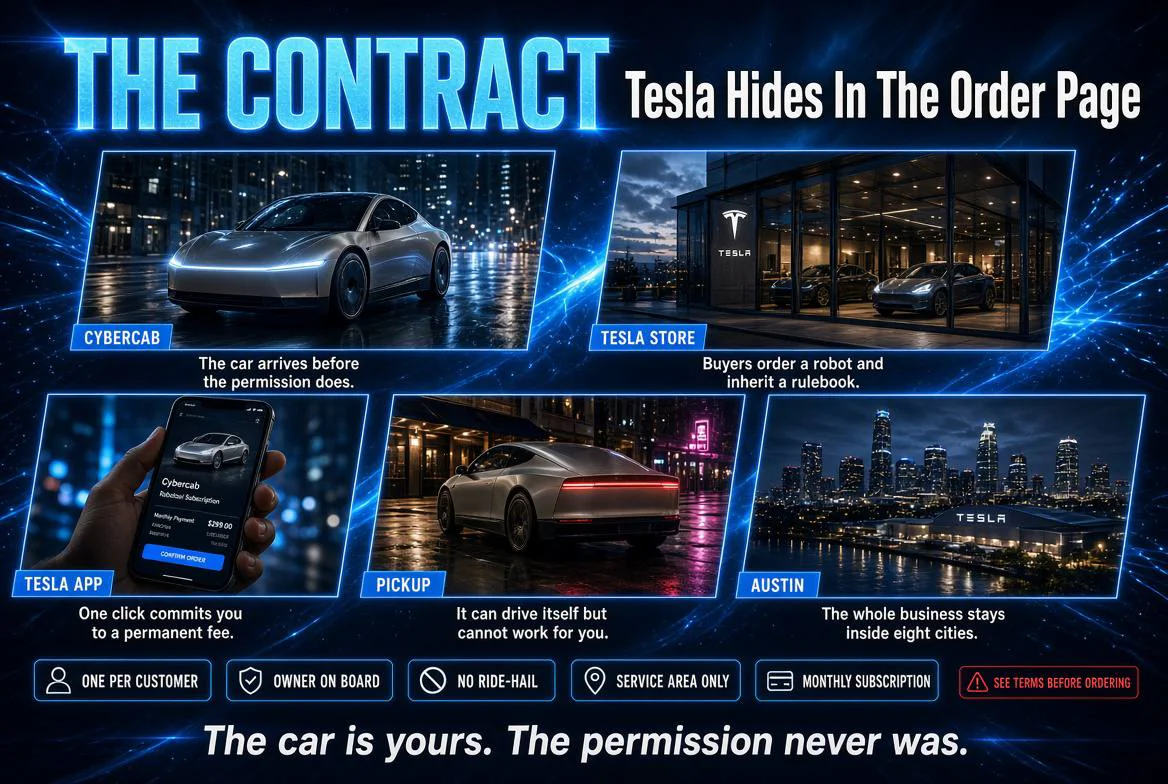
What the Order Page Actually Permits
The contradiction is not buried in fine print at the bottom of a lease. It is the structure of the offer itself. Tesla has spent years telling investors that the Cybercab is the vehicle that turns a car into a revenue-generating robot, and the personal-use program it just opened sells exactly that hardware under terms that forbid the revenue.
Electrek’s review of the order flow lays out the restrictions directly: personal, non-commercial use only; one vehicle per customer; the registered owner must be physically on board. Buyers in the personal program are not enrolled in Tesla’s Robotaxi Network, meaning the fleet that Tesla operates in Austin and other cities is closed to them. Putting the car on a ride-hail platform or a delivery service is out as well.
There is also the recurring fee. The Cybercab does not operate without an active Autonomy Subscription priced at $299 per month, with one month included at delivery. Not a licence to earn, in other words — a licence to move.
Those specific clause texts come from Electrek’s reporting. Tesla’s own configurator terms page did not load from this desk, so where this article attributes a restriction to “the terms,” it is the terms as Electrek read them off the order page.
| Restriction | What It Says | What It Costs the Buyer |
|---|---|---|
| Use | Personal, non-commercial only | No ride-hail, no delivery, no fleet work |
| Quantity | One vehicle per customer | No small fleet, no scaling the bet |
| Occupancy | Registered owner must be on board | Cannot send it out to earn while you work |
| Network | Not enrolled in Tesla’s Robotaxi Network | Locked out of the only built-in earning channel |
| Platforms | Barred from ride-hail and delivery services | Uber, Lyft and courier work are off the table |
| Subscription | $299 per month, one month included | Stop paying and the car stops moving |
The Real Price of a Five-Year Bet
Start with the sticker and the maths does not look insane. $29,990 is less than the average new car in the United States, and it buys hardware that no other manufacturer is currently selling to the public. That is the pitch, and it is a good one.
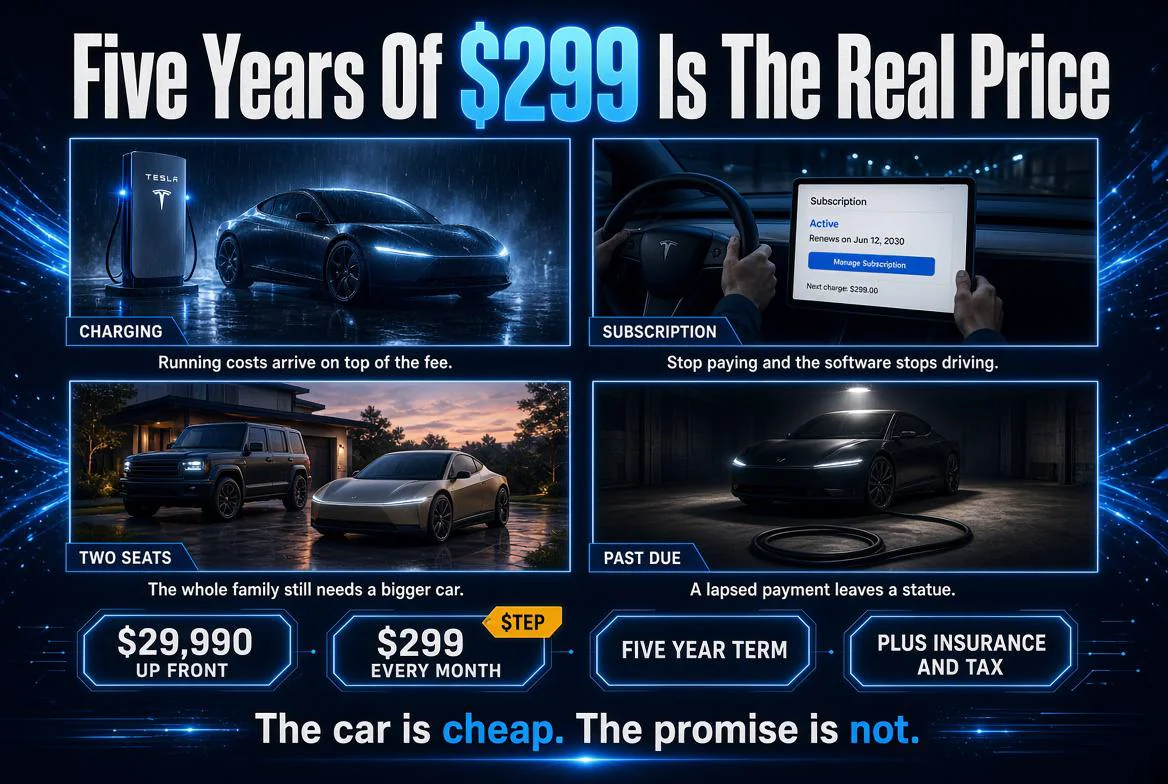
Then add the subscription. $299 a month is $3,588 a year, or $17,940 across five years. The purchase price plus the subscription comes to $47,930 before a single dollar of insurance, registration, tyres or electricity. Strip the single included month off and a five-year owner is looking at roughly $47,600 in Tesla’s direction alone.
Insurance on a vehicle with no steering wheel and no established actuarial history is its own open question. Nothing in the personal-use program answers what a policy costs for a two-seat autonomous pod in a market where the manufacturer is also the party deciding what the car is permitted to do.
Musk has publicly put the robotaxi running cost at about $115 a month in a post on X, which is the number that made the business case sound irresistible. That figure describes a vehicle earning money inside Tesla’s own fleet. It does not describe a vehicle you cannot put into a fleet.
| Cost Line | One Year | Five Years |
|---|---|---|
| Vehicle, before taxes | $29,990 | $29,990 |
| Autonomy Subscription | $3,588 | $17,940 |
| Subscription plus purchase | $33,578 | $47,930 |
| Musk’s stated running cost | About $1,380 | Does not apply outside the fleet |
| Insurance, tax, charging | Not disclosed | Not disclosed |
Eight Cities, and a Map That Shrinks Under Inspection
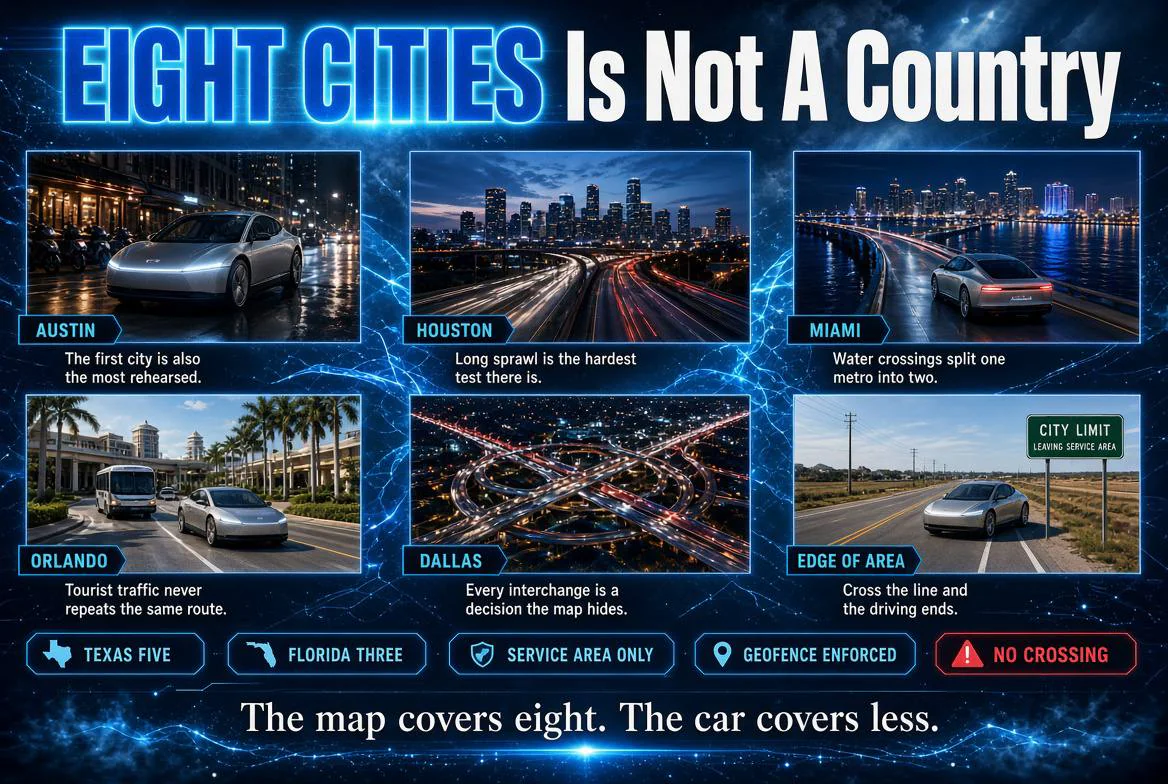
The car only operates inside Tesla’s Robotaxi service areas, which is the second restriction nobody puts on the poster. At launch the personal-use program is tied to eight metro areas: Austin, Dallas, Fort Worth, Houston and San Antonio in Texas, and Miami, Orlando and Tampa in Florida.
Those geofences are considerably smaller in practice than in the marketing. An independent tracker maintained by Koby Pierce has mapped the actual service areas against the advertised ones and found the real operating footprint in Austin at roughly 59 percent of what Tesla’s own coverage map implies. A buyer in a suburb that looks included may find the car simply will not go there.
That is not a small caveat, because the entire promise of the product is that the car takes itself somewhere. A two-seat pod confined to a subset of five Texas metros and three Florida metros is a very expensive second vehicle for people who live in those specific neighbourhoods and nowhere else.
The Same Computer, Running Somebody Else’s Business
Here is the detail that makes the pricing hard to defend. The Cybercab does not run new silicon. It ships with the same AI4 computer found in a Model Y, the same hardware Tesla has already put into customer vehicles and is already running driverless in Austin without a person behind the wheel.
So the buyer is not paying a premium for a capability nobody else has. They are paying $29,990 plus $299 a month for a two-seat body wrapped around a computer that Tesla sells in cars that seat five and can be driven by a human when the software says no.
If the autonomous capability is the same, what the personal-use buyer is actually purchasing is the enclosure. And the enclosure comes with a contract that removes the earning potential the capability was supposed to unlock.
Three Buyers, Three Different Answers
The “is this a good business” question depends entirely on which buyer is asking. For a person who wants a cheap, strange, driverless second car in central Austin, the maths is simply whether $299 a month is worth the novelty and the convenience. That is a consumer decision, not an investment.
For someone who wants to build a small ride-hail operation, the answer is a flat no, and it is a no written into the order page rather than discovered later in a court filing. One vehicle. Owner on board. No platforms. No Tesla network.
For a fleet operator or an investor treating the Cybercab as the first mile of an autonomous transport business, the personal-use program is not the product they were sold. The product they were sold is the one Tesla keeps for itself, and there is no order button for that.
| Question | Personal Buyer | Would-Be Operator |
|---|---|---|
| Can I use it to earn? | No. Non-commercial only | No. Contract forbids it |
| Can I buy several? | No. One per customer | No. Fleet is closed |
| Do I need to be inside? | Yes. Owner on board | Yes. Kills the model |
| Where can it drive? | Eight metros only | Eight metros only |
| What happens if I stop paying? | Vehicle will not operate | Vehicle will not operate |
| Best-case use | A pricey private shuttle | None exists under these terms |
The Subscription Is the Real Product
Strip the branding away and Tesla is selling a hardware subsidy attached to a monthly subscription. The vehicle price gets the headlines, the recurring revenue gets the spreadsheet. A Cybercab owner who stops paying $299 a month owns a two-seat sculpture in a garage.
That structure is familiar to anyone who has watched the software business model move into physical products. It is also where the risk sits, and it is not symmetric. Tesla controls the price of the subscription, the terms that grant permission to operate, and the geofences that decide where the car is allowed to go. The buyer controls none of the three and is contractually bound to keep paying for all of them.
Compare the two ownership models directly, because the difference is the entire story.
| Factor | Buying a Car the Normal Way | Buying the Personal-Use Cybercab |
|---|---|---|
| Who controls where it goes | You, on any public road | Tesla, via service-area geofence |
| Can it earn money | Yes, on any platform | No, contract forbids it |
| Cost after purchase | Fuel, insurance, service | $299 a month or it stops |
| Who can change the terms | Nobody, once sold | Tesla, at any time |
| Seats | Four or more, typically | Two |
| Resale market | Established, priced daily | Thin, and the terms are attached |
What Tesla Gets Out of It
Every restricted buyer is a buyer who is not competing with Tesla’s own fleet. Selling a personal-use Cybercab at $29,990 with a $299 subscription takes money from people who want in on the robotaxi thesis without ever creating a rival operator in the eight cities where Tesla already runs its own fleet.
It also creates a paid testing population. Thousands of these vehicles driving real roads in real traffic generate the exact data an autonomous system needs, and the owner pays for the privilege of supplying it. That is not a conspiracy; it is simply what the arrangement does, and it is worth naming because the marketing sells the opposite.
The Honest Bottom Line
This is not a bad car. It may be a remarkable one. It is a bad business, and the reason is not the price or the hardware. The reason is that the permission was never part of the sale.
If the plan was to buy a Cybercab, pay a subscription, and watch it earn while you sleep, the order page says no before you finish typing a card number. The one thing that would have made the maths work is the one thing the contract removes.
Frequently Asked Questions
Can I use a Tesla Cybercab to earn money?
Under the personal-use program, no. The order terms restrict the vehicle to personal, non-commercial use, and buyers are not enrolled in Tesla’s Robotaxi Network. Ride-hail and delivery platforms are excluded.
How much does the Cybercab cost in total?
The vehicle is $29,990 before taxes, and the Autonomy Subscription is $299 per month with one month included. Over five years that is roughly $47,600 in vehicle and subscription costs before insurance, tax or charging.
Do I have to be in the Cybercab for it to drive?
Under the personal-use terms reviewed by Electrek, the registered owner must be physically on board. A vehicle that only moves with its owner inside cannot be sent out to work.
Where do Cybercabs operate?
Tesla’s Robotaxi service areas currently cover eight metro areas: Austin, Dallas, Fort Worth, Houston and San Antonio in Texas, and Miami, Orlando and Tampa in Florida. An independent tracker built by Koby Pierce has found the real service areas to be smaller than Tesla’s coverage map implies.
What happens if I stop paying the Autonomy Subscription?
The vehicle does not operate without an active subscription. Stopping the $299 monthly payment leaves you owning a car that will not move.

About Barak Schurr
Barak Schurr built and sold a major ticketing platform, ran global nightlife operations at Eventbrite, and now spends his time figuring out which AI tools actually move the needle for independent business owners — and which ones are just noise. No hype. No fluff. Just what works.
Email: [email protected]
More AI Resources for Your Business