The state of the AI assistant
⚡ Expert Summary: Stanford’s 2026 AI Index found agents fail roughly one task in three. Gartner expects more than 40% of agentic AI projects to be cancelled by the end of 2027. MIT measured 95% of enterprise AI pilots returning zero measurable profit. Forrester found fewer than 15% of organisations have turned agentic features on at all. The assistant is not coming for your job yet. It is coming for your patience, and somebody is charging you for both.
Seven out of ten people told a survey this year they would rather speak to a human than an AI assistant. That number gets reported as a compliment to humanity. It is not. It is a bill of indictment against every company that spent three years insisting the opposite and shipped the assistant anyway.
The state of the AI assistant in November 2026 is this: it can do more than it could last year, it still fails constantly, the companies selling it know the failure rate, and nobody is publishing it on the box. What follows is an audit of where the assistant actually is, surface by surface, with the numbers attached and the names attached to the numbers.
What the assistant actually is now — and what it was sold as
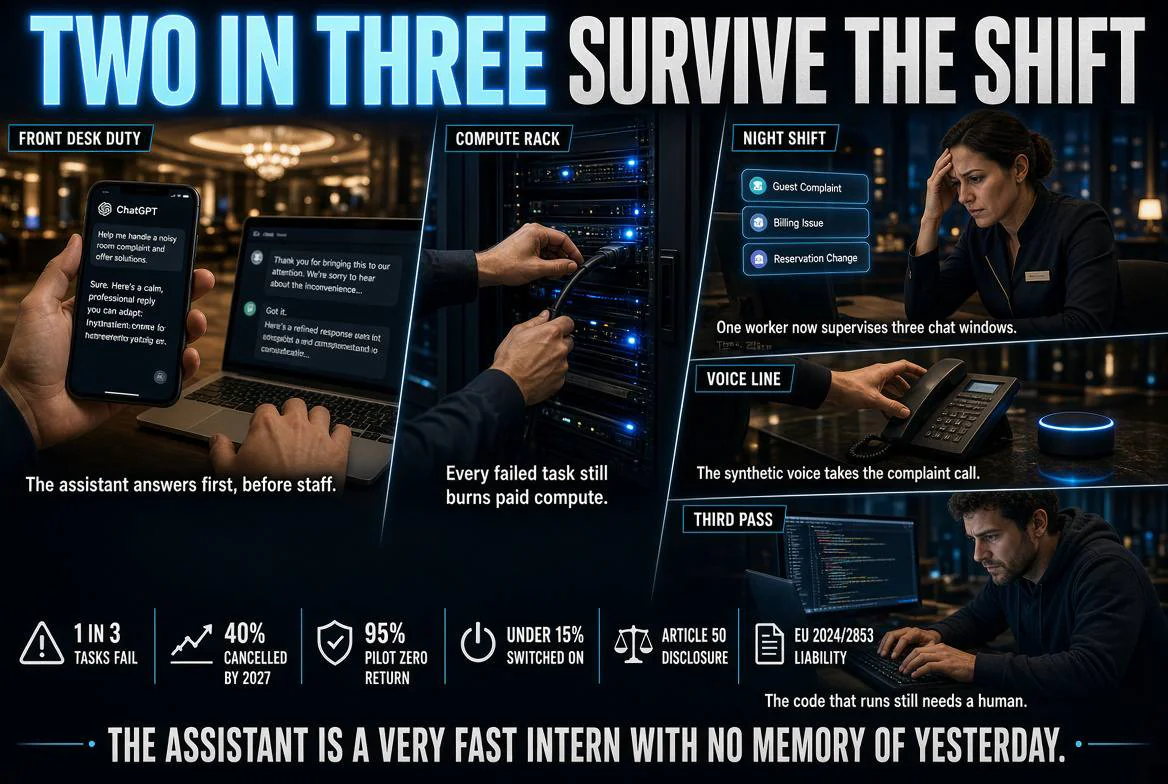
The pitch was an employee. The reality is a very fast intern with no memory of yesterday, no ability to check its own work, and an unshakeable confidence that survives every mistake.
Stanford’s Institute for Human-Centered AI published its 2026 AI Index in the spring. The headline finding on agents was blunt: multi-step agentic systems still fail roughly one task in three. That is not a rounding error. If a third of your assistant’s attempts fail, you cannot hand it a task and walk away — you have to supervise it, which means the labour saving is not a labour saving. It is a labour redistribution, with the tedious half moved to you and the interesting half removed.
Gartner’s read is harsher. The firm expects more than 40% of agentic AI projects to be cancelled outright by the end of 2027. Cancelled, not delayed. That word matters, because it tells you what is happening inside companies right now: not a slow season, but a write-off.
MIT’s widely cited study of enterprise pilots produced the number that should sit above every assistant demo in the industry: 95% of enterprise AI pilots delivered no measurable bottom-line return. Forrester’s contribution is the quietest and the most damning — fewer than 15% of organisations have actually switched agentic features on.
Read those four together and a shape appears. The capability is real. The deployment is thin. The cancellation rate is high. The measured return is near zero. And almost everybody is still paying the subscription.
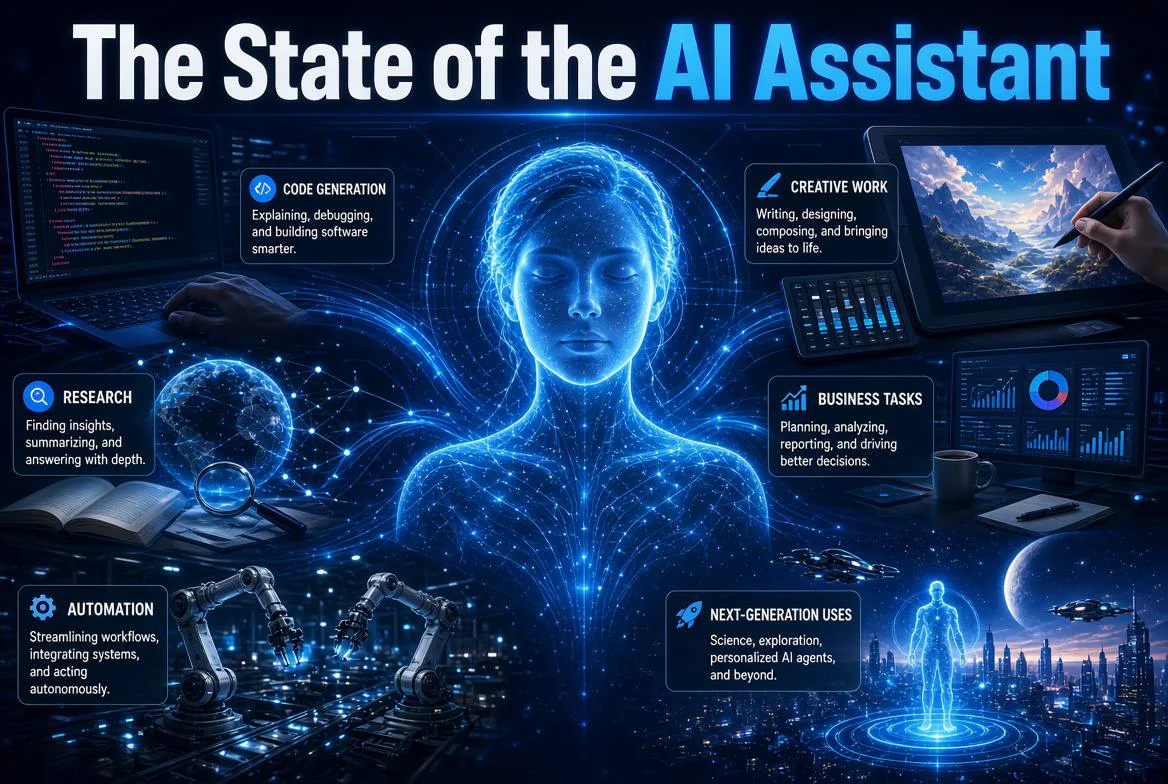
The ten surfaces an assistant is supposed to run — tested against the record
The industry talks about “the AI assistant” as if it were one thing. It is ten different products wearing the same word. Each one has a different failure mode, and each one fails for a different reason.
| Surface | What it is sold as doing | Where it actually breaks |
|---|---|---|
| Writing and documents | Drafts, edits, summarises, formats | Confident invention of facts, figures and citations |
| Files and computer control | Moves files, fills forms, drives the desktop | Breaks the moment interface layout changes |
| Browser and purchases | Books, buys, compares, checks out | No accountability when it buys the wrong thing |
| Communication | Drafts email, replies, chases | Sends the draft it should have held back |
| Calendar | Schedules, reschedules, protects focus time | Works well, largely because scope is narrow |
| Money | Reads accounts, flags subscriptions, pays bills | The failure mode is unrecoverable and personal |
| Code | Writes, tests, patches, ships | Best-performing surface, still needs expert review |
| Media | Images, video, audio, edits | Plausible output, unverifiable rights, no provenance |
| Phone and the real world | Calls, books, negotiates on your behalf | Disclosure rules and liability land on the caller |
| Memory and proactivity | Remembers you, anticipates, acts unprompted | Remembers wrong, and there is no correction window |
The pattern in that table is not random. The surfaces where the assistant is genuinely useful are the ones with a narrow scope and a cheap failure — calendar, code, writing drafts you then read. The surfaces where it is dangerous are the ones with an expensive failure and no undo: money, purchases, sending messages in your name.
Nobody selling an assistant draws that line for you. You have to draw it yourself, and most people find out where the line was by crossing it.
The four numbers the industry does not put in the pitch deck
Four organisations, four numbers, all published, none of them on a landing page.
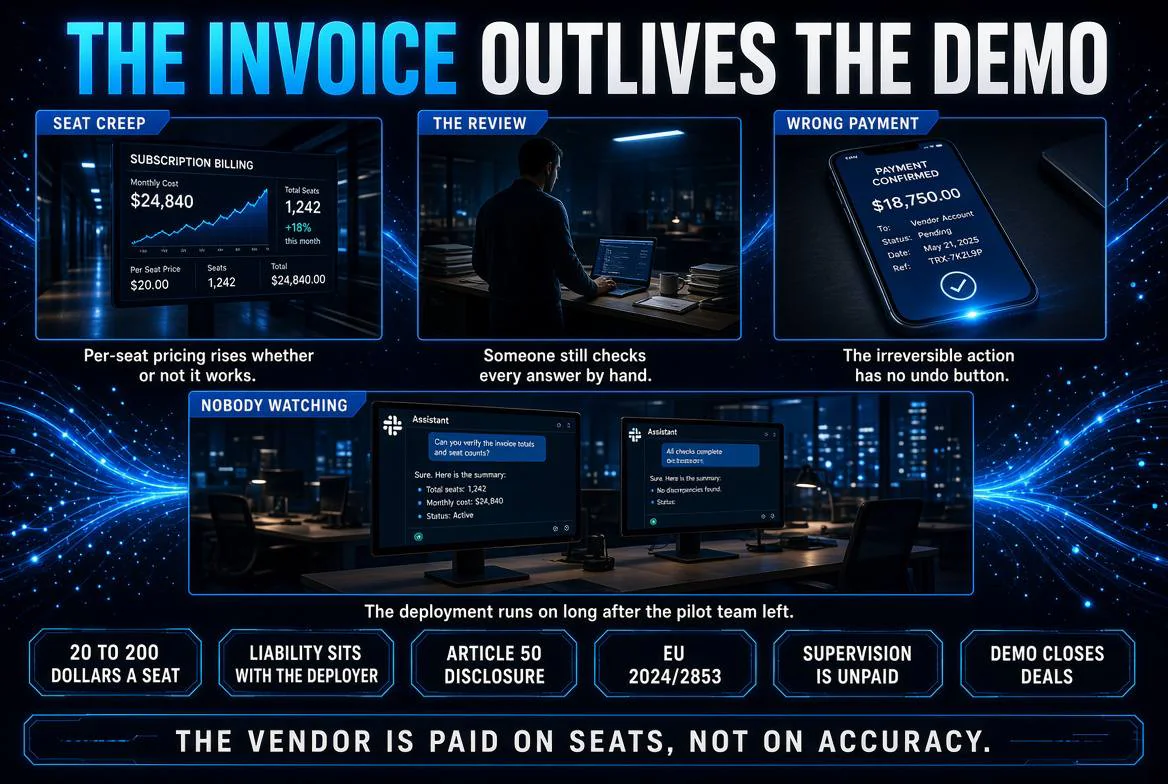
Stanford HAI’s AI Index, 2026: roughly one in three agentic tasks fails. Gartner, 2026: more than 40% of agentic AI projects cancelled by end-2027. MIT: 95% of enterprise pilots show zero return. Forrester: fewer than 15% of firms have agentic features switched on.
Now compare the fiction to the adoption. Every productivity vendor advertises an assistant. Almost none of them will tell you how many of their customers keep it switched on after month three. That is not an oversight. It is a number with no upside.
There is a second layer that gets almost no coverage, and it is the one that should worry anyone signing a contract: the assistant’s failures are currently priced onto the customer, not the vendor. When an agent books the wrong flight, sends the wrong email or pays the wrong invoice, the cost lands on the person who deployed it. The vendor’s terms of service in almost every case say so explicitly, and almost nobody reads them before switching the thing on.
What the law just did to the “we’re just the tool” defence
Two European instruments changed the arithmetic this year, and both of them remove the escape hatch the industry had been counting on.
The EU AI Act’s Article 50 transparency obligations require disclosure when a person is interacting with an AI system rather than a human. That sounds modest. It is not, for anyone running an assistant that talks to customers on the phone or in a chat window. You cannot quietly let a synthetic voice handle the complaint line and hope it passes. The disclosure has to happen, and the obligation sits with the deployer.
Then came the revised product liability directive, EU 2024/2853, which brings software into the product liability regime. Software is no longer a service you can disclaim into oblivion. It is a product, and products can be defective, and defective products generate liability without anyone having to prove negligence.
Put those two together and the “our assistant made a mistake, not us” defence evaporates. If the assistant is your deployment, the mistake is yours. That is a sentence every operator should read twice before rolling an agent into anything with money attached.
Why would anybody prefer a human? Because they have met both
The survey finding that roughly 79% of people would rather talk to a person than an AI assistant is usually framed as nostalgia. It is more useful read as quality control.
A human who cannot help you says so. An assistant that cannot help you invents an answer, states it in perfect grammar, and lets you walk out of the door believing it. The failure modes are not equivalent. One is an inconvenience. The other is a confident wrong answer delivered at scale.
That is the whole reason the human preference number is so stubborn. It is not technophobia. It is experience. People have used the assistants. They have been told a refund was processed when it was not, given a policy that did not exist, and reassured about a delivery that never shipped. They have learned that a human voice costs thirty seconds of hold music and an AI assistant costs a week of finding out.
Any vendor reading that number as a problem to be marketed around rather than a signal to be fixed is heading directly into the Gartner cancellation list.
The comparison that matters: what you are actually buying
| Factor | Pitched assistant | Human you can replace |
|---|---|---|
| Cost per month | $20 to $200 per seat | A salary plus overhead |
| Availability | Always on, never tired | Shifts, holidays, notice periods |
| Failure rate | Roughly one task in three | Variable, but self-reported and fixable |
| Failure visibility | Silent, confident, often undetected | Announced at the moment it happens |
| Who pays for the error | You, under the vendor’s terms | Shared, and negotiated |
| Supervision needed | Constant, and usually unpaid | Defined by role and review |
| Improvement over time | Outside your control, changes without notice | Learns your business specifically |
Line four is the one that decides this. A human who breaks something tells you. An assistant that breaks something usually does not, because it does not know it broke anything, and the interface presents the same calm confidence either way.
That is not a reason to avoid assistants. It is a reason to only ever point them at work where a silent failure is cheap: drafting, summarising, sorting, first-pass code. The moment the failure becomes expensive and invisible at the same time, you have built a liability with a nice chat window.
The vendor incentive nobody names
Here is the uncomfortable structural point. The company selling you the assistant is not paid on accuracy. It is paid on seats, tokens, or a flat subscription, all of which go up when you use the thing more regardless of whether it worked.
That incentive produces a very specific behaviour: ship the capability before the reliability, because the reliability curve is expensive and the capability demo closes deals. The failure rate gets documented later, by researchers, in an index nobody reads, and by analysts, in a report people skim.
The 40% cancellation figure is what happens when that bill comes due. Enterprises buy the demo, deploy the thing, discover a third of the tasks fail and nobody can supervise all of it, and quietly stop the project. Gartner publishes the number. The vendor’s case study page does not.
This is not a conspiracy. It is an incentive, and incentives do not need conspirators. Every participant behaves rationally and the customer still ends up holding a subscription to something that fails a third of the time with no published error rate.
What an operator does about this on a Monday
None of the above means avoid AI assistants. It means stop buying them the way you buy software.
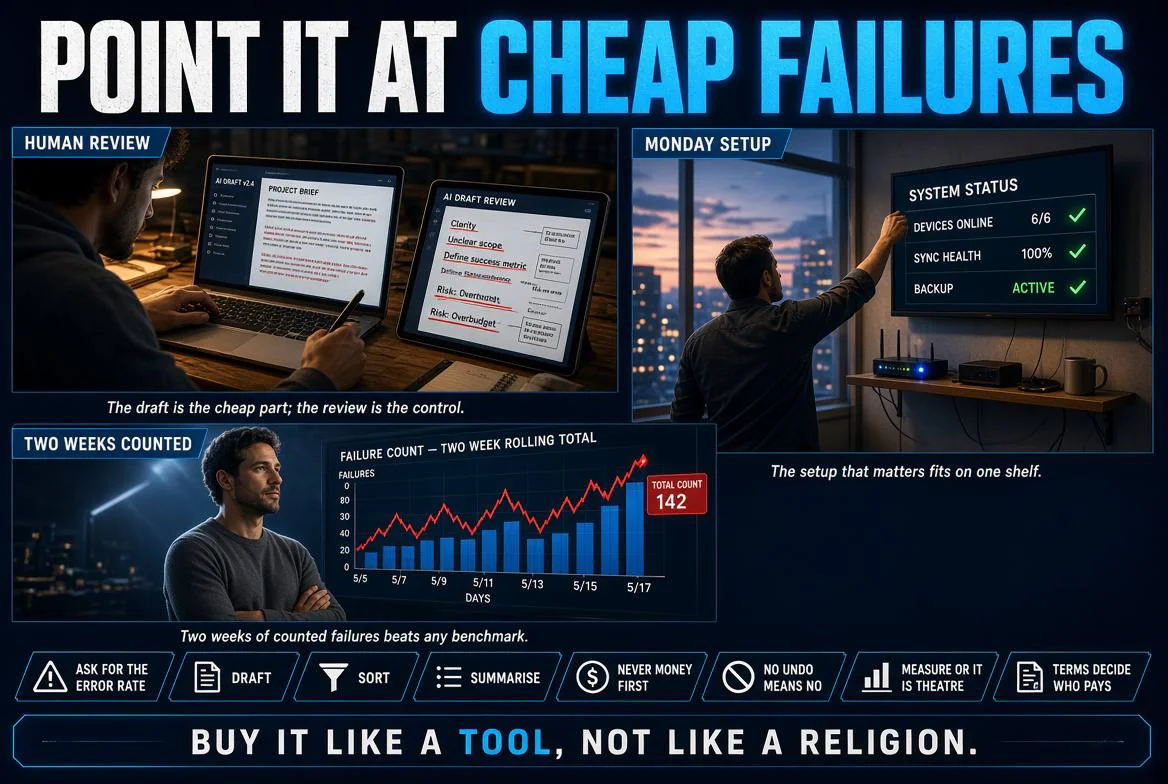
Ask the vendor for the error rate. Not the benchmark, the error rate on your workflow. Almost none of them will have it, and the fact that they do not is itself the answer to whether the pilot was designed to be measured or designed to be demonstrated.
Point the assistant at the cheap failures first. Drafting, summarising, categorising, first-pass anything with a human review step afterwards. Never start with money, never start with outbound communication in your name, never start with anything that has no undo.
Assume the liability is yours, because under the revised product liability directive and the disclosure obligations it now is. Read the terms of service for who pays when the agent is wrong, and expect the answer to be you.
And measure the thing. Pick a task, count the failures for two weeks, and compare against the same task done by a person. If the numbers cannot be produced, the deployment is theatre.
The honest verdict
The assistant is genuinely better than it was a year ago. It is also being sold as something it is not, at a volume that has nothing to do with the measured return, with the error rate buried and the liability transferred to whoever switched it on.
Four published numbers — one in three tasks failing, more than 40% of projects cancelled, 95% of pilots with no return, fewer than 15% switched on — describe an industry mid-correction. The correction is healthy. The marketing has not caught up.
The people saying they would rather talk to a human are not resisting the future. They are telling you, precisely and without any technical vocabulary at all, where the product is still broken. Somebody should send that to the people who build it. They have the number. They have had it for months.
Frequently asked questions
How often do AI agents actually fail?
Stanford’s 2026 AI Index puts multi-step agentic task failure at roughly one in three. That is the aggregate across benchmarked tasks, not a guarantee for any single workflow, and the rate varies widely by task type.
Why are so many agentic AI projects being cancelled?
Gartner expects more than 40% of agentic AI projects to be cancelled by the end of 2027, citing cost, unclear business value and inadequate risk controls. The pattern is a deployment that was approved on a demonstration and never measured afterward.
What did MIT find about enterprise AI pilots?
MIT’s study found 95% of enterprise AI pilots produced no measurable bottom-line return. The finding is about pilots, not about every use of AI inside a company, and it does not distinguish between badly scoped pilots and the technology itself.
Who is liable when an AI assistant makes a mistake?
Increasingly, the deployer. The EU AI Act’s Article 50 requires disclosure when a person is interacting with an AI system, and the revised product liability directive EU 2024/2853 brings software into the product liability regime, where a defective product can create liability without proof of negligence.
Which tasks are safe to hand to an assistant today?
Tasks with a narrow scope and a cheap, visible failure: drafting text a person will read, summarising documents, sorting and categorising, and first-pass code with expert review. Avoid anything involving money, irreversible action, or outbound communication sent under your name without review.
Should I ask a vendor for their error rate?
Yes. Ask for the failure rate on your specific workflow, not a published benchmark. Most vendors cannot produce it, and the inability to produce it tells you whether the deployment was designed to be measured or merely demonstrated.

About Barak Schurr
Barak Schurr built and sold a major ticketing platform, ran global nightlife operations at Eventbrite, and now spends his time figuring out which AI tools actually move the needle for independent business owners — and which ones are just noise. No hype. No fluff. Just what works.
Email: [email protected]
More AI Resources for Your Business