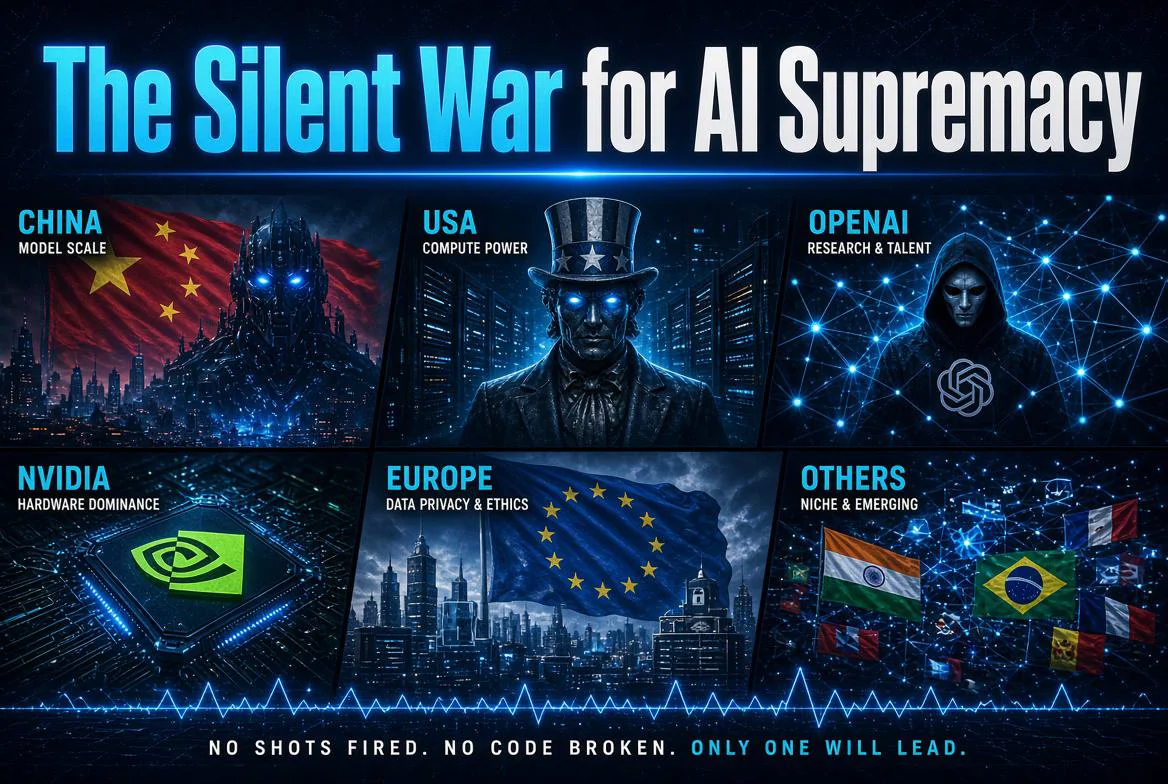
The Silent War for AI Supremacy
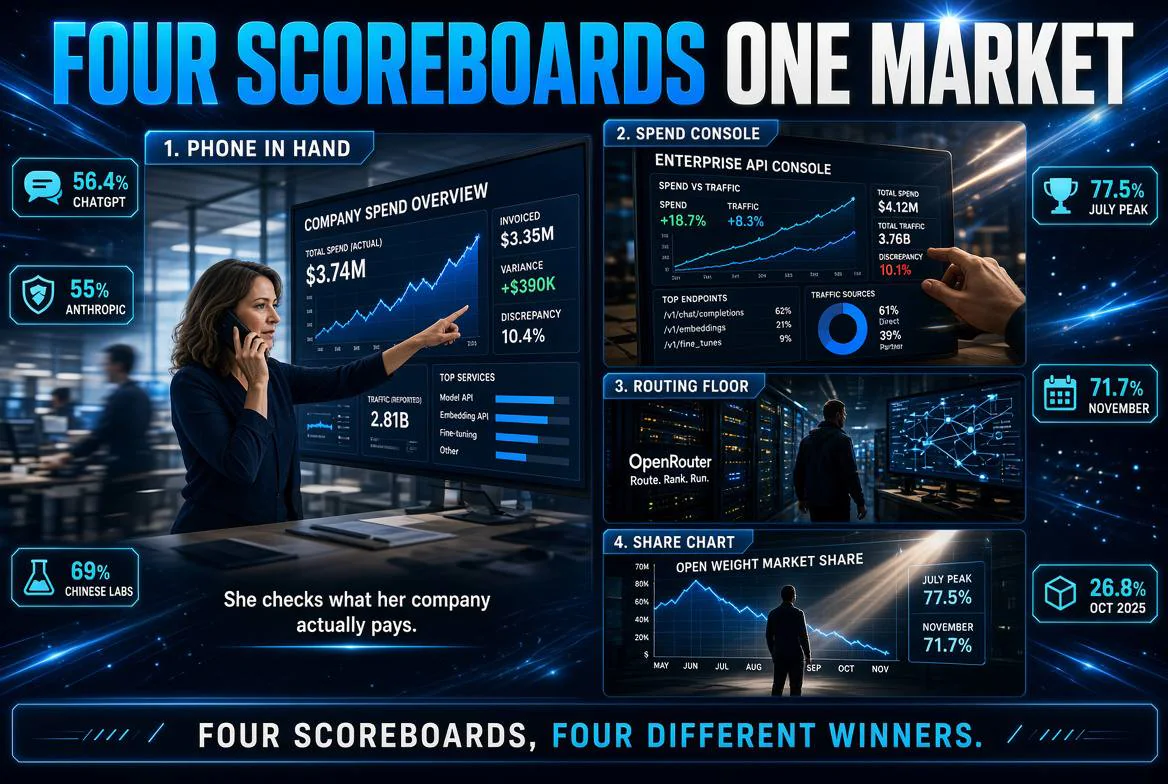
⚡ Expert Summary: There is no single AI leaderboard, because the people keeping score disagree. ChatGPT holds 56.4% of consumer AI web traffic. Anthropic holds 55% of enterprise API spend. Chinese labs carry 69% of developer tokens on OpenRouter. And open-weight models went from 26.8% of tokens served on OpenRouter in October 2025 to 71.7% by the end of September 2026 — which means the thing developers actually route through took the majority in under a year, while the thing enterprises actually pay for stayed closed. Every lab that wins one scoreboard has a commercial reason to keep the other two shut. That is the war, and nobody is announcing it.
Ask who is winning AI and you will get a different answer from a consumer, a chief information officer, and a developer, and all three will be right.
That is not a public-relations problem or a sign the market is too young to measure. It is the structure of the fight. The AI industry has at least three separate scoreboards, each with different players, different economics, and different definitions of victory — and the strategy of every major lab is to win the one where its business model works and quietly argue the others do not count.
Three Scoreboards, Three Winners
Here are the numbers, side by side, from sources that were read directly rather than summarised.
| Scoreboard | Who leads | Number |
|---|---|---|
| Consumer AI web traffic | OpenAI (ChatGPT) | 56.4% |
| Enterprise API spend | Anthropic | 55% |
| Developer tokens on OpenRouter | Chinese labs | 69% |
| Share of OpenRouter tokens served by open weights | Open-weight models | 71.7% in September 2026 |
Nobody wins all four. That is the whole picture, and it is the thing every vendor summary of the market carefully omits.
The four lines are not measuring the same behaviour. Consumer traffic is a measure of habit — people opening a browser and typing. Enterprise spend is a measure of procurement, budget cycles and compliance review. Developer tokens are a measure of what gets routed automatically, at one in the morning, by a piece of software choosing the cheapest adequate model. Open-weight share within that last category is a measure of what developers stop paying a premium for.
One company can be dominant in the inbox and irrelevant in the invoice. Another can own the invoice and be almost invisible to the public. A third can serve most of the world’s machine tokens while being nearly unknown to both.
What Happened to Open Weights in Twelve Months
The single most underreported number in AI comes from Hugging Face’s blog on its OpenRouter data, published November 17, 2026, and read directly for this piece.
Open-weight models went from 26.8% of the tokens served on OpenRouter in October 2025 to 71.7% at the end of September 2026 — after peaking at 77.5% in July. Over the same period, weekly open-weight volume grew more than 60-fold, against almost tenfold for closed models.
Two things are happening in that sentence, and most coverage of it only sees one.
The first is a genuine shift: open weights became the default routing choice on the main multi-model market. Not because they beat the best closed models on benchmarks — they mostly do not — but because for the overwhelming majority of requests, “good enough and a fraction of the price” wins. That is what routing software does. It optimises for cost per acceptable answer, and open weights stopped being noticeably less acceptable.
The second is subtler and more important: the number peaked at 77.5% in July and fell to 71.7% by the end of September. The open camp did not keep climbing. Something pulled volume back toward closed models — most likely the release of capabilities that open weights could not match, and enterprises willing to pay for them. That easing, not the peak, is the interesting part. It means the shift is real but not one-directional.
Who Actually Owns the Open Ecosystem
If open weights are winning the routing war, the obvious question is: whose open weights?
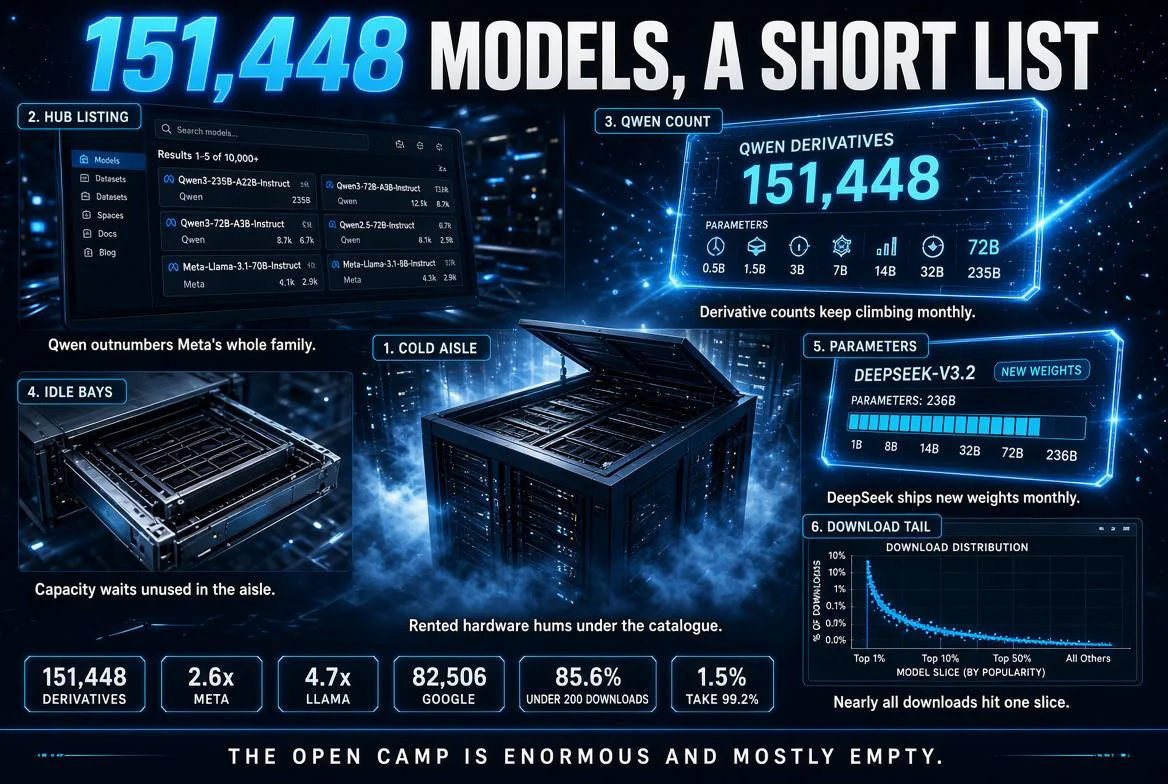
The answer is uncomfortable for the Western companies that created the category. According to Hugging Face’s State of Open Models report for Summer 2026, published August 14 and read directly: “Qwen-based models now account for 151,448 derivatives on the Hub, 2.6× Meta’s total footprint and 4.7× the Llama repositories specifically. Google follows with 82,506 derivatives.”
Read that twice. Qwen — Alibaba’s model family — has 2.6 times the derivative footprint of Meta, the company that gave away Llama and effectively created the open-weights era. On the specific metric of Llama repositories, it is 4.7 times larger.
The same report contains a second number that should temper any excitement about the open ecosystem’s breadth: “roughly 85.6% of models have fewer than 200 lifetime downloads, and 1.5% of repositories account for 99.2% of all downloads.”
So the open camp is enormous and mostly empty at the same time. A hundred and fifty thousand Qwen derivatives, and 1.5% of the catalogue absorbs 99.2% of the attention. Open weights have not produced a broad, competitive ecosystem of many strong models. They have produced a handful of foundations with huge downstream fan-out, and a long tail nobody runs.
The China fact is not incidental to this story. It runs through it. Chinese labs carry 69% of developer tokens on OpenRouter. DeepSeek’s V4.1-Flash, released September 10, 2026 under an MIT licence, runs 552 billion total parameters with 8 billion active and a million-token context; V4-Pro from April runs 1.6 trillion total. Qwen3.8-Flash-Next shipped August 26 as a 125-billion-parameter model with 6 billion active. Kimi K3.1 Pro published its weights on Hugging Face on November 4 under a modified MIT licence, at 2.8 trillion total parameters and 1.56 terabytes of MXFP4 weights.
Those parameter counts are large enough that the open/closed distinction stops being about capability and starts being about distribution. A 2.8-trillion-parameter model with published weights is not a toy.
What the Closed Camp Actually Says
The most quoted line in this debate belongs to a document that cannot be loaded. A widely circulated paraphrase attributes to Anthropic chief executive Dario Amodei the argument that open weights merely shift concentration to those with the most compute and chips. That source returns an error and the quote has not been verified, so it is not quoted here.
What Anthropic did publish, on July 27, 2026, in a post titled “Our position on open-weights models,” is more useful because it is more careful.
“Anthropic has never advocated for a ban on open-weights models,” Amodei wrote. “Open-weights models that don’t have dangerous capabilities are a public good: they don’t cost anything besides the compute needed to run them, and they provide value to businesses, developers, and researchers.”
He then drew the distinction that the entire policy fight actually rests on: “Open-weights models — it does not matter whether they come from China or anywhere else — do potentially present a higher risk than closed models, because it is very difficult to apply guardrails to them or monitor their usage, and once weights are released they cannot be withdrawn.”
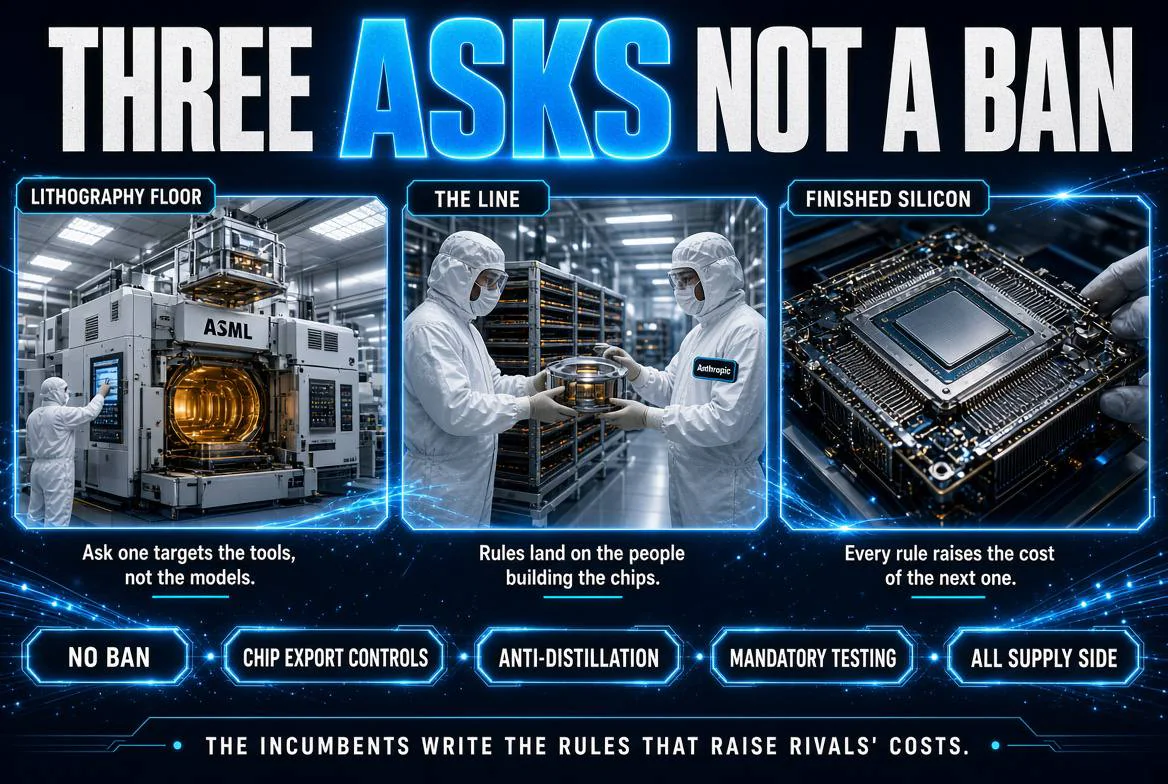
And on the accusation that this is commercial self-interest dressed as safety, he was unusually direct: “It would protect US AI companies from competition, but that has never been my goal.” He acknowledged the charge exists — “some people have even accused Anthropic of wanting to ban open-weights models as a means of protecting our business” — and answered it with three specific asks rather than a denial: stop selling powerful chips and chipmaking equipment to China, crack down on industrial-scale distillation operations, and put all sufficiently capable models, open and closed, through mandatory safety testing.
Note what those three asks have in common. None of them requires an open-weight ban. All three raise the cost of the open camp’s cheapest strategy — distilling a frontier model, and running it on hardware you bought from the same supply chain.
The Hybrid Posture Nobody Talks About
Google is the clearest case of a company playing both sides, and it does not hide it.
On June 3, 2026, Google released Gemma 4 12B under Apache 2.0, describing it in its own blog as designed “to bring high-performance multimodal intelligence directly to your laptop, combining mobile-first efficiency with advanced reasoning.” An EmbeddingGemma 2 update followed in October. Meanwhile Google sells Gemini as a closed product with closed APIs.
That is not hypocrisy, it is portfolio management. Give away the small model to seed local deployment and developer familiarity; sell the frontier model where the margin lives. Meta did the same thing more visibly and then changed course.
Meta has not shipped a new Llama model since April 2025. Its 2026 open releases arrived under a different name entirely — Muse Glimmer, a 30-billion-parameter model in August, and Muse Spark Open, an 816-billion-parameter mixture-of-experts with 42 billion active and a million-token context, in October. Meta’s chief of AI, Alexandr Wang, called the latter “the most capable US open-weight model to date.”
The company that started the open-weights era stopped branding its open weights, and the most capable US open model is now more than a year behind the Chinese frontier in scale.
What OpenAI’s Absence Means
The most consequential fact in the open-weights debate is a negative one.
OpenAI’s last open-weight release was gpt-oss-120b and gpt-oss-20b in August 2025, both under Apache 2.0. There has been no open-weight release from OpenAI in 2026. Its 2026 flagships are closed. Its legacy models — GPT-4o, GPT-4.1, GPT-5.1 — were retired between February and March 2026.
So the company with the largest consumer footprint has opted out of the open camp entirely, and it is winning the scoreboard that depends on habit rather than procurement. That is a coherent strategy, and it is the reason the “open weights are taking over” narrative has to be qualified every time it is stated. Open weights took over the routing layer. They did not take over the inbox.
Europe’s Smaller Open Camp
The non-Chinese open ecosystem is real and much smaller than the headlines suggest.
Mistral announced Mistral Large 4 on October 6, 2026, with a commitment rather than a delivery: “We will release the weights by the end of the month. Until then, we are red-teaming the model in real-world settings with cybersecurity leaders, vetted partners, and state authorities, who will access the same model with reduced moderation and expanded cyber capabilities.” That is a responsible process and it is also a delay worth noting.
Around it: Black Forest Labs shipped FLUX 3 Image Klein, a 5.6-billion-parameter open-weight text-to-image and editing model, on October 15. Thinking Machines Lab released Inkling 2 Small on November 5 — 594 billion total parameters, 17 billion active, one-million-token context, Apache 2.0 — with a model card stating it “is released with open weights to support research, fine-tuning and integration into third-party products by downstream developers.” Reflection AI shipped Beam, a 501-billion-parameter sparse model, on October 5.
Four serious open releases from the West in six weeks. None of them changes the OpenRouter numbers, because none of them is cheap enough or familiar enough to displace Qwen and DeepSeek in the routing layer.
The Benchmarks Are Contested, and That Is the Finding
Anyone who tells you exactly how far open models trail closed ones is guessing, and the sources disagree with each other in ways that are impossible to reconcile.
One set of figures puts the strongest open models at 30 to 32 on the Artificial Analysis Intelligence Index against 58 for the best closed model, and rates GLM-5.3 at 41.8% on Terminal-Bench 4.0 against Claude Opus 5.5 at 64.8% — roughly a four-month lag by Epoch AI’s estimate.
Another source, published November 7, reports that on the overall open-weight leaderboard Kimi K3.1 Pro trails the best closed model by 14 index points, but that on Terminal-Bench 4.0 it leads by 2.
Both cannot be true. Both are secondary sources. Neither is a settled number, and the honest position — the one this piece takes — is that the benchmark gap is contested, directional, and moving fast enough that any figure you read is a snapshot of a race, not a verdict on it.
| Lab | Posture | Scoreboard it is playing for |
|---|---|---|
| OpenAI | Closed only; no open release since August 2025 | Consumer habit, 56.4% of web traffic |
| Anthropic | Closed; open weights tolerated, not banned, regulated instead | Enterprise spend, 55% of API revenue |
| Hybrid: Gemma open under Apache, Gemini closed | Both, without leading either | |
| Meta | Open, but rebranded off Llama | Open ecosystem, now 2.6x behind Qwen |
| Chinese labs | Open weights at frontier scale, MIT or near-MIT terms | Developer tokens, 69% on OpenRouter |
What Policy Is Actually Doing
Both camps are legislating, and the pattern is consistent: the incumbents write the rules that raise their competitors’ costs.
In Europe, the practical effect of the AI Act’s open-source exemption is narrower than the phrase suggests. As one legal commentary put it in October 2026: “If you deploy an open-source model in a high-risk use case, the exemption is simply switched off.” Open weights are not a regulatory shield once the deployment is consequential.
In the United States, Anthropic’s three asks are the clearest published policy position in the industry, and they are all supply-side: chip export controls, anti-distillation enforcement, mandatory testing for capable models regardless of licence. Every one of those is easier for a company with a large compliance organisation and harder for a company shipping weights from a smaller jurisdiction.
What is missing from the public record is just as telling. There is no confirmed 2026 statement from Altman, Hassabis, Musk or Zuckerberg attacking open weights. There is no confirmed statement of Google’s position on the July 2026 open-weights letter. There is no primary announcement from Meta for the Muse models, only reporting. The war is being fought in benchmarks, distribution and regulation — not in statements of intent.
What to Watch
Three things will decide the next twelve months, and none of them is a press release.
The OpenRouter curve. Open weights peaked at 77.5% and settled at 71.7%. If that line resumes climbing, price is still the deciding variable. If it keeps sliding, capability at the frontier is still worth paying for and the open camp has a ceiling.
Meta’s silence. The most capable US open model is now a Muse, not a Llama, and the derivatives leaderboard belongs to Qwen by a factor of 2.6. If Meta stays out of the open-weight race in 2027, the Western open camp is Google’s hobby and Europe’s small releases — against a Chinese ecosystem that owns the routing layer.
The distillation crackdown. Anthropic’s second ask is the one with teeth. Distillation is how a smaller lab turns a frontier model into a cheap one, and enforcement against it would be the single largest change to the open camp’s economics since Llama shipped. Watch what the labs file, not what they say.
What is not in dispute is that there is no winner. There is a consumer habit, a procurement budget, and a routing decision, and three different companies are winning them. Anyone who presents this market as a single race with a single leader has picked a scoreboard and is hoping you do not ask which one.
Frequently Asked Questions
Are open-weight models beating closed models?
On one measure, yes. Open-weight models served 71.7% of tokens on OpenRouter at the end of September 2026, up from 26.8% a year earlier. But closed models still dominate enterprise procurement, and the share eased from a July peak of 77.5%, so the answer depends entirely on which scoreboard you read.
Who is actually winning the AI race?
Three different companies win three different measures. OpenAI leads consumer web traffic at 56.4%, Anthropic leads enterprise API spend at 55%, and Chinese labs carry 69% of developer tokens on OpenRouter. No company leads more than one of the three.
Why is Qwen bigger than Llama in the open ecosystem?
According to Hugging Face’s Summer 2026 State of Open Models report, Qwen-based models account for 151,448 derivatives, 2.6 times Meta’s total footprint and 4.7 times the Llama repositories specifically. Meta has not released a new Llama since April 2025.
Did OpenAI stop releasing open-weight models?
Yes. OpenAI’s last open-weight release was gpt-oss-120b and gpt-oss-20b in August 2025 under Apache 2.0. There was no open-weight release from OpenAI in 2026, and its 2026 flagship models are closed.
Is Anthropic trying to ban open-weight models?
Anthropic’s chief executive Dario Amodei has stated publicly: “Anthropic has never advocated for a ban on open-weights models,” and called non-dangerous open-weight models a public good. He has acknowledged that some people accuse the company of protecting its business, and answered with three policy asks instead of a ban.
How far behind are open models on benchmarks?
The sources disagree and none is definitive. One set puts the gap at roughly four months with open models scoring 30 to 32 against 58 for the best closed model on the Artificial Analysis Intelligence Index. Another reports an open model leading on Terminal-Bench 4.0 by 2 points while trailing by 14 overall.
What does the EU AI Act say about open-source models?
The open-source exemption is narrower than it appears. As legal commentary published in October 2026 put it, deploying an open-source model in a high-risk use case switches the exemption off entirely.
What should businesses actually take from all this?
That choice of model is now a routing decision, not a loyalty decision. Open weights serve most developer tokens at a fraction of the price, closed models still win the highest-stakes work, and the correct architecture is to route by task cost rather than commit to one camp.

About Barak Schurr
Barak Schurr built and sold a major ticketing platform, ran global nightlife operations at Eventbrite, and now spends his time figuring out which AI tools actually move the needle for independent business owners — and which ones are just noise. No hype. No fluff. Just what works.
Email: [email protected]
More AI Resources for Your Business