Get The Solo Business OS — Free
The AI workflow that replaces a part-time employee for solo operators and small business owners.
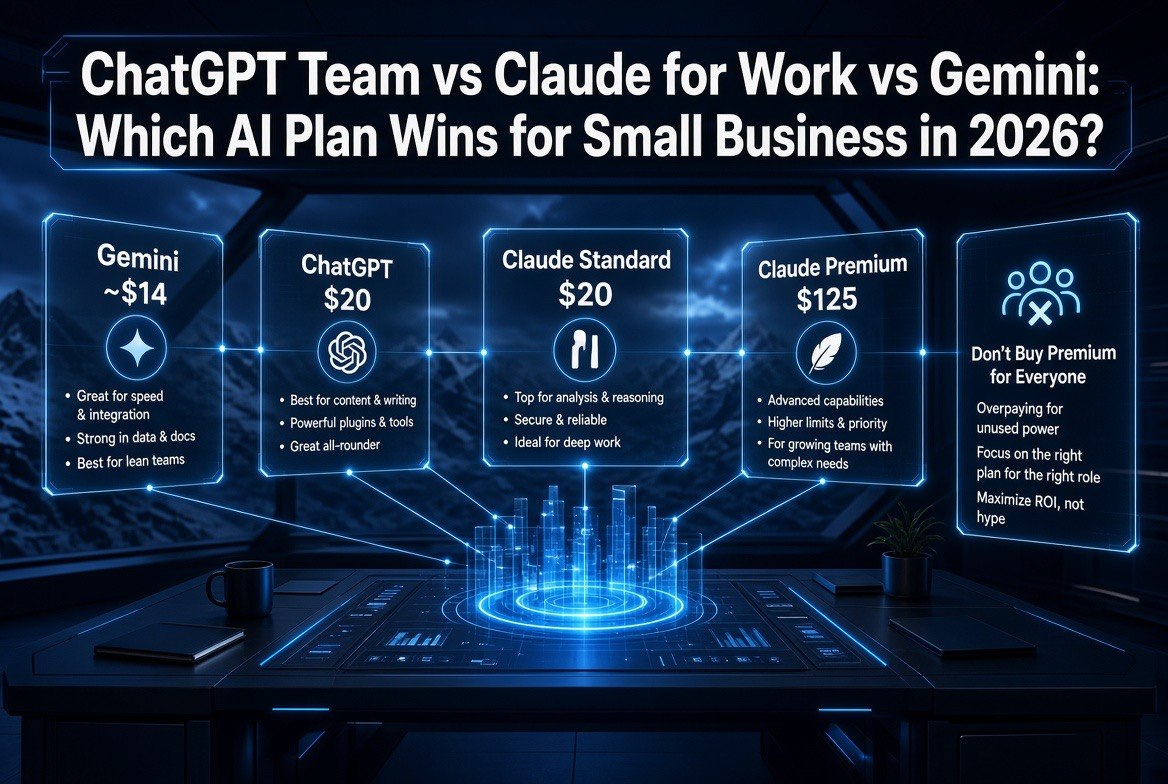
ChatGPT Team vs Claude for Work vs Gemini: Which AI Plan Wins for Small Business in 2026?
⚡ Expert Summary: There is no single winner, and any article that hands you one is selling something. ChatGPT Business ($20/user/mo annual, $25 monthly) wins on integration breadth with 60+ connectors. Claude Team Premium ($125/seat/mo) wins for coding and long-form writing teams because it is the only tier that unlocks Claude Code and frontier-model access. Google Workspace with Gemini wins on cost for most small businesses — Business Standard at roughly $14/user/mo gives you AI inside Gmail, Docs, Sheets and Meet at a price that is often lower than the AI subscription you are already paying for separately. For a 10-person team, the spread between the cheapest and priciest sensible configuration is about $13,000 a year.
Every small business owner I talk to is asking the same question in 2026, and they are asking it wrong.
The question is usually “which AI should we standardize on?” The better question is “which of our teams needs which shape of AI, and what is the cheapest way to buy it?” Those produce completely different answers, and the difference is real money.
Here is the trap. All three vendors — OpenAI, Anthropic, and Google — now sell team plans that look nearly identical if you only read the headline price. ChatGPT Business is $20 per user per month annually. Claude Team Standard is $20 per member per month annually. Google Workspace Business Standard is roughly $14. On paper that is a rounding-error gap. In practice these three products do different jobs, and buying the wrong one for a team costs you either capability or cash — usually both, because you end up buying a second subscription to fill the gap.
This breakdown covers what each plan actually includes in 2026, what it costs at real team sizes, and the decision framework that stops you from paying for three overlapping AI subscriptions.
What Each Plan Actually Is
Start with positioning, because the marketing names obscure real differences in shape.
ChatGPT Business is OpenAI’s mid-market offering, formerly called ChatGPT Team before the rebrand. It is built as a general-purpose AI workspace with the widest integration surface of the three — more than 60 app connectors spanning Slack, Google Drive, Salesforce, GitHub, Notion, and Confluence. If your workflows hop between a dozen SaaS tools, this is the plan designed to sit in the middle of them. It enforces a 2-seat minimum, and it does not train on your data by default.
Claude for Work — Anthropic’s team offering, split into Team Standard and Team Premium — is model-first. The Premium tier is the one that matters strategically: at $125 per seat per month it is the only tier that includes both Claude Code and permanent frontier-model access. Team Standard at $20/member/month annually (up to 150 seats) gives 1.25x more usage than the individual Pro plan, which is a modest step up rather than a different product. This is a plan you buy for developer teams and long-form writing workflows, not for general office assistance.
Google Workspace with Gemini makes a fundamentally different bet: that AI should not be a separate destination you switch to, but something native to the tools where work already happens. Gemini is embedded across Gmail, Docs, Sheets, Slides, Drive, Chat, Meet, and Calendar rather than living in a standalone chat product. That distinction drives everything about its cost advantage — if you are already paying Google for email and documents, you are largely buying AI access you may already have partially paid for.
The Real Cost at Real Team Sizes
Per-seat pricing hides the number that matters to a small business: the annual total. Here is what each plan costs across realistic team sizes, using annual billing.
| Plan | Per Seat / Month | 5-Person Team / Year | 10-Person Team / Year |
|---|---|---|---|
| Google Workspace Business Standard (inc. Gemini) | ~$14 | $840 | $1,680 |
| ChatGPT Business (annual) | $20 | $1,200 | $2,400 |
| ChatGPT Business (monthly) | $25 | $1,500 | $3,000 |
| Claude Team Standard (annual) | $20 | $1,200 | $2,400 |
| Claude Team Premium | $125 | $7,500 | $15,000 |
| Spread at 10 seats | $14 vs $125 | — | $1,680 vs $15,000 |
Read that spread carefully, because it reframes the entire decision. At ten seats, the gap between the cheapest sensible option and the most expensive one is roughly $13,300 a year. That is not a rounding error — it is a hire, a piece of equipment, or a year of another tool.
But here is the part most cost comparisons get wrong: Claude Team Premium is not competing with Google Workspace Business Standard. Those are different products for different jobs. The right comparison is not “which is cheapest” but “which seats actually need which capability.”
Where the Money Goes Wrong
The most common failure pattern in small businesses is not picking the wrong vendor. It is buying for everyone what only three people need.
A 12-person company with two developers and one serious content marketer does not need 12 Premium seats at $125. It needs Google Workspace Business Standard for the whole company at roughly $14 per seat, giving everyone AI inside Gmail and Docs where they already work — plus Claude Team Premium for exactly the three people who will use Claude Code and frontier-model writing. That configuration costs about $2,016 for the company-wide layer plus $4,500 for the three premium seats, totaling roughly $6,500 a year.
Buying Premium for all 12 would cost $18,000. Buying nothing but a single premium tool for everyone costs you the native integration that makes the other nine people actually use AI at all.
This is the configuration that genuinely wins for most small businesses in 2026, and it is not a tool choice — it is a tiering decision.
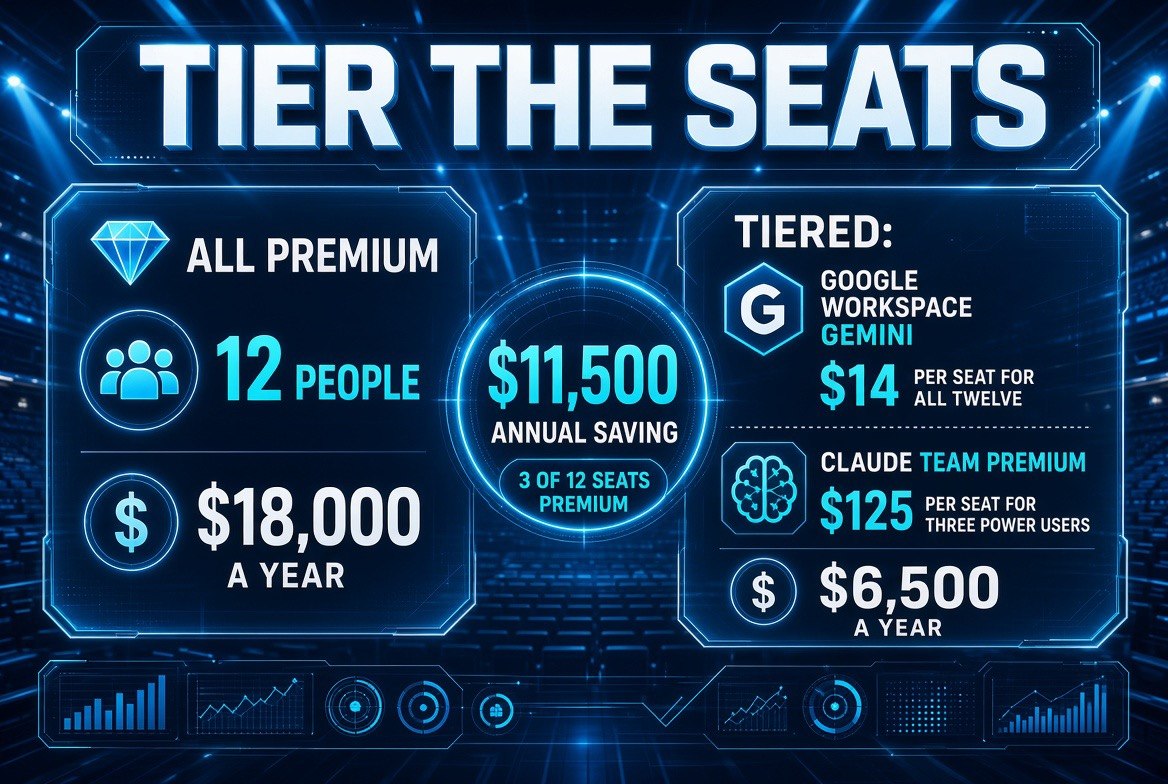
Three premium seats out of twelve is the whole decision: $6,500 a year tiered against $18,000 for Premium everywhere — an $11,500 gap for a 12-person company.
Head-to-Head: What Each Plan Actually Wins
Once you accept that these are different shapes of AI rather than three versions of the same thing, the strengths become straightforward.
| Factor | ChatGPT Business | Claude for Work | Gemini in Workspace |
|---|---|---|---|
| Entry price (annual) | $20/user/mo | $20/member/mo | ~$14/user/mo |
| Top tier | Enterprise ~$60+/user/mo | Premium $125/seat/mo | Business Plus ~$22/mo |
| Biggest strength | 60+ app integrations | Coding + long-form writing | Native inside Gmail/Docs/Sheets |
| Context window | 400K | 1M | 2M |
| Minimum seats | 2 | No team minimum | 1 |
| Data trained on yours | No, by default | No, by default | No, by default |
| Best for | Mixed tool stacks, automation | Dev teams, content-heavy orgs | Google-native teams |
ChatGPT Business wins on breadth. With more than 60 integrations, Agent Mode for multi-step tasks across apps, and a 400K context window, it is the strongest choice for a team whose work genuinely spans Slack, Salesforce, Notion, GitHub, and a pile of SaaS tools. One detail matters if you are evaluating it for development: as of June 24, 2026, Codex seats are no longer available to new Business plans or workspaces that had not previously added them. Existing users can continue and add usage-based seats, but a new customer wanting CLI-style coding capability should budget for it separately — or look at Claude Code or Cursor instead.
Claude for Work wins on depth where depth pays. A 1M-token context window handles document analysis that smaller windows simply cannot, which is why it leads for legal, research, and long-form content work. And Claude Team Premium is the only path to Claude Code — a terminal-native agentic coding tool that developer teams consistently describe as the reason they buy the plan at all. At $125 per seat this is expensive, and it is worth it only for seats doing that specific work. Putting an entire office on Premium seats is the single most common expensive mistake in this category.
Gemini in Workspace wins on being already there. A 2M context window is the largest of the three, and the AI is embedded directly in the applications where your team already spends its day rather than requiring a context switch. Proactive agents and no-code workflow automation handle the repetitive glue work without anyone opening a separate product. If your team lives in Gmail and Docs, Gemini is not merely the cheapest — it is the most likely to actually get used, and adoption is the variable that determines whether an AI subscription returns anything at all.
How to Decide in Three Questions
Question one: where does your team already work? If the answer is Google Workspace, default to Gemini and stop there. You are buying AI where your team already is, at the lowest incremental cost. If the answer is Microsoft 365 or a genuinely mixed stack, ChatGPT Business is the more natural fit because its integration surface assumes heterogeneity rather than a single ecosystem.
Question two: what is the primary AI use case? Coding-heavy work points to Claude Team Premium. Cross-app workflow automation points to ChatGPT Business. In-workflow assistance — drafting emails, summarizing documents, spotting trends in a spreadsheet — points to Gemini inside Workspace. Be honest here, because the failure mode is buying for an aspirational use case nobody on the team performs.
Question three: what is your budget tolerance per seat? Under $20 per seat points to Gemini through an existing Workspace bundle, or ChatGPT Business on annual billing. If $125 per seat is acceptable, Claude Team Premium unlocks capability the others do not match in its specific domain. Most small businesses should answer this question differently for different teams, and that is the correct answer rather than a cop-out.
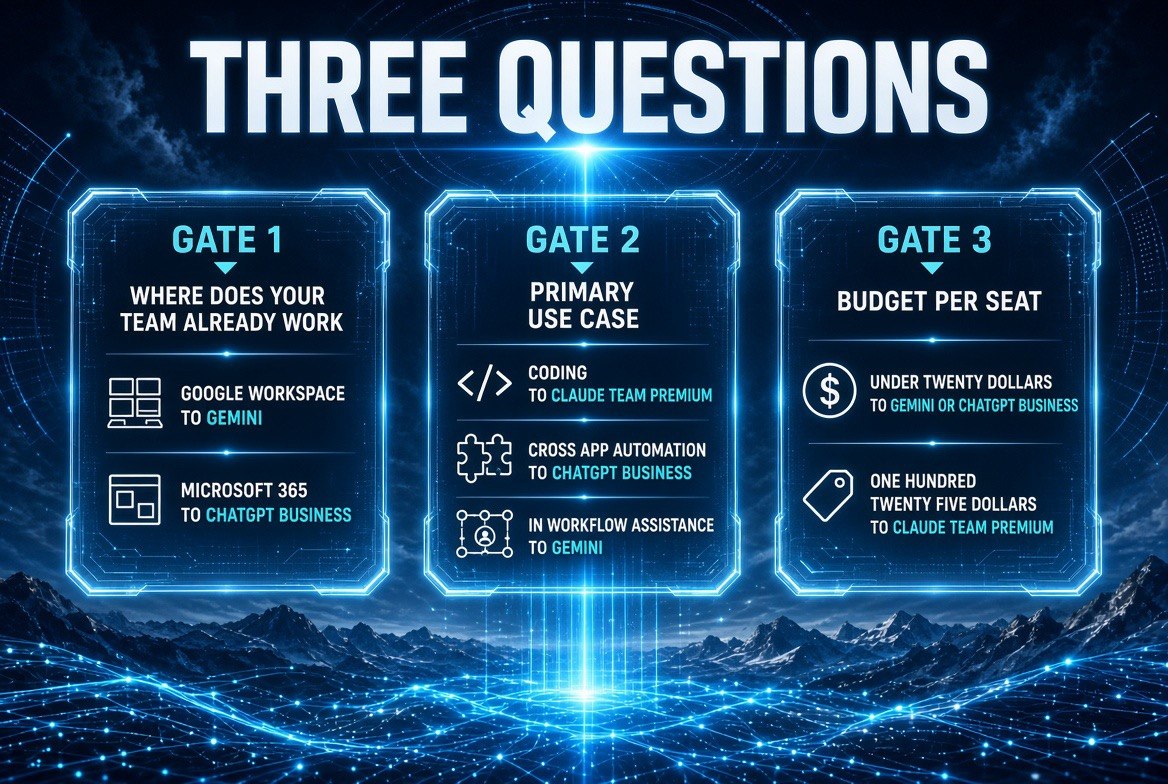
Three questions, three answers: where your team already works, what the primary use case actually is, and what you will tolerate per seat. Most small businesses should answer question three differently for different teams.
The Configuration That Actually Wins
Here is the recommendation, stated plainly.
Run Google Workspace with Gemini as your company-wide layer. Business Standard at roughly $14 per user per month covers email, documents, spreadsheets, and meetings on one bill with AI built into all of it. This is the cheapest per-seat AI access available to a small business, and doing it this way means every employee has functional AI without a separate subscription.
Add Claude Team Premium seats for the people who need them. Your developers. Your technical writers. Anyone producing long-form content where a 1M-token context and frontier-model reasoning make a measurable difference. Three to five seats is a realistic number for most companies under 50 people. Buying Premium for the whole company is how a $6,500 configuration becomes an $18,000 one.
Consider ChatGPT Business only if your workflows genuinely span non-Google tools. If you are heavy on Slack, Notion, and Salesforce, the 60+ integrations earn their $20 per seat. If your stack is Google-native, you are paying twice for overlapping capability.
Run the numbers on your own team before you commit. Count how many seats need frontier capability versus how many need competent AI inside their existing tools. Almost every small business finds the answer is roughly 20% and 80% — and buying accordingly is where the $13,000 annual difference lives.
Two Things to Watch in the Months Ahead
Usage-based pricing is spreading. The flat all-you-can-eat seat fee is being replaced by hybrid models — a base seat price plus metered token or credit consumption on top, particularly for agent-style workloads. GitHub Copilot already retired its unlimited premium tier in June 2026. If your team runs autonomous agents, model your costs with a metered component included, because a flat seat price will not reflect what you actually spend. Budget for variability, not just a per-seat number.
Premium seat tiers are becoming the real product line. Every vendor is now segmenting by capability rather than by seat count. That means your per-seat average is going to depend far more on who on your team needs frontier access than on how many employees you have. Revisit your seat mapping every six months, because the person who needed the top tier in January may no longer need it by July — and the reverse happens just as often.
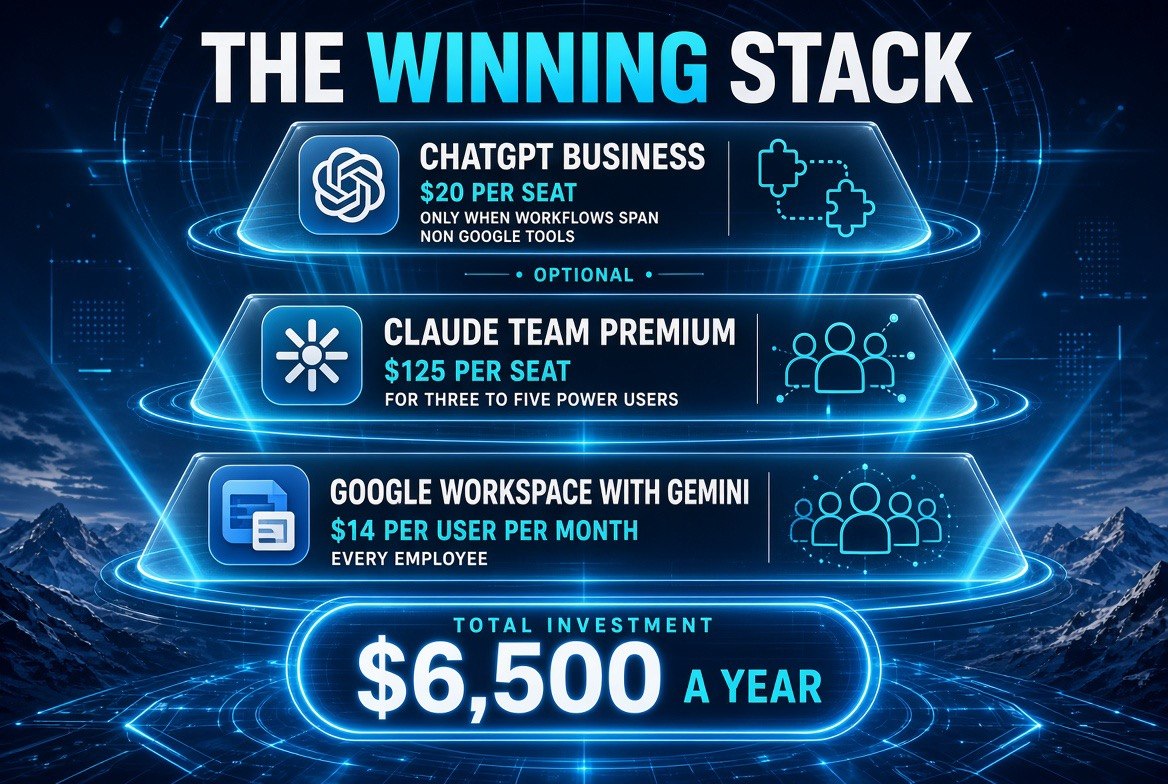
The stack that wins: Gemini inside Workspace as the company-wide layer, three to five Claude Team Premium seats for the people who need frontier access, and ChatGPT Business only if your stack is genuinely non-Google. About $6,500 a year.
Frequently Asked Questions
Which AI plan is cheapest for a small business in 2026?
Google Workspace with Gemini is cheapest at roughly $14 per user per month on Business Standard annual billing, and it is often cheaper still in practice because it replaces AI subscriptions you are already paying for separately. ChatGPT Business and Claude Team Standard both sit at $20 per user per month on annual billing. Claude Team Premium at $125 per seat per month is the most expensive tier and only makes sense for seats that need Claude Code or frontier-model access.
Do I need Claude Team Premium for my whole team?
No, and doing so is the most common expensive mistake in this category. Claude Team Premium exists to unlock Claude Code and frontier-model access for the seats doing coding or long-form writing work. Most small businesses need three to five Premium seats rather than a full company allocation — at ten seats, buying Premium for everyone costs $15,000 a year versus roughly $6,500 for a tiered configuration.
Is ChatGPT Business worth $20 per user per month?
It depends on your tool stack. ChatGPT Business earns its price when your workflows genuinely span many applications — it offers more than 60 integrations, the widest of the three plans compared here, plus Agent Mode for multi-step automation across apps. If your team is Google-native, you are better served by Gemini inside Workspace and would be paying twice for overlapping capability. Note that Codex seats are no longer available to new Business plans as of June 24, 2026.
Can I mix AI plans from different vendors?
Yes, and for most small businesses that is the correct approach rather than a compromise. A common configuration is Google Workspace with Gemini for the whole company as the baseline layer, plus Claude Team Premium seats for developers and content specialists. Run the numbers on how many seats actually need frontier capability — usually about 20% of your headcount — and tier accordingly.
Do any of these plans train AI on my business data?
All three state that they do not train on your data by default on their business tiers. ChatGPT Business, Claude for Work, and Gemini in Google Workspace each confirm no training on customer data by default. If you are in a regulated industry, check the specific certifications against your regulator — Google Workspace has the most mature HIPAA posture, Claude offers self-serve HIPAA configuration, and ChatGPT Business carries SOC 2 Type II compliance.
Will AI seat prices go up in 2026 and 2027?
The direction is toward hybrid pricing rather than simple increases. Vendors are moving from flat all-you-can-eat seat fees toward a base seat price plus metered usage on top, especially for agent workloads that consume far more tokens. GitHub Copilot retired its unlimited premium tier in June 2026. Model your budget with a variable component so that heavy agent usage does not produce a surprise, and re-evaluate your seat mapping every six months.

About Barak Schurr
Barak Schurr built and sold a major ticketing platform, ran global nightlife operations at Eventbrite, and now spends his time figuring out which AI tools actually move the needle for independent business owners — and which ones are just noise. No hype. No fluff. Just what works.
Email: [email protected]
More AI Tools for Small Business