Get The Solo Business OS — Free
The AI workflow that replaces a part-time employee for solo operators and small business owners.
Wabi 2.0: The AI App Builder That Became a Messenger
⚡ Expert Summary: Wabi, the prompt-based app builder founded by Replika creator Eugenia Kuyda, has relaunched as Wabi 2.0 — a messenger where a personal AI agent builds the interface you need at the moment you need it. The shift matters to small business owners because it signals where agent software is heading: not a chat box that talks, but a workspace that produces working tools on demand. This breakdown explains what actually changed, why chat-only agents hit a ceiling, and what this pattern means for how you will run your business software.
Most small business owners have already tried an AI assistant. They typed a question, got an answer, and closed the tab. Useful, but not a tool. You cannot run a business on a chat window that forgets what you were doing ten messages ago.
Wabi’s relaunch is a direct answer to that problem, and it comes from someone worth listening to. Founder Eugenia Kuyda previously built Replika, one of the most-used consumer AI companions. She is now betting that the next wave of agent software is not about better conversation — it is about producing working software in the middle of one.
What Actually Changed in Wabi 2.0
The original Wabi let users describe an app in a prompt and receive a working app. That model had a distribution problem: you built something useful and then had to find a reason to return to it.
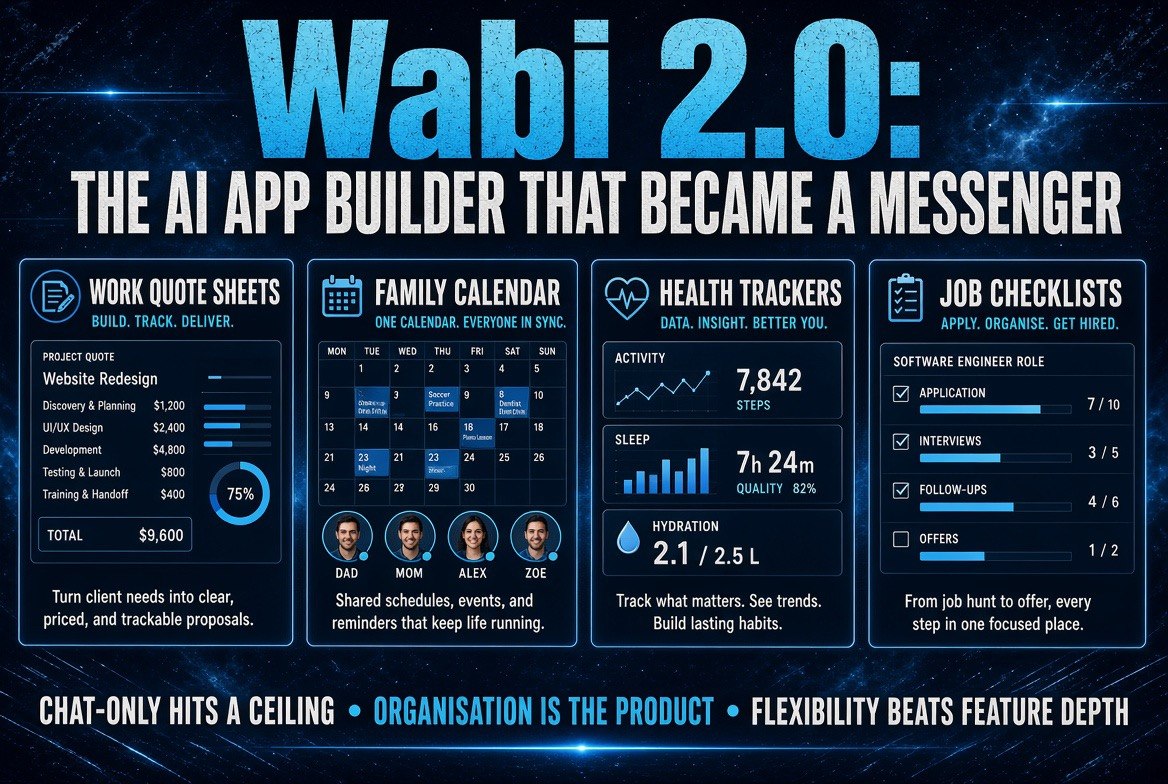
Wabi 2.0 keeps the generation engine and changes the container. Instead of a builder you visit, it is a messenger organised around threads — health, family, work — where the agent creates interfaces on demand as tasks come up. In Kuyda’s own examples, a health thread could grow a calorie tracker, a weightlifting log and a weight tracker. A family thread could grow a calendar of the kids’ activities, a language-learning app, and a tracker for local kid-friendly events.
That is the substantive shift. The apps are not separate destinations. They are artefacts that appear inside a context and persist where they are relevant.
| Factor | Chat-Only Agent | Wabi 2.0 Agent + Apps |
|---|---|---|
| Where work lives | One endless scroll of history | Threads by topic, with their own apps |
| Interface | Text in, text out | Built on demand for the current task |
| Ongoing tasks | Buried as the conversation grows | Retained in the thread that owns them |
| Interaction style | Type, type, type | Tap, scroll and look, as well as type |
| Access model | Open sign-up | Invite code only at launch |
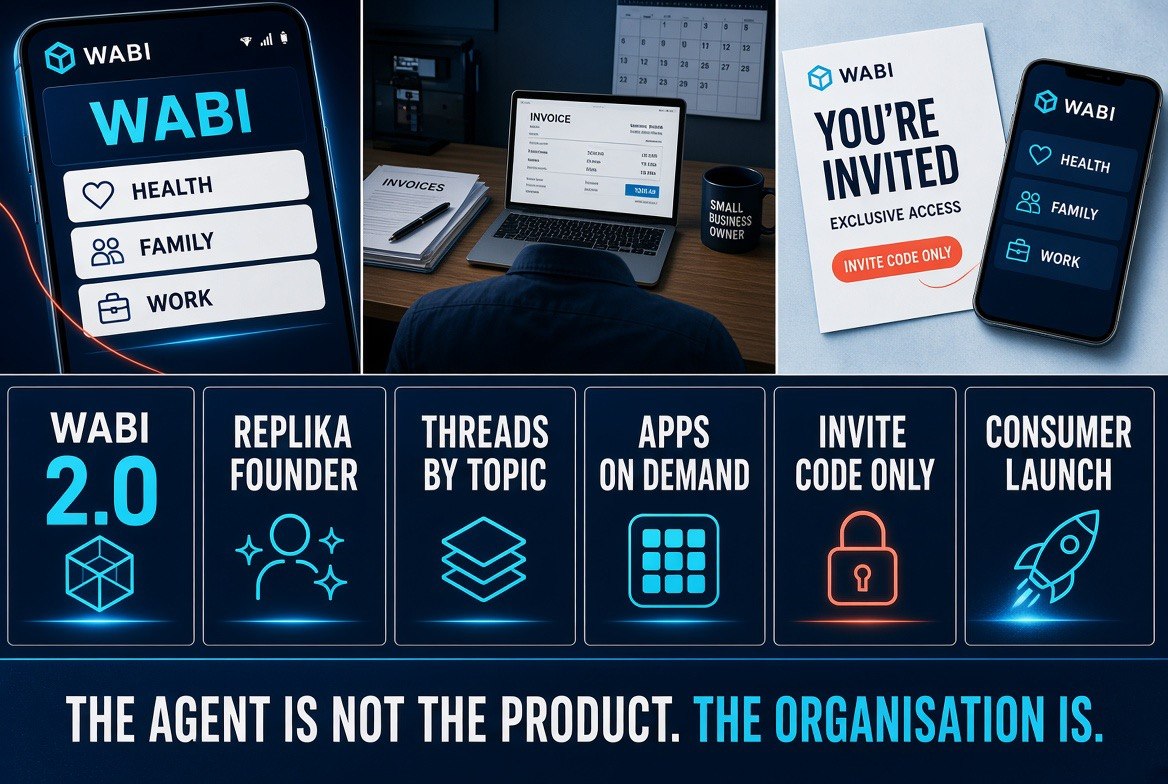
Wabi 2.0 in one frame: threads organise the work by context, and the interfaces are generated inside the thread that needs them rather than waiting in a separate app menu.
Why Chat-Only Agents Hit a Ceiling
Kuyda’s argument is blunt, and it matches what most owners have felt without being able to name. As you use a chat-only agent, the experience degrades. Your history and ongoing tasks end up buried in a single endless scroll. The thing gets worse the more you rely on it.
She is describing an information architecture failure, not a model failure. Software that stores everything in one linear conversation has no way to surface what matters. Humans do not work that way. We organise by context — money in one place, family in another, work in a third.
The insight worth extracting for a business is this: the agent is not the product. The organisation is.
The Strategic Question This Raises for Small Business
Wabi is a consumer product, invite-only at launch, and not something most owners should evaluate as a tool tomorrow. Its relevance is directional.
Three things are converging at once. OpenAI announced at DevDay that ChatGPT plug-ins would let apps offer interactive experiences inside ChatGPT, with app names pinned more visibly in the sidebar. Wabi is repositioning around agents that produce interfaces on demand. And agent platforms generally are moving from conversational answers toward completed work.
The pattern is consistent: the assistant stops being a text box and starts being a surface where things get done.
| Business Type | What On-Demand Interfaces Change | Watch Priority |
|---|---|---|
| Trades and services | Job trackers and quote sheets built per job | High |
| Retail and ecommerce | Stock and reorder views generated on request | High |
| Clinics and salons | Scheduling surfaces without separate software | Medium |
| Professional services | Intake forms and matter trackers on demand | Medium |
| Restaurants | Shift and prep checklists generated per service | Medium |
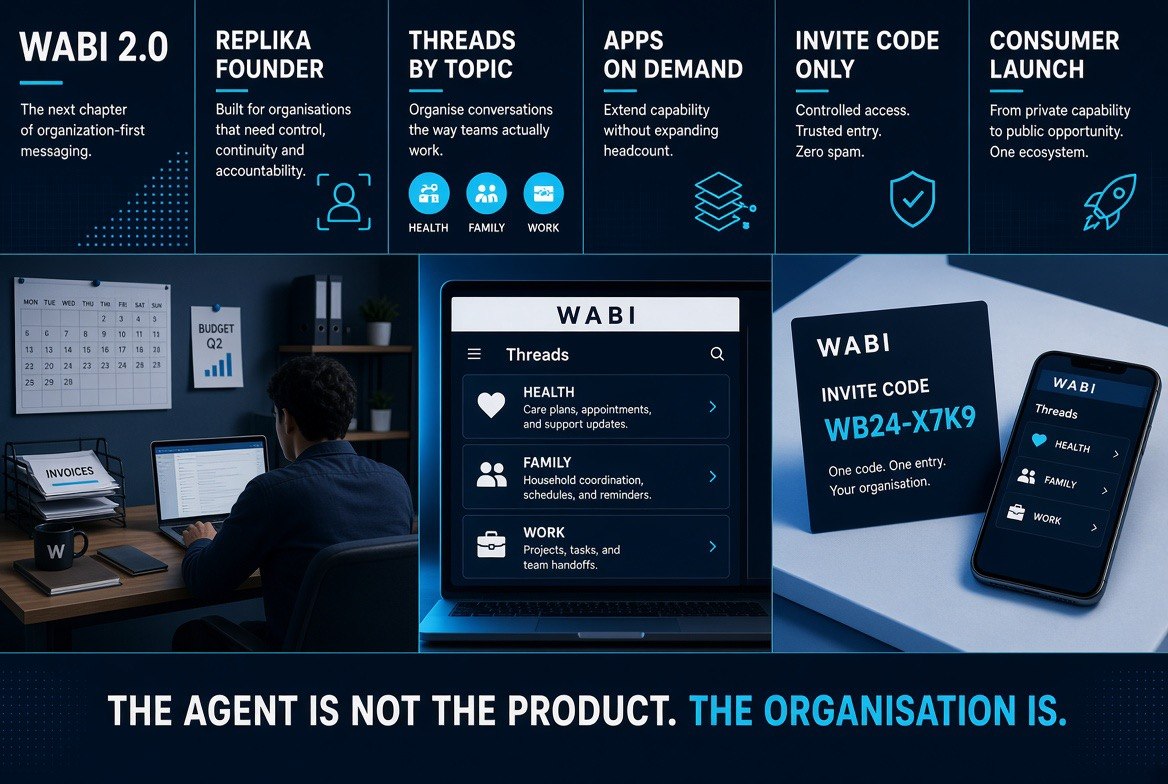
Wabi 2.0 mapped: the messenger organises work into context threads and generates the interface inside the thread that needs it — a consumer relaunch from the founder of Replika, invite code only.
What This Means for the Software You Buy Today
If interfaces can be generated on demand, the case for buying rigid single-purpose software weakens at the margin. The question shifts from “which app has this feature” to “which platform can produce the surface I need when I need it.”
That is a meaningful change in how you evaluate vendors, and it is worth adjusting your thinking before the products fully arrive.
Two practical implications follow. First, flexibility becomes more valuable than feature depth, because a system that can be reshaped beats a system that does one narrow thing perfectly. Second, data portability becomes more important, not less — if your tools are generated around your context, your context becomes the asset worth protecting.
The counterweight is real. Generated interfaces are new, unproven, and historically the failure mode of generated software is silent breakage. A surface that appears correctly and then mishandles an edge case is worse than no surface, because you have already trusted it with work.
Honest Limits — What Wabi 2.0 Is Not
Wabi 2.0 launched with invite codes distributed on X. That is a consumer rollout, not a business procurement channel, and it tells you the maturity level.
There is no published business pricing, no compliance documentation, and no enterprise support surface. A business that depends on a supplier could not run on it today, and no owner should plan around that changing on a predictable timetable.
What it does provide is a clear view of the direction of travel. The most useful thing an owner can do right now is not adopt it — it is to notice that the assumption “software comes in fixed apps you choose from a menu” is being actively challenged by well-funded teams, and to make sure their own systems are not built on the opposite bet.
Watch the pattern, keep your data portable, and be slow to lock into any single interface while the ground is still moving. That posture costs nothing today and is worth a great deal when the shift lands.
The Precedent Behind Wabi 2.0: OpenAI’s DevDay Shift
Wabi did not pivot in isolation. OpenAI used its DevDay event to announce an update to ChatGPT’s plug-ins that lets apps offer interactive experiences inside ChatGPT, with the app’s name pinned in a more visible position on the sidebar. Two separate companies, the same week, arrived at the same conclusion: a chat interface alone is not enough to hold serious work.
That convergence is the story worth paying attention to, because it means the on-demand interface model is not one founder’s thesis. It is where the money and the platform incentives are pointing.
The direction of travel is consistent across the field. Agents that only answer questions compete on the quality of their prose. Agents that produce working surfaces compete on whether the job actually got done. Only one of those outcomes is measurable, and only one of them is something a business owner can build a process around.
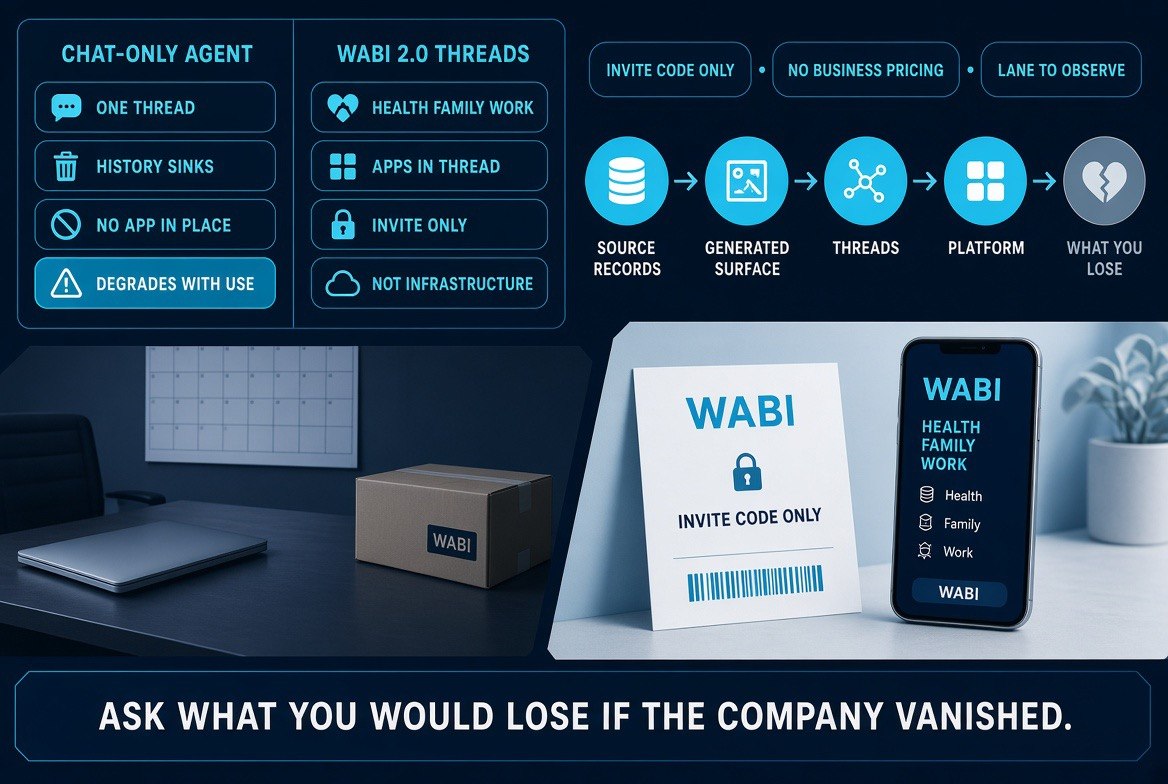
Where the risk actually sits: the generated surface is a rendering of your context, not an asset you own — which is why the question to ask any agent platform is what you would lose if the company vanished.
The Ownership Question Every Owner Should Ask Now
There is a quiet risk buried in the shift toward generated interfaces, and it applies to every small business regardless of which vendor wins.
When an agent builds the surface you use, that surface is a rendering of your context rather than an asset you own. Close the account and the interface does not follow you. Your data may export, but the organisation of it — the threads, the relationships between tasks, the accumulated shape of how you work — is a product of the platform, not a file you control.
That is a different kind of dependency than the software lock-in owners are used to. Traditional lock-in is about switching cost. This is about the disappearance of a layer you never thought of as portable, because until recently the interface layer was not generated at all.
The practical defence is unglamorous and cheap. Keep the source of truth for anything critical in a system that exports cleanly. Treat generated surfaces as a view over your data rather than the home of it. And when you evaluate any agent platform from here, ask a specific question: if this company disappeared tomorrow, what exactly would I lose that I could not rebuild?
What to Watch Over the Next Two Quarters
The signals that will tell you whether this is a real shift or a marketing refresh are not the announcements. They are the operational details.
Watch whether generated interfaces persist. A tool that vanishes when the session ends is a demo; a tool that is still there next month, holding state and accumulated context, is infrastructure. Persistence is the dividing line.
Watch whether they survive contact with edge cases. Generated software has a known failure mode: it handles the common path convincingly and then breaks silently on the exception. For a business, the exception is usually where the money is — the rescheduled job, the partial refund, the order that changed mid-fulfilment. Vendors that publish how they handle those cases are serious. Vendors that only demo the happy path are not yet.
Watch whether business pricing and support arrive. Consumer invite codes are a signal about maturity, not capability. Anything intended to run a payroll or a booking book will eventually need contracts, uptime commitments and someone to call. Until those exist, this remains a lane to observe rather than to depend on.
Where This Leaves the Independent Business Owner
The honest summary is that Wabi 2.0 is not something to adopt this quarter. It is invite-only, consumer-facing, and carries no business-grade commitments. Adopting it as infrastructure today would be a mistake.
What it is worth is attention. The most useful thing an owner can take from this week is a corrected assumption about what software is becoming. The menu of fixed apps you pick between is being challenged by software that assembles the tool you need at the moment you describe it.
The businesses that handle that transition well will not be the ones that moved first. They will be the ones whose data was portable, whose critical records lived in systems they could export, and who had already decided which parts of their operation they were willing to rent rather than own.
Frequently Asked Questions
What is Wabi 2.0?
It is a relaunch of the Wabi prompt-based app builder as a messenger. A personal AI agent creates interfaces on demand inside topic-based threads, rather than waiting for users to visit a separate builder. It was announced in late September 2026 and launched by invite code.
Who is behind Wabi?
Founder Eugenia Kuyda, who previously founded the AI companion startup Replika. She describes Wabi 2.0 as “a personal agent that does stuff for you and builds the interface you need in the moment.”
Should a small business owner sign up?
Not for business purposes yet. It is consumer-oriented, invite-only, with no published business pricing, compliance documentation or support commitments. It is worth watching as a signal of where agent software is heading, not adopting as infrastructure.
Why does a chat-only agent get worse over time?
Because everything accumulates in one linear scroll. History and ongoing tasks get buried, so the tool becomes harder to use the more you rely on it. Threads with their own generated apps solve that by keeping work in a context that persists.
What is the takeaway for how I buy software?
Value flexibility over feature depth, and protect data portability. If interfaces can be generated on demand, the platform that adapts beats the single-purpose app, and your business context — not the app — becomes the asset worth keeping portable.

About Barak Schurr
Barak Schurr built and sold a major ticketing platform, ran global nightlife operations at Eventbrite, and now spends his time figuring out which AI tools actually move the needle for independent business owners – and which ones are just noise. No hype. No fluff. Just what works.
Email: [email protected]
More AI Resources for Your Business