Perplexity: The AI Search Engine Built on Smoke and Mirrors
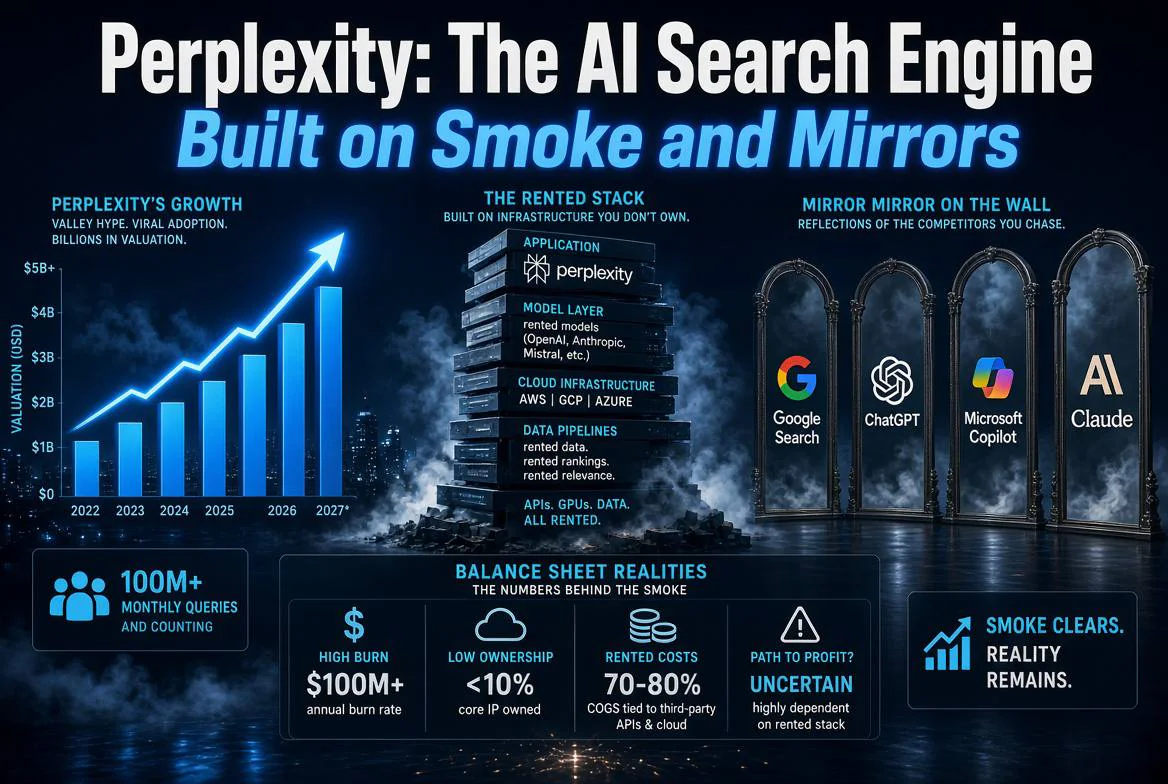
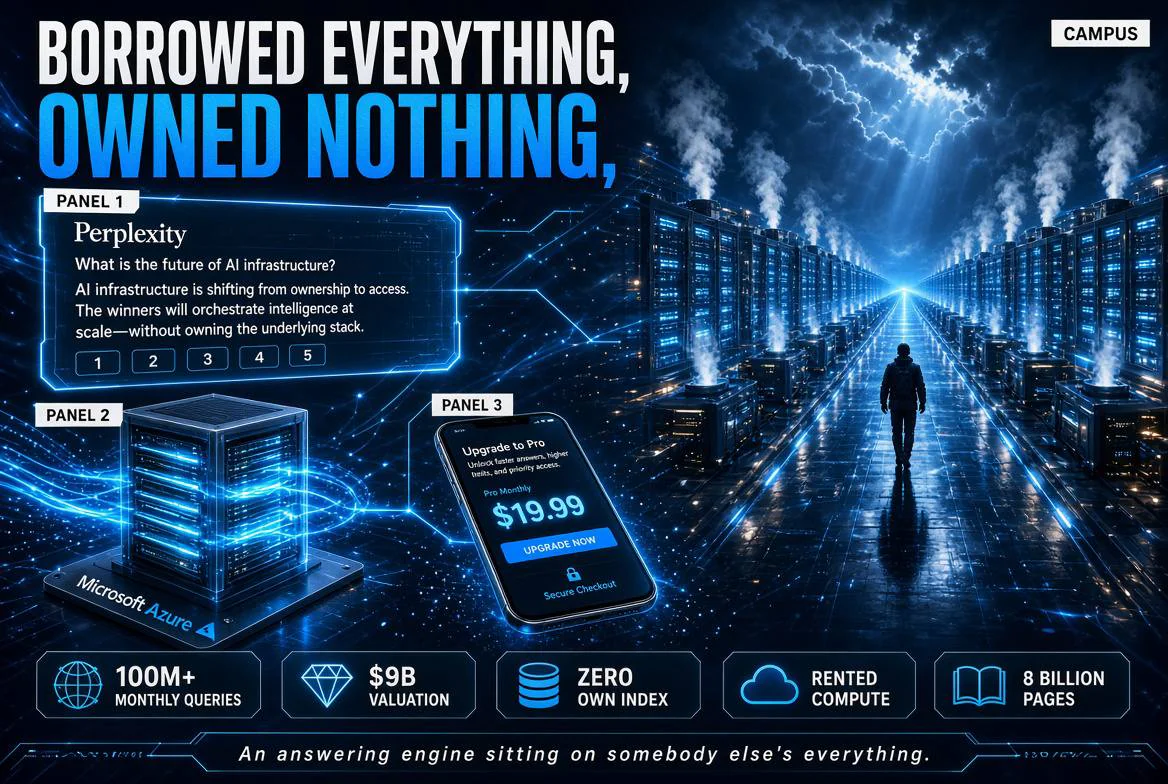
⚡ Expert Summary: Perplexity is the fastest-growing answer engine in the world and it owns almost none of what makes it work. The content comes from publishers suing it, the models come from labs it competes with, and the shopping comes through platforms it is fighting in court. It pays $250 million a year for cloud compute while its entire annual revenue is smaller than that bill, and it was last reported in talks at $30 billion on roughly $750 million of sales – about 40 times revenue, in a market that pays 2 to 3. The product is genuinely good. The balance sheet is the story, and the smoke is in the multiple.
There is a version of the Perplexity story that everybody tells and it is true: the product got better, people started using it, the numbers went up fast. The other version is more interesting and almost nobody says it out loud. Every layer of the stack that makes that product work is rented, licensed, or being litigated against by the company renting it out.
Let me put the two versions next to each other and let you decide which one is the actual company.
The Growth Is Real. Give It That.
Perplexity’s revenue went from under $250 million in January 2026 to about $450 million by March, per the Financial Times, and then past $750 million by August, per The Information. That is not a rounding error or a press release. Tripling revenue in eight months is what a company looks like when it has found something people want.
It found it because the answer engine beats the search box for a lot of questions. You ask, it answers with citations, you don’t scroll ten links. Anyone who has used it for a research question knows the difference within about four minutes.
Now the other side of the ledger. Aravind Srinivas, the CEO, has a line he uses: “We don’t have competitors. We have contributors.” It is a good joke. It is also, read carefully, a confession. When your suppliers are your contributors, they are not on your side. They are upstream of you and they know it.
It Committed $250 Million a Year to a Business Making Less Than That
In January 2026, Perplexity signed a three-year, $750 million cloud agreement for Microsoft Azure capacity. That is roughly $250 million a year in committed compute spend.
At the time it signed, its annual revenue was under $250 million.
Read those two sentences again in sequence. It promised to spend, every year for three years, more than it was making in a year. That is not a criticism of ambition – you cannot run an answer engine without inference capacity, and the deal was presumably priced well against list. But it does mean that the growth everyone is excited about has to happen just to service a bill that was signed when the company was half its current size.
And that number is the one nobody on either side of the table has confirmed on the record. Microsoft has not confirmed it. Perplexity has not confirmed it. It comes from reporting, not a filing. Treat it accordingly – which is exactly what makes the rest of the story so strange, because the $750 million is the only cost figure we have a number for, and it is unaudited.
Forty Times Sales Is Not a Valuation. It’s a Bet.
Perplexity’s valuation history reads like a fever chart. $1 billion in April 2024. $9 billion by December. $14 to $18 billion mid-2025. $20 billion in September 2025. $21 to $23 billion in January 2026. And in August 2026, reports of talks above $30 billion.
On $750 million of revenue, $30 billion is roughly 40 times sales. For context, a healthy public software company trades at 2 to 3 times. Even the wildly valued AI names do not usually get 40x on reported revenue without a margin story underneath.
Here is the margin story, and it is thin. The Information reported that Perplexity’s roughly 60% gross margin is calculated with free-tier and trial inference excluded from cost of revenue. Include those costs and the margin goes negative. That is not accounting fraud. It is a presentation choice, and plenty of companies make it. But it means the 60% number that gets quoted in every funding story is the number for the paying business only, sitting on top of a free business that costs money to run.
| What Perplexity owns | Who actually supplies it | Their relationship to Perplexity |
|---|---|---|
| The answer content | News Corp, NYT, Reddit, CNN, Tribune papers and others | Suing it. Seven active suits, zero settlements |
| The frontier model | OpenAI, Anthropic, xAI; Sonar is a fine-tuned Llama 3.3 | Direct competitors, and its suppliers |
| The compute | Microsoft Azure, $750M over three years | Committed spend larger than 2026 revenue at signing |
| The shopping layer | Amazon, whose site Comet navigates | Won an injunction, lost it on appeal, still fighting |
| The browser | Chromium, and Google’s index behind it | Google is also the thing it is trying to replace |
| The brand and the interface | Perplexity | This is the whole asset |
That last row is the honest one. Perplexity’s owned asset is the brand and the interface, and it is a very good interface. It is also the only part of the business that nobody is suing over.
Seven Lawsuits and Counting
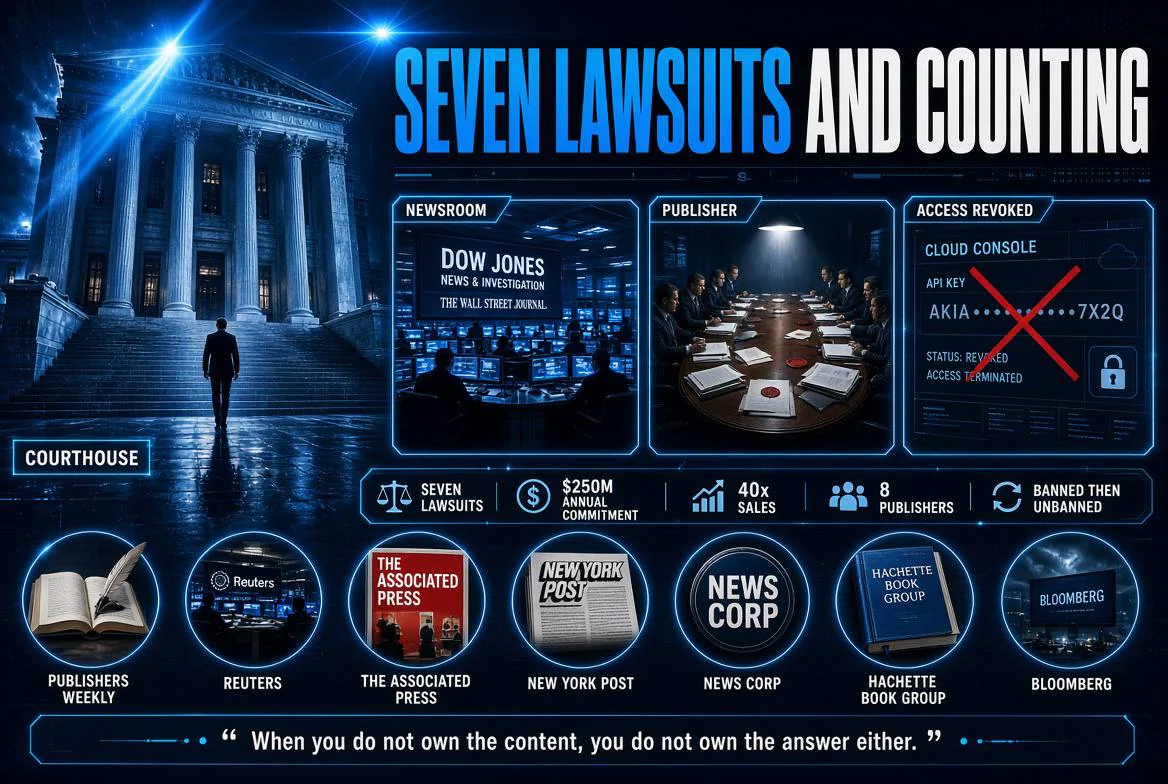
The publisher list is long and it is not slowing down. Dow Jones and the New York Post sued in October 2024. Britannica and Merriam-Webster followed in September 2025. Reddit in October 2025. The Chicago Tribune and seven other dailies in December 2025. The New York Times that same December. CNN in May 2026.
Seven active suits. Zero settlements.
Robert Thomson, chief executive of News Corp, did not mince it: Perplexity had “wilfully copied copious amounts of copyrighted material without compensation.” That is the accusation, not a ruling, and Perplexity disputes it. But the direction of travel matters. Every one of those suits is asking the same question – whether an answer engine can summarise somebody’s reporting and sell the summary – and the answer has not been given yet.
What makes this structurally worse than a normal legal problem is that the content is the product. If a court rules that Perplexity cannot summarise publisher work without paying, the cost of goods sold changes by an amount nobody has priced. The $750 million Azure commitment is a known number. The publisher bill is an unknown one, and unknown costs are the ones that end valuations.
The Comet Plus Pool Nobody Will Talk About
Perplexity did try to buy peace. It set up Comet Plus, a $42.5 million revenue pool for publishers, with an 80% revenue share to content owners.
That is a real number and a real commitment, and it deserves credit. It is also, as of this writing, a pot with no public disclosure of what any individual publisher has been paid out of it. Nobody has said. Not Perplexity, not the publishers, not the pool’s administrator.
If the point of Comet Plus is to prove that a voluntary market can price content fairly, the missing piece is the price. A pool with no disclosed distributions is a gesture, not a settlement.
Publishers can read that themselves, which may be why the lawsuits kept coming after it was announced.
Then Amazon Banned It. Then a Court Unbanned It.
The Amazon fight is the clearest window into what this company actually is.
Comet, Perplexity’s browser, would log into a user’s Amazon account and place orders on their behalf, and according to reporting in The Guardian it presented itself as a normal Chrome browser while doing it. Amazon complained. In March 2026 a court granted a preliminary injunction that banned Comet from the site and ordered data destroyed.
In August 2026 the Ninth Circuit vacated it, case 26-1444, on a line that is going to be quoted for years: “It is the user who accesses Amazon’s computers.”
Perplexity won that one. And the fight is not over – there are now claims about the iPhone app copying session cookies, a motion to dismiss filed in October 2026, and a hearing set for 20 November 2026.
Notice what this dispute is actually about. Not whether AI can browse. Whether the agent acts as the user or as a company inserting itself between a customer and a merchant. Perplexity argued the first. Amazon argued the second. The appeals court agreed with Perplexity, narrowly, on the technical question of whose computer is being accessed.
There is a small irony sitting on top of all of it: Jeff Bezos is an early investor in Perplexity. His company sued it anyway. That is what happens when the business model is the dispute.
The 360 Million Users Who Turned Into 14 Million
This is the number I keep coming back to.
In 2025, Airtel – the Indian telecom – bundled free Perplexity Pro for its customers. Reported reach: 360 million people. Peak monthly active users: 22 million in October 2025. By July 2026, after the promotion expired, that was 14 million, and downloads had fallen about 90%.
Was that a failure? Not exactly. Free trials that shrink when they end are normal, and 14 million retained users in one market is not nothing.
But it does tell you something the funding stories never mention: a large part of the growth chart was a telecom promotion, not a product habit. And nobody has disclosed who paid for the inference on 360 million free queries. That is one of the four open questions in this piece, and it is the one I would most like answered, because the answer determines whether that growth was revenue-funded or marketing-funded.
The same pattern shows up in the ad business. Perplexity launched advertising, then killed it in February 2026. Srinivas’s explanation: “even labeled ads made users doubt everything.”
I believe him, and it is a costly kind of integrity. The cleanest monetisation path for an answer engine – sponsored answers – was abandoned because it would poison the only thing Perplexity owns, which is trust in the answer.
The $34.5 Billion Bid for a Browser It Couldn’t Buy
In August 2025, Perplexity made an unsolicited all-cash offer of $34.5 billion for Google Chrome. Perplexity was valued at $18 billion at the time.
Chrome was not for sale. Google had not offered it. And per reporting, no named fund was attached to the bid – no committed financing, no partner list, no term sheet anyone could inspect.
I am not going to pretend to know what that bid was for. But a company that is worth $18 billion offering $34.5 billion in cash for an asset nobody put on the market, with no visible financier, is not making an acquisition proposal. It is making a statement about where it thinks the future is. And statements are free.
That is the part of the Perplexity story that gives the title of this piece its teeth. Some of the loudest moves are theatrical. The $34.5 billion bid that could not close. The Chrome-sized ambition. “We don’t have competitors, we have contributors.” The product is real, the revenue is real, and a meaningful share of the narrative around it is performance.
The 40x Is the Whole Argument
Let me put the two tables together and say the quiet part.
A conventional public software company is worth 2 to 3 times revenue because its revenue is predictable, its costs are known, and its growth is slowing. Perplexity is being priced at 40 times revenue because its growth is fast and the market believes answer engines replace search.
For 40x to be rational, one of two things has to become true. Either the gross margin has to go up dramatically once scale arrives, or the revenue has to keep compounding long enough for 40x to look like 10x in hindsight.
| Factor | Normal SaaS company | Perplexity, as reported |
|---|---|---|
| Valuation multiple | 2-3x revenue | ~40x revenue ($30B on ~$750M ARR) |
| Gross margin | 70-80%, all costs included | ~60% only with free-tier inference excluded; negative otherwise |
| Supplier dependency | Low – owned IP, owned infrastructure or commodity cloud | Total – content, models, compute and commerce all rented |
| Legal exposure | Occasional, bounded | Seven active publisher suits, zero settled |
| Growth durability | Predictable, contracted | Partly promo-driven: 22M peak to 14M after the Airtel cliff |
| What you own if it works | A business | A brand with a very good interface |
The Human Cost Nobody Assigns
One number deserves its own section because it is the part the industry finds least comfortable.
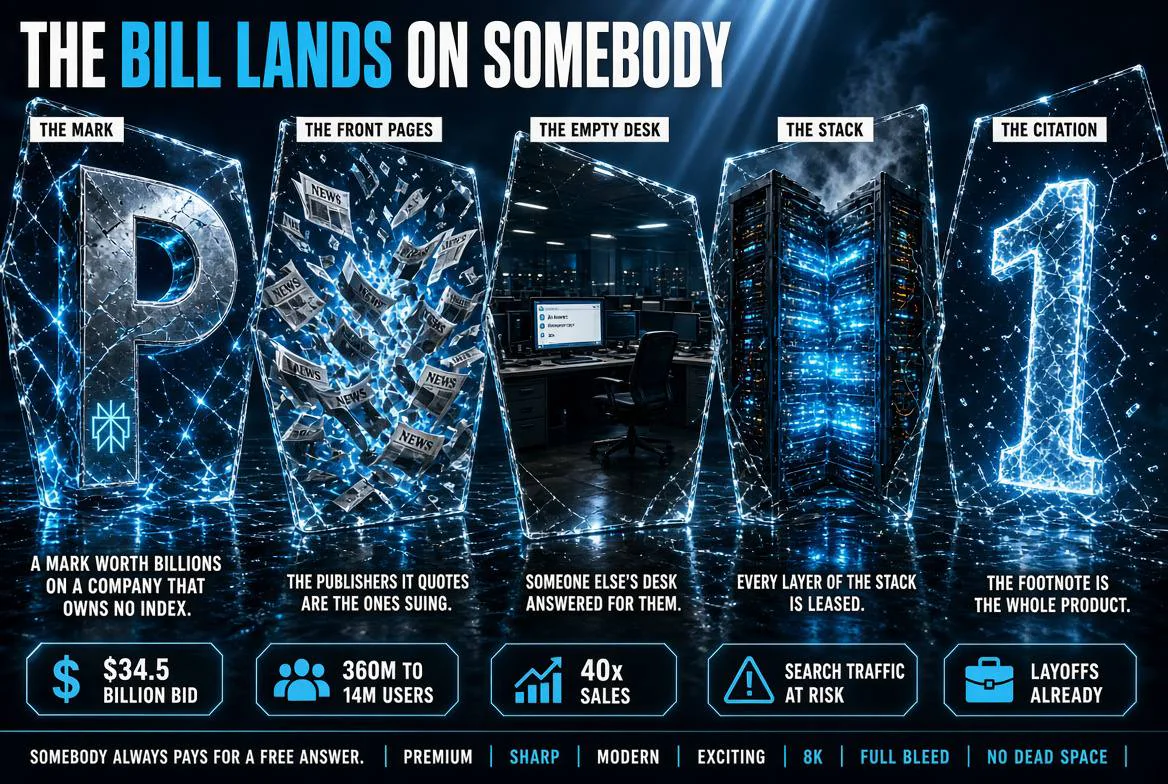
Gisele Navarro, managing editor at HouseFresh, reported that 90% of the site’s search traffic disappeared. HouseFresh is a small publisher that tested air purifiers and told readers which ones actually worked. It did not lose that traffic to a better competitor. It lost it to an answer that never sent the click.
Her reporting is about Google’s AI Overviews, not about Perplexity specifically, and I am not going to blur that to make a sharper point.
But the mechanism is identical, and Perplexity’s whole product is that mechanism with a chat box on it. Every answer engine – Google’s, Perplexity’s, OpenAI’s – is trained to satisfy the question in place. The publisher gets the summary, and the summary is the last thing the reader sees.
That is why the lawsuits exist. Not because publishers are sentimental about copyright, but because the click was the business.
What This Means If You’re Buying Search Traffic
If you run a business that depends on search, the Perplexity story is not really about Perplexity. It is about what a 40x multiple is buying.
It is buying the expectation that the answer engine replaces the search box. If that happens, the traffic that used to arrive on your site arrives as a citation instead – or not at all. A company with a $250 million annual compute bill and a 60% margin that only exists on paper has to monetise answers aggressively to justify itself, and the most aggressive monetisation of answers is that fewer people click through.
So the number to watch is not the valuation. It is whether Perplexity’s traffic grows on habits or on promotions, and whether its supplier disputes resolve into a chequebook or a court order. The first tells you if the product is sticky. The second tells you what the cost of goods actually is. If you want the wider map of what these AI tools are doing to ordinary businesses, that is where this thread continues.
Right now neither is answered. That is not a reason to dismiss the company – it is a very good product with real revenue and a real brand. It is a reason to read the next round’s press release with one eyebrow raised, and to keep the receipts.
Frequently Asked Questions
Is Perplexity profitable?
Perplexity does not publish audited financials and has not disclosed profitability. The Information reported its gross margin at roughly 60% with free-tier and trial inference excluded from cost of revenue, and negative when those costs are included. With a $750 million, three-year Azure commitment signed in January 2026, its compute cost alone is about $250 million a year.
Why is Perplexity being sued by publishers?
Seven publishers or groups have sued: Dow Jones and the New York Post (October 2024), Britannica and Merriam-Webster (September 2025), Reddit (October 2025), the Chicago Tribune and seven other dailies (December 2025), the New York Times (December 2025), and CNN (May 2026). None has settled. The core claim is that Perplexity summarises copyrighted reporting without paying for it.
What happened with Amazon and Perplexity’s Comet browser?
Amazon complained that Comet logged into users’ Amazon accounts, placed orders and disguised itself as a normal Chrome browser. A March 2026 preliminary injunction banned it from the site and ordered data destroyed. The Ninth Circuit vacated that injunction in August 2026, ruling that “it is the user who accesses Amazon’s computers.” Further proceedings, including a motion to dismiss and a November 2026 hearing, are ongoing.
Did Perplexity’s growth come from free promotions?
Partly. Airtel bundled free Perplexity Pro for 360 million customers in India, which took monthly active users to a peak of about 22 million in October 2025. After the promotion expired in July 2026, that fell to about 14 million and downloads dropped around 90%. Who paid the inference bill for those free queries has never been disclosed.
Is Perplexity valued at $30 billion?
Reports in August 2026 described funding talks above $30 billion. That is not a completed round and should be treated as reported, not confirmed. On roughly $750 million of annualised revenue it implies about 40 times sales, versus 2 to 3 times for a typical public software company.
Does Perplexity have its own AI model?
Not a frontier model. Its Sonar search model is a fine-tuned Llama 3.3, and R1 1776 is a fine-tuned DeepSeek R1. For frontier capability it relies on licensed access to models from OpenAI, Anthropic and xAI, which are also its competitors.

About Barak Schurr
Barak Schurr built and sold a major ticketing platform, ran global nightlife operations at Eventbrite, and now spends his time figuring out which AI tools actually move the needle for independent business owners — and which ones are just noise. No hype. No fluff. Just what works.
Email: [email protected]
More AI Resources for Your Business