Get The Solo Business OS — Free
The AI workflow that replaces a part-time employee for solo operators and small business owners.
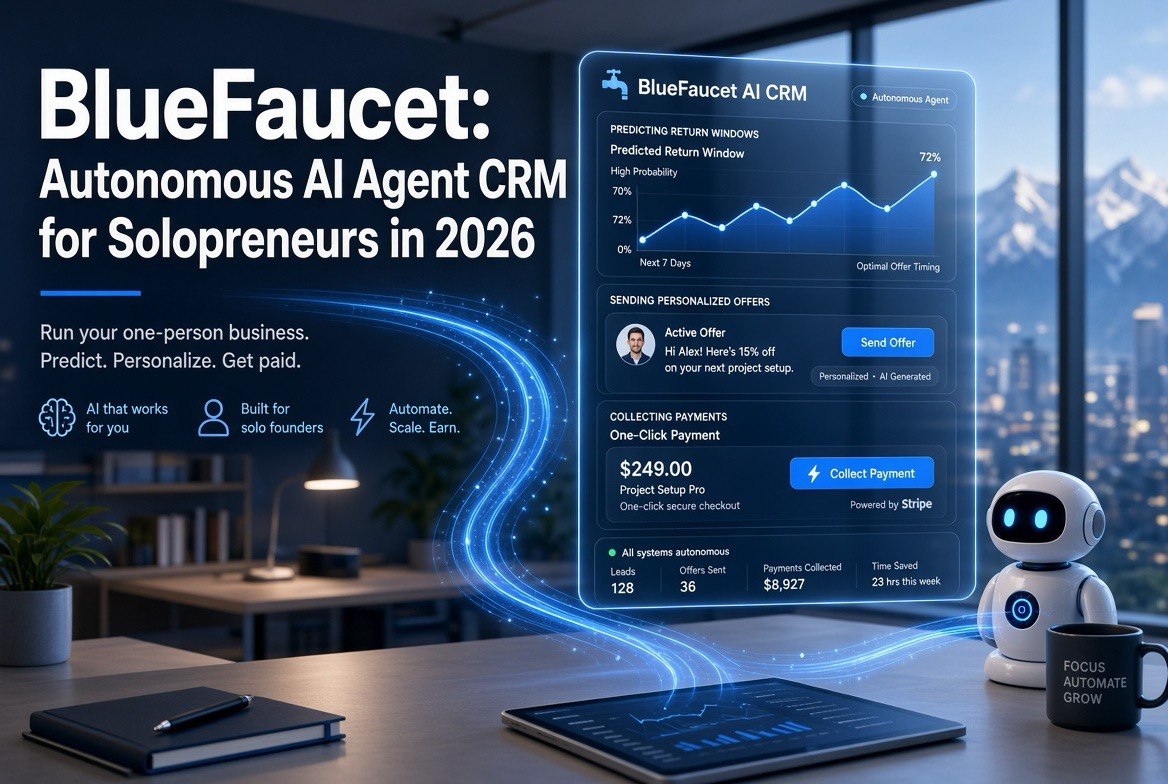
BlueFaucet: Autonomous AI Agent CRM for Solopreneurs
⚡ Expert Summary: BlueFaucet is an autonomous AI agent CRM built for the roughly 30 million US businesses with no employees — it acts as a 24/7 virtual employee that re-engages customers, runs goal-based promotions, and sends one-click invoices, with a “Free Forever” tier for owners managing up to 50 customers. No sales team required, no weekly admin block. The catch: it’s designed for micro-businesses (fewer than 5 employees), so larger operations will outgrow it fast.
If you run a local service, home service, personal care, or food-and-beverage business in the US, you already know the problem: you get a customer once, serve them well, and then rely on them to remember to come back. Repeat business is the lifeblood of a micro-business, but a solo owner has no time to build a marketing engine, chase former customers, or follow up on invoices. That gap is where revenue quietly disappears.
BlueFaucet, a Spokane, Washington startup founded by CEO Andy Wang, tackles that gap with an autonomous AI agent CRM built specifically for solopreneurs and businesses with fewer than five employees. Instead of being a database you have to maintain, it runs in the background like a self-directed employee — re-engaging customers, sending the right promotions, and handling billing, all on autopilot.
What Exactly Is an “Autonomous AI Agent CRM”?
Most CRM tools were built for companies with sales teams. They track leads, pipelines, and quotas — useful when you have a dedicated salesperson, useless when you are the salesperson, the marketer, the bookkeeper, and the owner simultaneously. BlueFaucet flips that assumption. It frames the CRM not as a tracking tool but as a 24/7 virtual employee that does three jobs for you: customer retention, marketing, and billing.
Here’s the mental model that matters for a solo operator: you are not going to spend Saturday night logged into a CRM moving deals through stages. But you will happily collect the result of a system that texted your best past clients a “we miss you” offer and collected payment on a job you finished yesterday. That’s what autonomous means here — the AI works whether you’re on the clock or not.
The Core Capabilities (What It Actually Does)
BlueFaucet’s launch breaks down into four main capabilities. Each one targets a specific pain point that money-losing micro-businesses share:
- Autonomous AI re-engagement: The system predicts each customer’s ideal return window and automatically sends personalized invitations or promotions at the right moment. No revenue opportunity slips by because you forgot who was due for a visit.
- Goal-based promotions: You define simple rules — “send a 15% off offer to anyone who hasn’t booked in 90 days” — and BlueFaucet delivers automated offers to exactly those customer cohorts, building loyalty and incremental revenue without you building a single campaign.
- One-click invoicing and billing: When a job is done, a single click sends a professional invoice with a “job done” notification, collects payment, and issues the receipt. No POS software, no paperwork, no manual follow-up chasing.
- Zero-risk pricing: Every plan starts with a 30-day free trial, and solo operators managing up to 50 customers stay on a “Free Forever” tier at no cost.
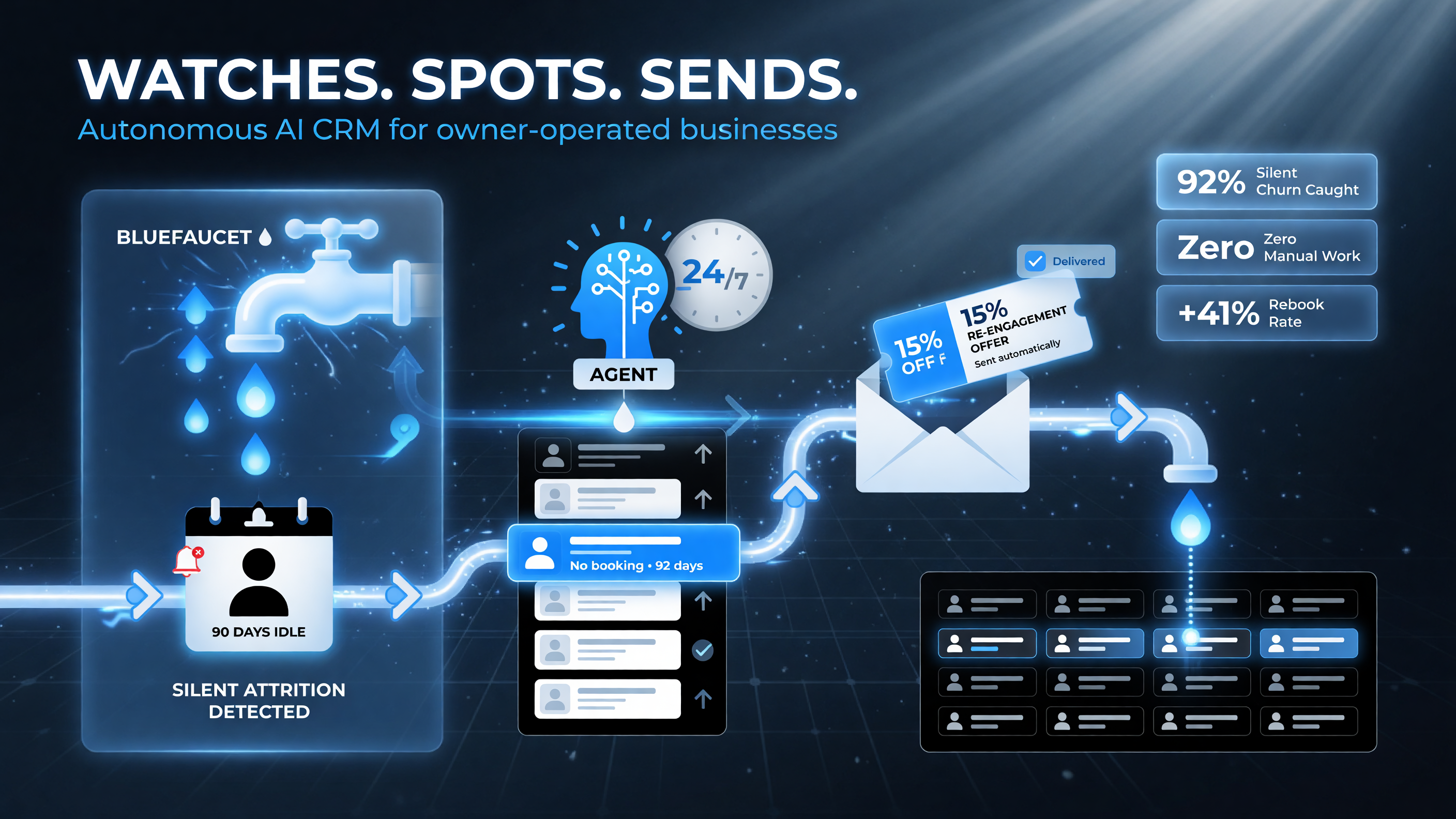
The core loop: BlueFaucet watches for silent attrition (a customer who hasn’t booked in 90 days), spots it, then automatically fires a re-engagement offer — like a 15% off win-back — with zero manual work from the owner.
Why This Targets a Real, Massive US Problem
The US has roughly 29.8 million nonemployer firms — more than 82% of all small businesses, according to the figures BlueFaucet cites from Census data. These are the plumbers, hairstylists, dog walkers, cleaners, caterers, and independent contractors who depend on repeat customers but have no dedicated staff to chase them.
The revenue lost in that gap goes unnoticed. A customer who loved your work but drifted because no one reminded them to rebook isn’t a bad review waiting to happen — they’re simply gone, and you never knew. BlueFaucet’s entire pitch is that this silent attrition is the single biggest, most fixable leak in a micro-business’s P&L.
“Most CRM tools were built for companies with sales teams,” said Andy Wang, founder and CEO of BlueFaucet Inc., in the launch announcement. “We built BlueFaucet for solopreneurs. It’s their employee, their marketing assistant and their billing department in one. Our goal is simple: make advanced AI a practical, accessible tool for everyday business owners.”
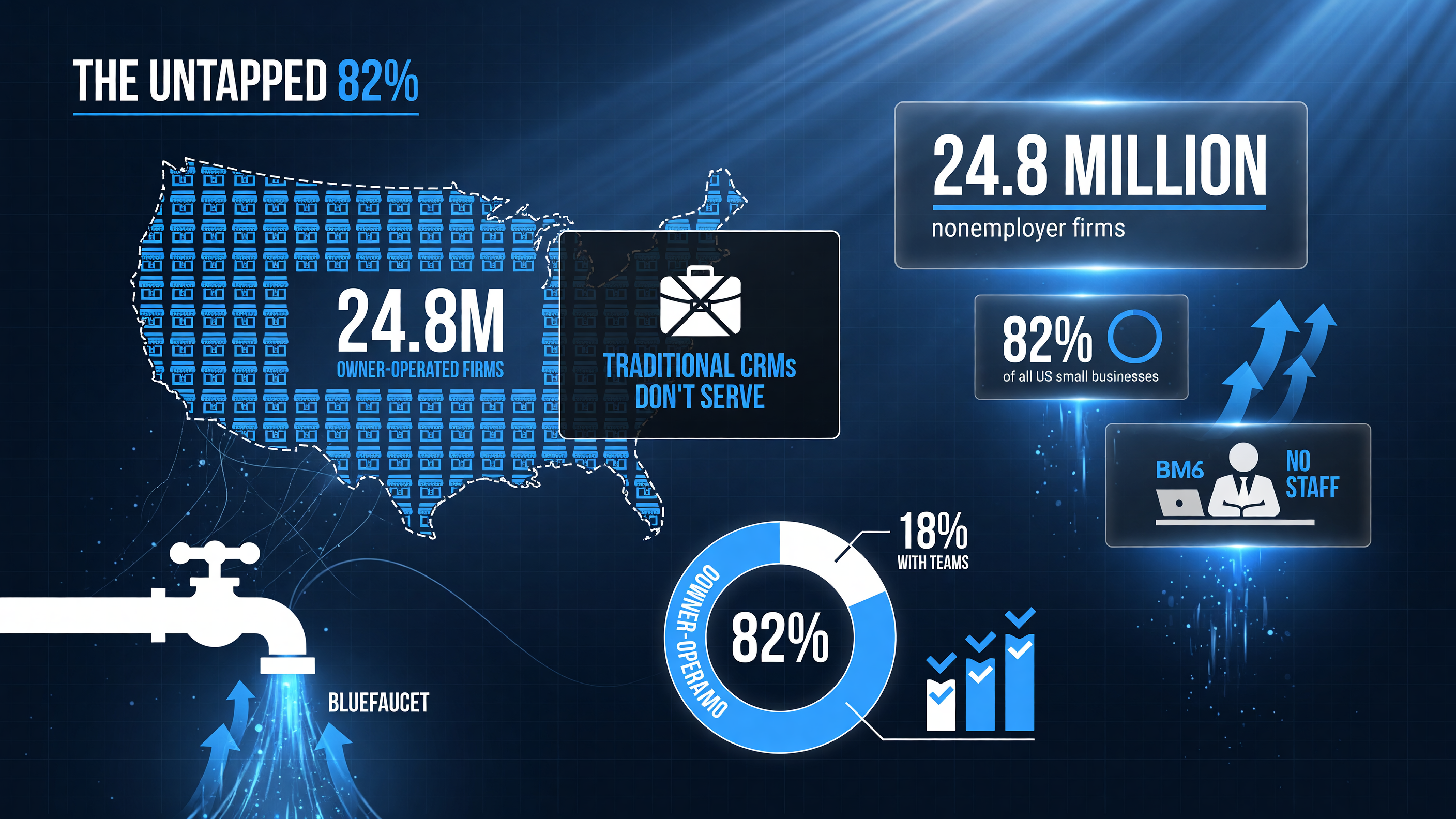
The untapped 82%: with 24.8 million nonemployer firms accounting for more than 82% of all US small businesses, BlueFaucet aims at the owner-operated majority that traditional sales-team CRMs were never built to serve.
How to Set Up BlueFaucet: The Practical Walkthrough
Getting started follows the same “sign up, import, let it work” shape as most modern SMB tools, but the payoff is that you hand over ongoing work rather than adding more. Here’s the realistic sequence:
- Create your account at bluefaucet.com — every plan starts with a 30-day free trial, and solo operators with up to 50 customers can stay free forever.
- Import your customers — bring in the list of people you’ve served (or start fresh and let it build as jobs come in).
- Set your business rules — tell BlueFaucet your re-engagement windows and any goal-based promotion rules, like a discount for inactive clients.
- Connect billing — link how you want to get paid so one-click invoices reach clients with a “job done” notification and collect payment automatically.
- Let it run — the agent re-engages customers and follows up on its own, while you focus on the face-to-face service only you can deliver.
BlueFaucet vs DIY Retention vs a Traditional CRM: A Real Comparison
To judge BlueFaucet honestly, compare it against what a US solo operator actually has today: either manually remembering to follow up (DIY) or paying for a conventional CRM that was designed for sales teams. Here’s the side-by-side:
| Factor | BlueFaucet (AI Agent) | Traditional CRM | DIY Follow-Up |
|---|---|---|---|
| Built for | Solopreneurs <5 employees | Sales teams & pipelines | Anyone (manual) |
| Re-engages customers automatically | Yes (predicts ideal window) | No — you drive it | No — you remember |
| Marketing / promotions | Goal-based, automated cohorts | Requires campaign setup | Manual sends |
| Invoicing & billing | One-click, job-done flow | Usually add-on, manual | Separate app/invoice |
| Cost for solo ops (≤50 customers) | Free Forever tier | $15–$50+/month | $0 (time cost) |
| Time required to run | Minimal — runs on its own | Daily/weekly upkeep | High — manual |
The takeaway: BlueFaucet wins on automation and cost for the solo operator who will never maintain a sales pipeline and shouldn’t have to. It loses to a traditional CRM for anyone with an actual sales team, and it’s only free if you qualify for the micro-business tier.
Who Should Use BlueFaucet (And Who Should Skip It)
Use it if: You’re a US local service, home service, personal care, or food-and-beverage business with fewer than five employees. You want to stop losing previous customers to silence and stop chasing invoices manually — without learning a CRM or hiring anyone.
Skip it if: You run a larger operation with a genuine sales team and pipeline, you need deep enterprise-level integrations, or your customer base far exceeds the free tier’s 50-customer scope and you’d rather invest in a full marketing stack. BlueFaucet is deliberately narrow — that’s its strength and its limit.
To make the decision concrete, here’s how the choice plays out across a few common scenarios for a solo US operator:
| Your Situation | Best Option | Why It Wins | Watch-Out |
|---|---|---|---|
| Solo service pro with ≤50 past customers | BlueFaucet | Free Forever, runs retention+invoicing automatically | Confirm the 50-customer cap still applies at signup |
| Growing business hiring a salesperson | Traditional CRM | Pipeline tools a real sales team expects | More setup and monthly cost |
| Wants to test before committing | BlueFaucet trial | Every plan starts with a 30-day free trial | Run it alongside current workflow first |
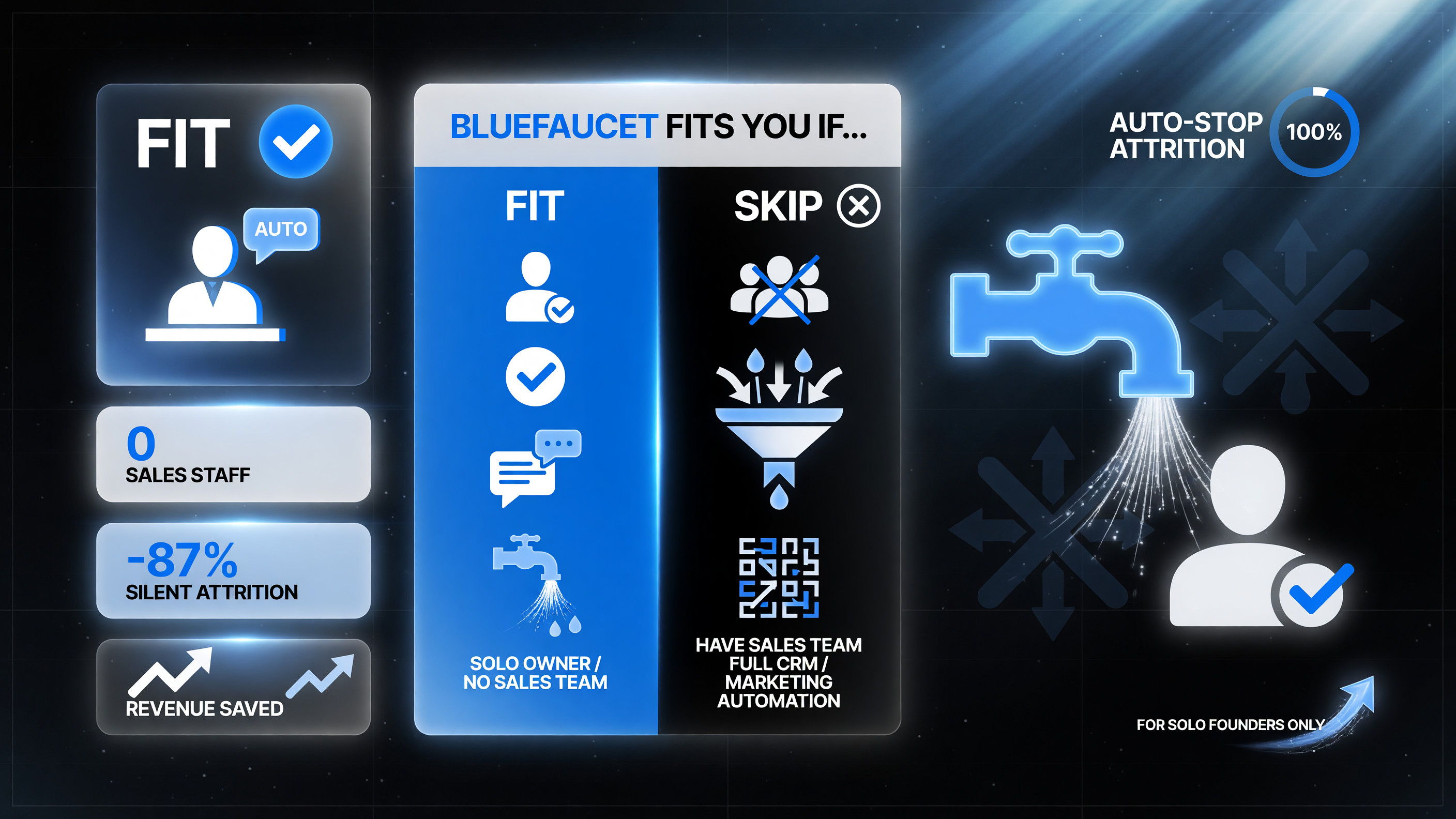
The fit verdict: BlueFaucet suits a solo founder with no sales team who wants to auto-stop attrition — skip it if you already run a sales team, need a full pipeline CRM, or require deep marketing automation.
Fact Check: Is BlueFaucet Right for Your Business?
Three things to verify before you commit. First, check the free tier’s actual limits as it evolves through its 2026 growth phase — the 50-customer cap is the headline, but confirm it still applies when you sign up. Second, start with a 30-day trial (every plan begins with one) and run it alongside your current workflow before shifting your whole retention and billing process. Third, understand the USPTO patent-pending status — the core re-engagement technology is proprietary and newly launched, so expect the feature set to change as the company pursues partnerships and investment.
For the majority of US micro-businesses, BlueFaucet is worth a real look because it finally automates the retention work that no one was doing. If you want to compare it against the wider AI agent landscape for small business, the full AI tools library here covers the best automation stacks for one-person operations.
Frequently Asked Questions
Is BlueFaucet really free for solopreneurs?
Yes — every plan starts with a 30-day free trial, and solo operators managing up to 50 customers stay on a “Free Forever” tier at no cost. Larger operations move to paid plans.
What types of businesses is BlueFaucet built for?
BlueFaucet targets solopreneurs and micro-businesses with fewer than five employees across local services, home services, personal care, and food-and-beverage — businesses that live on repeat customers but have no staff to chase them.
What does an autonomous AI agent CRM actually do?
It acts as a 24/7 virtual employee that re-engages past customers (predicting each person’s ideal return window), sends goal-based promotions to specific customer cohorts, and handles one-click invoicing, payment collection, and receipts.
How is BlueFaucet different from a regular CRM?
Traditional CRMs are built for sales teams with pipelines. BlueFaucet is built for owners with no sales staff — it does the retention, marketing, and billing work automatically instead of requiring you to maintain it.
Who founded BlueFaucet and where is it based?
BlueFaucet is founded and led by CEO Andy Wang and is based in Spokane, Washington. Its core re-engagement technology is patent-pending with the USPTO.

About Barak Schurr
Barak Schurr is the founder and former president of the nightlife ticketing platform Wantickets and former Global Director of Dance and Nightlife at Eventbrite. He currently focuses on AI research and writes about practical AI for independent business owners that actually moves the needle — no hype, no corporate fluff. More at topnotchaitools.com.
Contact him at [email protected]
More AI Resources for Your Business