United Banned AI Agents But Can’t Tell Who Is Using One
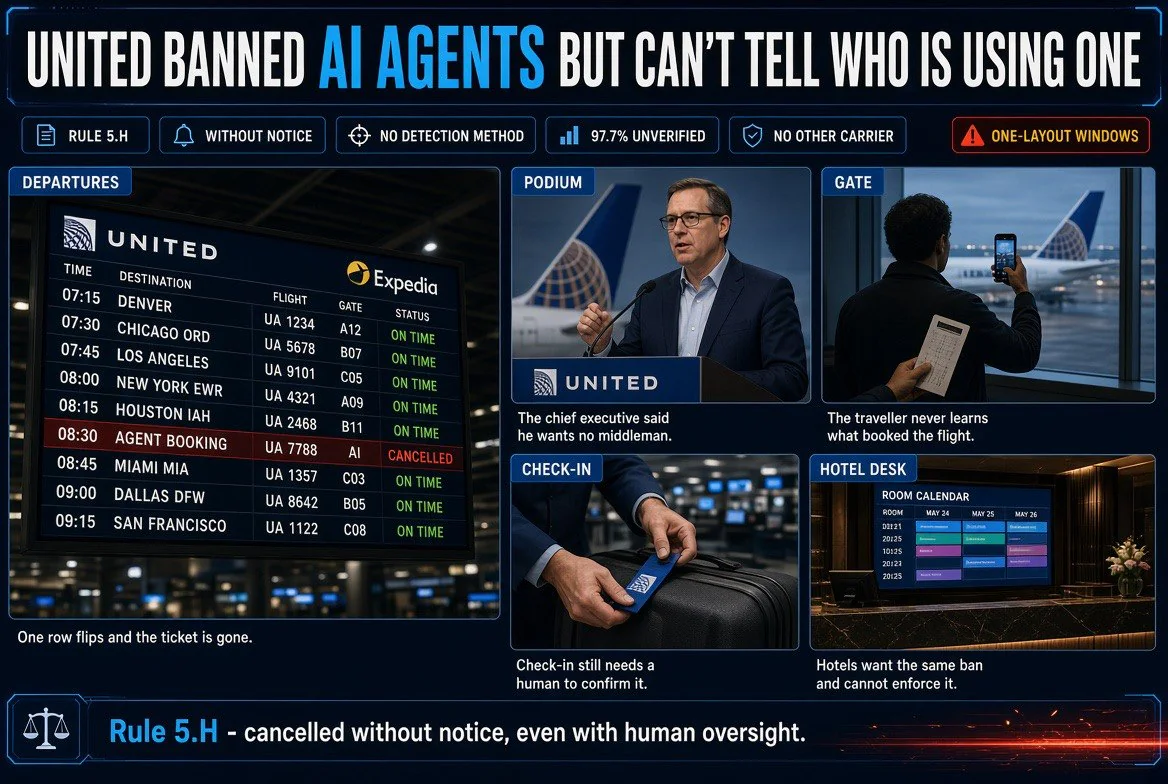
⚡ Expert Summary: On November 11, 2026, United Airlines rewrote its Contract of Carriage to make an AI agent booking a cancellable offence — even when a human supervised the agent. The clause covers agents acting “whether or not Passenger or another individual supervises or approves its actions.” United also says it has not seen a large volume of agent bookings, and the ban has no published method of detection. A contractual ban is not a technical one: an agent booking through Expedia looks like an Expedia booking to United. For a small business owner whose travel gets booked by software, the risk is now yours to carry.
United Airlines updated its Contract of Carriage on November 11, 2026. Buried in Rule 5.H, among the categories of “improper reservations” the airline says it will cancel without notice, is a new line: reservations made, modified or serviced by AI Agents. Rule 6.J.6, under Prohibited Practices, states it plainly: “The use of AI Agents to make, modify or service a Ticket, and/or to purchase any service or product.”
That is a consumer contract, and most people will never read it. If you run a small business and your travel gets booked by an assistant — yours, your bookkeeper’s, the agent your operations person set up — this is now your problem, not the software’s. You are the party to the contract. United’s remedy sits against your ticket.
The detail that makes this more than a terms-of-service update is one phrase in Rule 1, the definitions section. The definition of “AI Agents” is drafted to cover assistants, agents and AI browsers acting “whether or not Passenger or another individual supervises or approves its actions.” Human oversight, the most basic control any business owner can apply to an automated process, is written out of the contract entirely.
What United Actually Wrote Into the Contract
The primary document is public. United’s Contract of Carriage carries the line “revised November 11, 2026” at the top of the document, and the AI agent language appears in four places across the revised rules. The airline also published a companion page in its Digital Trust Center titled “Third-Party AI Agents,” which is where the plain-English version sits.
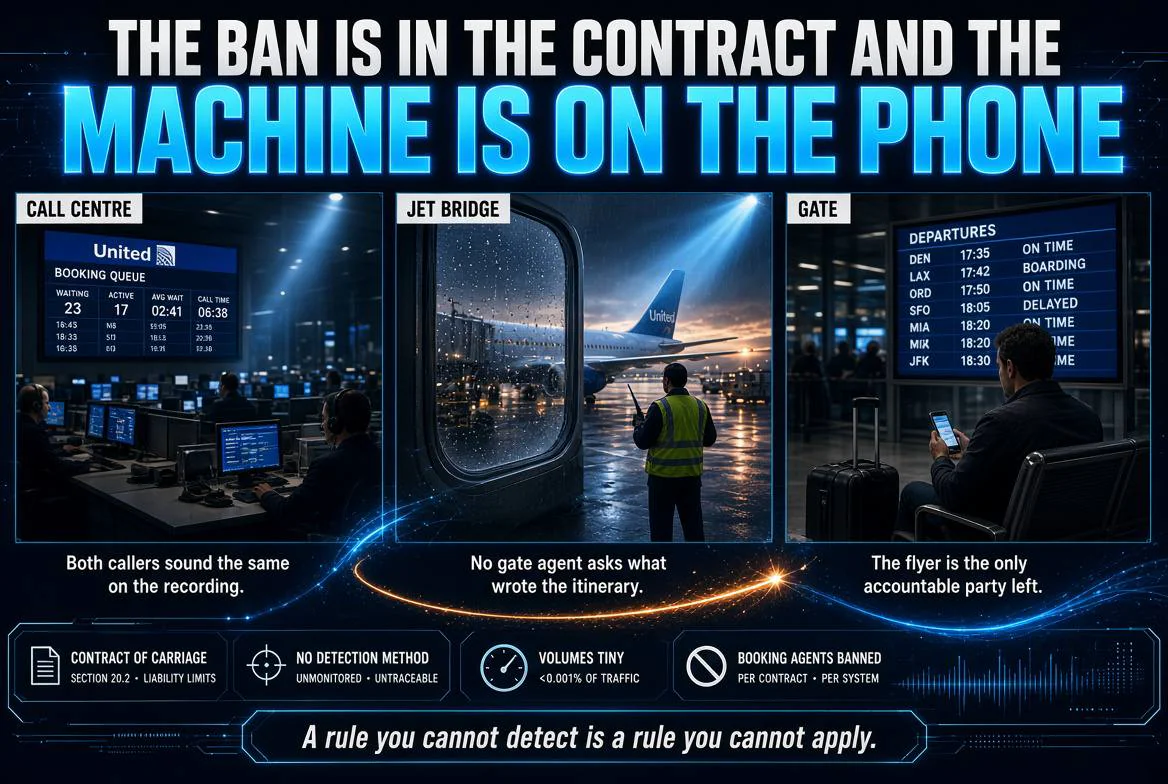
Three clauses do the work. The first defines what an AI agent is, and defines it broadly enough to include browser extensions, assistants built into messaging and search platforms, and standalone agents. The second, Rule 5.H, places agent-made reservations in the improper-reservations bucket that United can cancel without notice. The third, Rule 6.J.6, makes the use of an agent to make, modify or service a ticket a prohibited practice — which routes the booking into Rule 6’s remedies.
| United rule (revised Nov 11, 2026) | What it says | What it means for a ticket |
|---|---|---|
| Rule 1 — definition of “AI Agents” | Covers assistants, agents and AI browsers acting “whether or not Passenger or another individual supervises or approves its actions” | A human checking the agent’s work does not put the booking back inside the rules |
| Rule 5.H — improper reservations | Reservations “made, modified or serviced by AI Agents” are cancelled without notice | No warning required before cancellation |
| Rule 6.J.6 — prohibited practices | “The use of AI Agents to make, modify or service a Ticket, and/or to purchase any service or product” | Routes the booking into Rule 6’s general remedies |
| Digital Trust Center FAQ | Bookings made before November 11, 2026 “will not be canceled”; users advised to review recent plans and change any shared MileagePlus password | Existing bookings are grandfathered; the airline’s own advice is manual verification |
| Net position | Agent use is a breach even with oversight | The booking risk moves to the traveller |
Rule 6 carries broader remedies than cancellation. As documented in a crowdsourced comparison of the November 11 revisions posted to the r/unitedairlines community, the change brings agent bookings under Rule 6.K, whose remedies include invalidating tickets and assessing amounts owed. United has not said publicly which of those remedies it would apply to an agent booking. That distinction matters: the difference between a cancelled reservation and an assessed full fare is the difference between an inconvenience and a chargeback fight.
What Is Still Allowed, and Where the Line Actually Sits
United’s Digital Trust Center page draws the line more clearly than the contract does, and it is a line most business travellers will cross without noticing. Research and trip planning are fine — as long as the AI tool does not touch united.com or the United app. The page states: “You can still use AI to research and plan trips, as long as the tool doesn’t access united.com or the United app.”
Once the tool is inside United’s own systems, it is unauthorized. Searching live inventory on United’s platforms, booking, buying seats or upgrades, changing flights and checking in all require a human to execute them directly. The FAQ also carves out assistive technology for customers with disabilities, which is unaffected.
There is an additional, sharper restriction aimed at the travel trade rather than at travellers. Accredited agencies are barred from supplying United content to personal AI agents at all — including for discovery and search, not just for booking. Agency-owned tools are permitted only with United’s specific permission. As of the reporting on this change, United had not announced any authorization deals, and Travel Weekly’s Robert Silk recorded the airline acknowledging it “hasn’t yet made any authorization deals for AI bookings.”
For a small operator, the practical effect is a set of rules with a wide grey band down the middle. A tool that reads publicly available fare data and tells you what to book is permitted. A tool that reads the same fares from United’s own site is not. The user cannot see the difference from the outside, and nothing in the booking flow warns them before the ticket is issued.
The Airline Says the Volumes Are Tiny
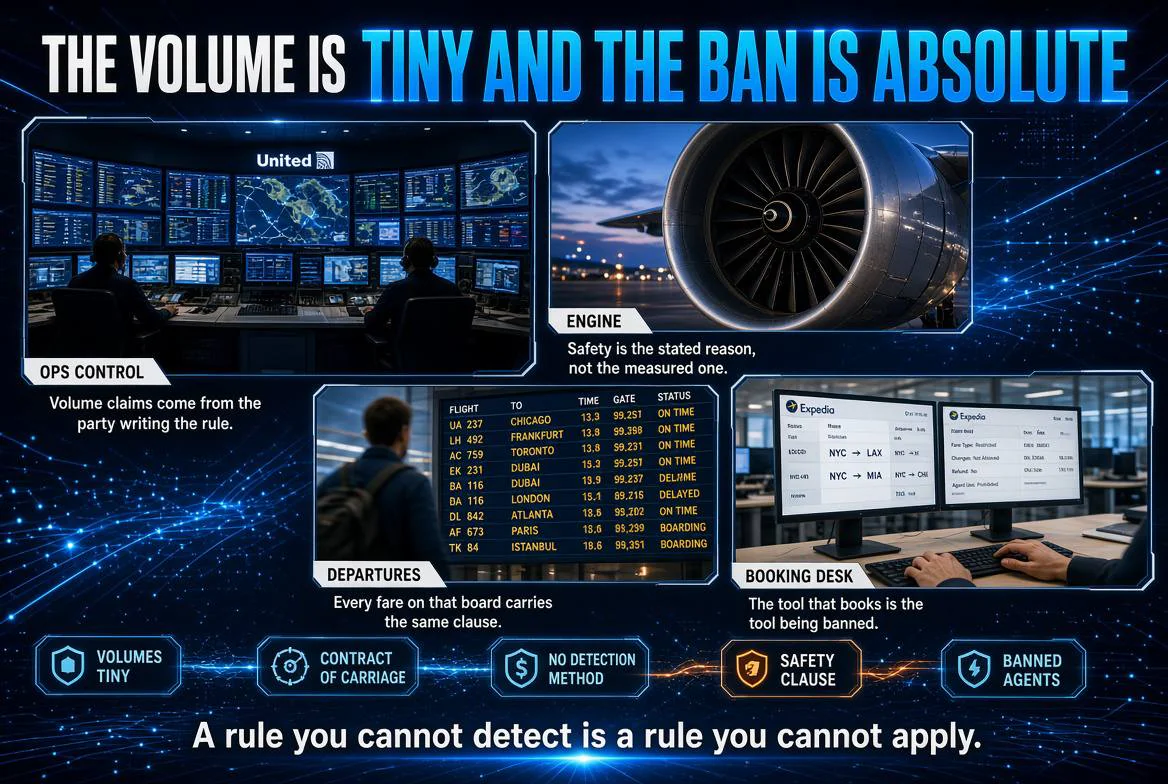
Here is the number that reframes the entire policy. United, according to reporting summarised by Seeking Alpha from The Wall Street Journal, “said it has not seen a large volume of bookings from AI agents.”
Read that against the remedies. The airline wrote a clause allowing cancellation without notice, and routed agent bookings into a remedies section that can invalidate tickets and assess fares, for a category of booking it describes as small. That is not a response to a crisis. It is a position being staked before the crisis arrives — which is a legitimate thing for a business to do, and also a thing a business does when it is protecting something other than safety.
What else was happening the same week is the tell. At the Skift Commerce Summit in New York on November 11, MCR Hotels chief executive Tyler Morse said he wants to ban AI agents from booking his hotels — and admitted he has no way to enforce it. More on that below, because the two confessions belong in the same paragraph.
Safety Reasons, Commercial Clause
The reasons United gives are safety reasons, and they are not invented. The Digital Trust Center page makes a specific argument about check-in: automated check-in can bypass the human acknowledgement that a bag does not contain banned substances. The page states that using a third-party agent to check in “could result in you missing important safety content,” and that flight check-in requires human acknowledgment about prohibited items. That is a real regulatory hook, not a pretext.
Credential exposure is the second reason, and it is well documented. The FAQ advises anyone who has shared a MileagePlus login with an AI agent to change their password immediately. That is sound advice regardless of policy.
But the clause that does the enforcement work — cancellation without notice — is not a safety mechanism. It is a distribution mechanism. The chief executive said so, at an event, on the record. Scott Kirby, speaking in Chicago on November 10, 2026, and quoted by The Wall Street Journal: “To be honest, I don’t want to create another middleman.”
That sentence explains the entire revision. Airlines have spent a decade fighting to own the point of sale, because the point of sale is where ancillary revenue lives — the seat selection, the bag fee, the upgrade, the preferred boarding. A personal AI agent that compares fares on a traveller’s behalf is a new interface between the airline and its customer, and every interface that has ever sat in that position has eventually wanted a fee.
| What United says publicly | What the same week shows |
|---|---|
| Agent check-in can bypass the DOT and FAA acknowledgement that a bag contains no prohibited items | The remedy is cancellation without notice and possible ticket invalidation, not a technical block on check-in |
| Sharing MileagePlus credentials exposes the account; users should change passwords | A password reset fixes a credential problem; only a contract clause fixes a distribution problem |
| United will “continue to evaluate how these tools interact with our services, with a focus on protecting our customers” | Scott Kirby, November 10: “To be honest, I don’t want to create another middleman.” |
| Framing: customer protection | Incentive: control of the point of sale |
The market read it the same way. Shares of Booking Holdings were up 1.1% in Wednesday afternoon trading, Expedia rallied 2.8%, and Tripadvisor gained 3.0%, while United was down 1.3%, according to Seeking Alpha’s report. If investors thought this was an airline safety story, the intermediaries would not have moved the other direction.
The Ban Nobody Can Enforce
The technical problem is simple and it is fatal to enforcement. Gary Leff, writing on View from the Wing on November 11, put it in six words: “A contractual ban isn’t a technical one.” He then explained the mechanism: if an agent completes a purchase on Expedia, United sees an Expedia booking, not how the booking was made.
That is the whole loophole. The agent does not have to touch united.com. It can book through any intermediary that holds a distribution relationship with the airline, and the airline will see an ordinary agency booking. The contract language anticipates this by restricting agencies from supplying United content to personal agents — but that only binds accredited agencies, and only if they cooperate in an environment where the customer is the one running the agent.
The detection problem is not unique to travel. Bot-defence firm Arkose Labs reported on October 20, 2026 that 97.7% of legitimate agent sessions it observed carried no verified identity, meaning many agents are technically indistinguishable from ordinary browsers. That is a vendor’s telemetry about its own market, so treat the figure as an illustration rather than an audit — but the direction of it matches every practitioner account: agents are built to look like people, because that is what makes them work.
Morse said the quiet part on the same day. According to Hospitality Net’s Terence Ronson, Morse told the Skift Commerce Summit that “everyone is going to ban the agents,” and then admitted: “I can’t figure out how to do it.” Ronson’s own verdict is worth quoting because it applies to airlines as much as hotels: “A ban is not a strategy. A guest list is.”
Ronson’s point is that the agent will not disappear because a contract says so. It will route around the front door. He notes that in Singapore and Japan, Agoda is already bookable through Meta’s Muse, and warns that if the platform then takes a cut on top of the OTA’s, the operator pays twice for the same transaction.
What the Record Does Not Say
Several important things are missing from this story, and the gaps are worth naming explicitly because they define how much confidence the policy deserves.
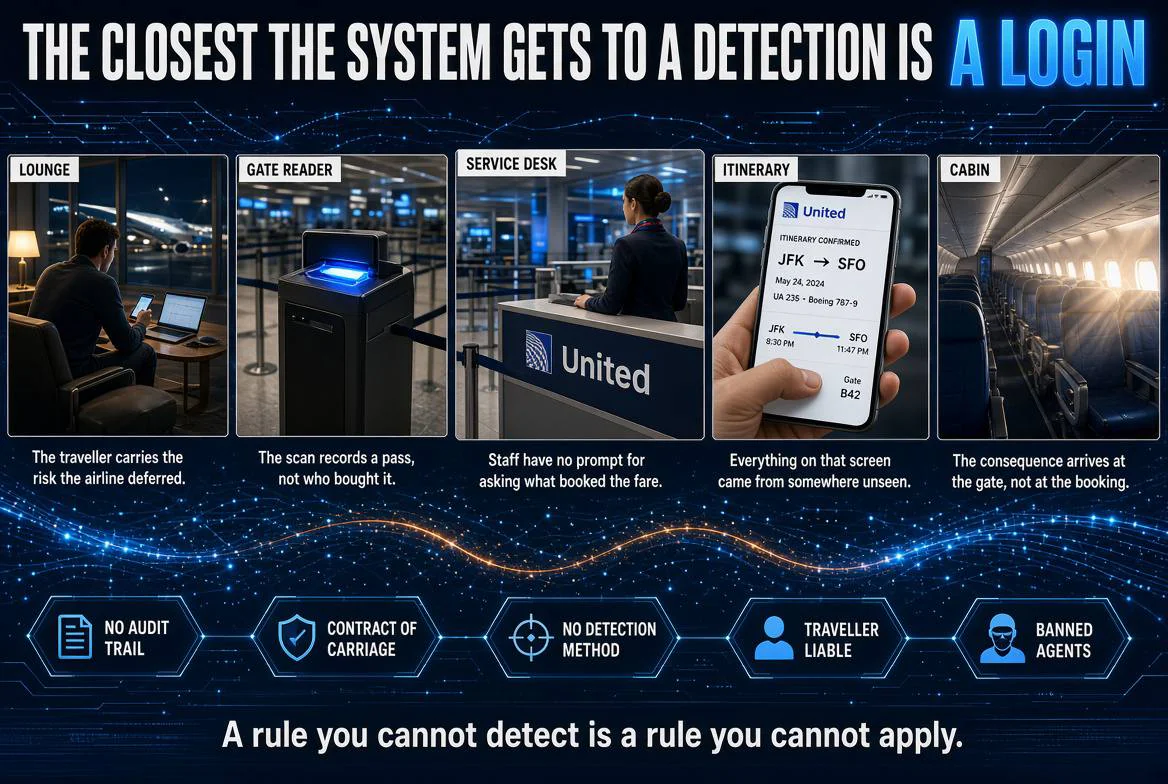
No outlet has documented United cancelling a single reservation under the new rule. No detection mechanism has been disclosed — neither United nor any reporter has explained how the airline would distinguish a human-supervised AI browser from a human. No other US carrier has copied the ban; Skift’s own newsletter records that United is the first carrier in the US to explicitly say it will restrict access to third-party AI agents. Neither the Department of Transportation nor the FAA has commented on the airline’s claim that AI check-in conflicts with federal rules. And no response from OpenAI, Meta, Perplexity or Google appears in the reporting.
There is also a genuine tension inside the consumer-protection framework that nobody has resolved. US Department of Transportation rules at 14 CFR 259.5 require carriers to allow cancellation or holding of a reservation made at least seven days before departure for 24 hours without penalty. United’s Rule 5.H now grants itself authority to cancel an agent-assisted booking without notice, at any time. Whether those two positions can coexist is an open legal question, and the airline has not addressed it publicly.
For a business owner, the gap is the exposure. If you cannot tell which of your bookings were made by a tool and which by a person, you cannot know which reservations are at risk. United’s own advice — review all recent travel plans to ensure they were booked and ticketed correctly — is the only remedy it offers, and it is advice, not a guarantee.
What This Means If You Book Travel With Software
The practical rules for an operator are unglamorous. First, know what your booking tool actually does. Research is permitted; anything that logs into United’s systems is not. Second, prefer completing the transaction yourself, in your own session, even if the agent finds the fare. Third, if you have handed credentials to a tool, change them — that is the airline’s own advice and it is good advice independent of policy.
Beyond the tactical, the strategic point is this. The interface layer is being contested. Airlines want to control the point of sale, hotels want to control the upsell, and the agent layer wants to sit in between and monetise the comparison. Every business that books travel through a third party is standing in the middle of that fight without a vote.
United’s clause is not the end of that fight. It is the opening move, written by the party that controls the contract, enforceable only to the extent the intermediary cooperates, and priced against customers who have not yet arrived in meaningful numbers. The ban will hold exactly as long as the airline can tell who is using an agent. On the current evidence, nobody selling a ban can.
Frequently Asked Questions
Can I still use ChatGPT or another AI assistant to research United flights?
Yes, provided the tool does not access united.com or the United app. United’s Digital Trust Center states that AI research and trip planning are permitted as long as the tool stays outside the airline’s own platforms, and that once the tool searches live inventory, books, changes or checks in on United’s systems, a human must execute it directly.
What happens to a booking I made with an AI agent before November 11, 2026?
It will not be cancelled. United’s FAQ states that agent bookings made prior to November 11, 2026 are not affected, and advises users to review recent travel plans to confirm they were booked and ticketed correctly and to change any MileagePlus password shared with a third-party agent.
Does having a human review the booking make it compliant?
No. United’s Rule 1 definition of AI Agents covers tools acting “whether or not Passenger or another individual supervises or approves its actions.” Human oversight is explicitly not a defence under the revised contract, which is the most consequential single phrase in the November 11 revision.
Can United tell whether a booking was made by an agent or a person?
Not reliably, according to the reporting. Gary Leff of View from the Wing notes that if an agent completes a purchase through a site like Expedia, United sees an Expedia booking rather than how the booking was made. United has not published a detection method, and no enforcement action has been documented since the rule took effect.
Have other airlines followed United’s lead?
Not as of November 13, 2026. Skift reports that United is the first carrier in the US to explicitly say it will restrict access to third-party AI agents, and no other US carrier has announced equivalent contract-of-carriage language.
What should a small business do about travel booked by an assistant?
Confirm which bookings were made by a tool rather than a person, complete future transactions yourself in your own session, keep agent activity out of United’s own platforms, and change any credentials you have shared with a third-party assistant.

About Barak Schurr
Barak Schurr built and sold a major ticketing platform, ran global nightlife operations at Eventbrite, and now spends his time figuring out which AI tools actually move the needle for independent business owners — and which ones are just noise. No hype. No fluff. Just what works.
Email: [email protected]
More AI Resources for Your Business